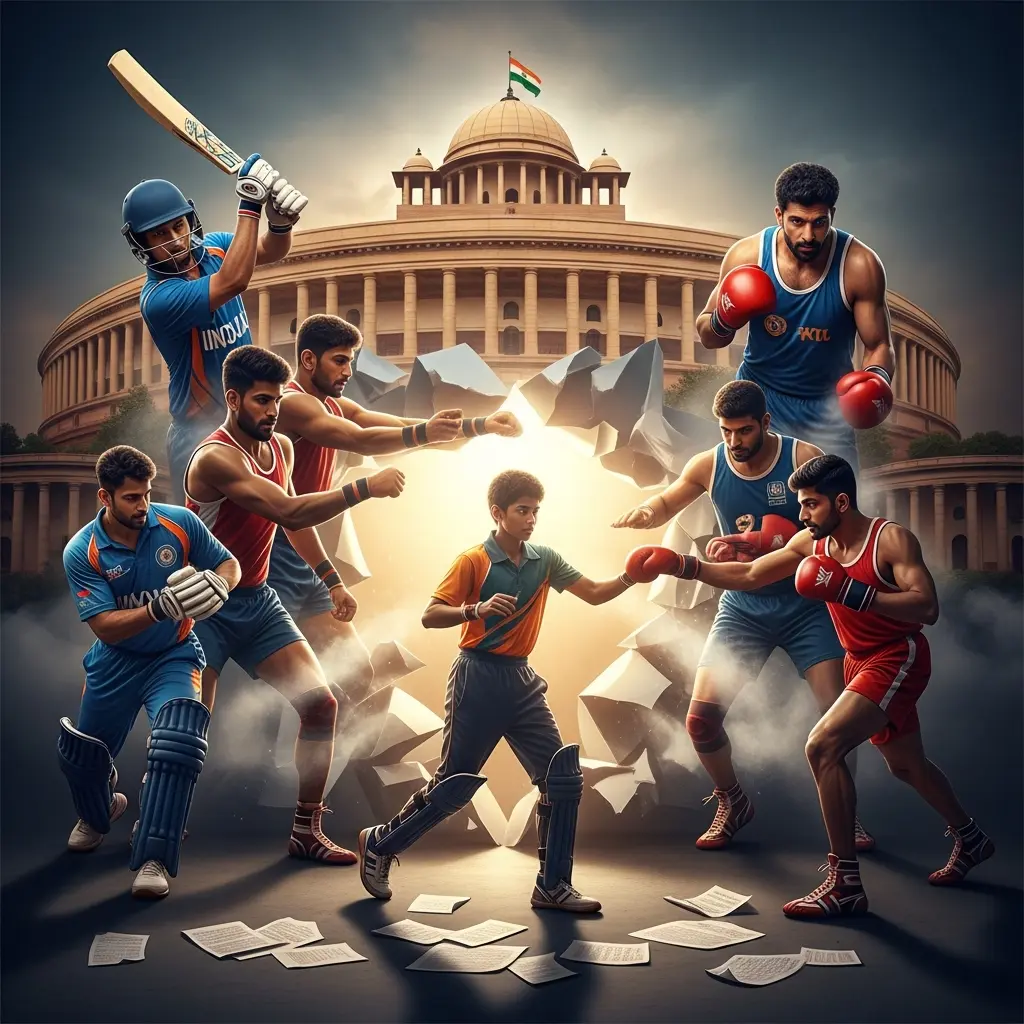
From doping crackdowns to athlete welfare mandates, India’s
governance reforms are attempting something harder than legislation — a genuine cultural shift in how sport is administered and protected.
There is a particular kind of frustration that comes from watching a system fail not because of bad intentions but because of bad structure. For those who have followed the story of Indian sport over the past decade, that frustration is familiar. Talented athletes have emerged from villages and small towns, won medals that made the country stand up in their living rooms — and then, too often, found themselves navigating institutions that weren’t built to support them, protect them, or even be straight with them. The Indian government’s sweeping governance reforms in sport are, at their core, an attempt to fix that structure before another generation pays the price for it.
The reforms being pushed through under the banner of India sports policy represent a significant widening of scope compared to anything that has come before. Where previous interventions tended to focus narrowly on individual infractions — a banned athlete, a suspended federation — the current initiative is explicitly systemic. It encompasses anti-doping India measures, athlete welfare protections, institutional accountability frameworks, and a mandate for much closer coordination between the central government, state sports bodies, and international agencies. The ambition, officials say, is nothing less than a full-spectrum clean-up of how Indian sport is governed from the ground up.
“Governance reform without athlete welfare reform is just paperwork. India is learning that the two cannot be separated.”
Central to this effort is the government’s engagement with global organisations, including the World Anti-Doping Agency and the International Olympic Committee. These partnerships are not just symbolic. There is technical assistance, audit frameworks and crucially, accountability benchmarks to which India’s domestic bodies cannot turn a blind eye. India’s sports law landscape is being restructured to align with international compliance standards, which means domestic federations accustomed to operating with considerable opacity are now being asked to open their books, their processes, and their decision-making to external scrutiny. For many of them, it is a jarring adjustment.
The monitoring dimension of the reforms is particularly substantive. Stricter, more frequent inspections of training centres — including state academies, private coaching institutions, and sports hostels — are being rolled out under new protocols. The logic is straightforward: if doping and welfare violations happen predominantly in training environments, that is where oversight must be concentrated. Random testing, unannounced facility checks, and mandatory record-keeping for medical treatments are among the measures being implemented. The National Anti-Doping Agency, now armed with a stronger legal mandate and for the first time, substantial budgetary support commensurate with its responsibilities, will likely be much more active in enforcement than in the past.
Perhaps the most quietly significant element of the governance reforms, however, is the athlete welfare component. Sports institutions in India have traditionally been paternalistic, giving athletes little agency, voice or recourse. Contracts, if they existed at all, were mostly one-sided. Grievance mechanisms were informal to the point of being useless. Coaches and administrators held near-total power over selection, funding, and career trajectory, and athletes who raised concerns about misconduct — including doping pressure — frequently found themselves sidelined rather than supported.
The new framework proposes to change this in concrete ways: independent athlete representatives on federation governance boards, formalised grievance channels with defined response timelines, and protections for athletes who report doping or misconduct. These provisions are a straight lift from models tried in countries with more mature sports governance ecosystems, and their presence in India’s reform package is a sign that officials understand the problem isn’t just about enforcement, but power dynamics within sporting institutions.
Coordination between sports bodies has long been another weak link. India’s sporting administration is layered and fragmented — central and state governments, autonomous national federations, privately run academies, and public sector sports units all operate with overlapping jurisdictions and minimal obligation to communicate with each other. The governance reform push is advocating structured coordination mechanisms: data-sharing agreements, unified compliance calendars, and joint oversight committees that bring different bodies into a common accountability framework. It won’t resolve every turf war overnight, but it does create the architecture through which genuine coordination becomes possible.
The road ahead is not without obstacles. Implementation across a country as vast and administratively complex as India is always harder than legislation implies. State-level political interests, the inertia of established federations, and limited institutional capacity in smaller sports bodies will all test the reform’s reach. There is also the perennial danger of ambition outrunning execution — of impressive announcements that fail to translate into changed practice on the ground, in the weight room, on the track.
But something feels different this time. The reforms are arriving alongside genuine public scrutiny of sports administration, growing athlete advocacy, and an international audience that is watching India’s sporting ambitions with both admiration and scepticism. For India to fulfil the promise of its athletic talent — and there is extraordinary talent — it needs institutions that are trustworthy, transparent, and genuinely oriented around the people who compete. That is what good governance means in sport. Not rules for their own sake, but structures that allow the best of human effort to shine without being corrupted along the way.
More Than Rules on Paper: India’s Push for Real Sports Governance.