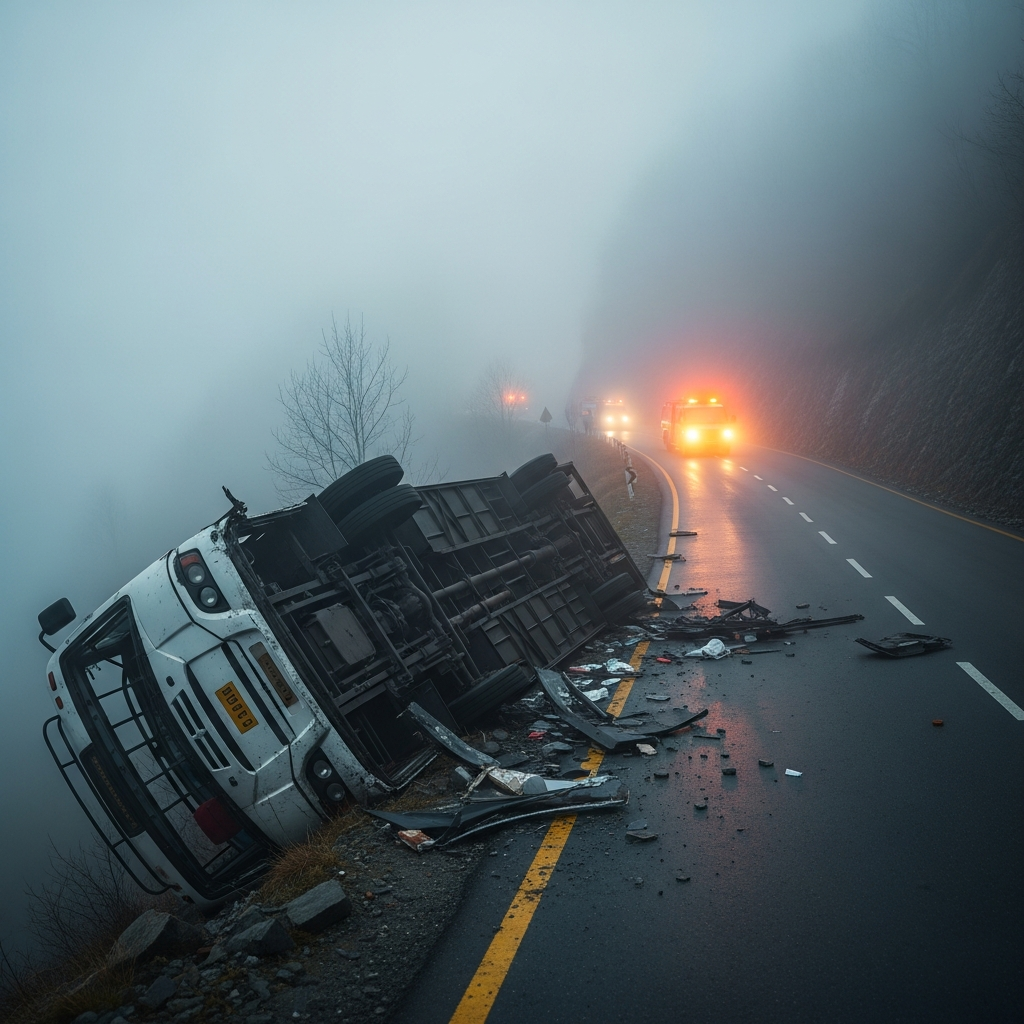
A devastating gorge plunge in Jammu & Kashmir has claimed at least 21 lives and left dozens injured — renewing urgent questions about road infrastructure and safety enforcement in India’s mountainous regions.
There are accidents. And then there are tragedies that quietly expose everything a society has chosen to ignore. The bus accident in Jammu & Kashmir that claimed at least 21 lives this week is, heartbreakingly, the latter.
On what should have been an ordinary journey through one of India’s most breathtaking — and most treacherous — mountain corridors, an overcrowded bus lost control and plunged into a gorge. In moments, dozens of families were shattered. The rescue operation that followed, carried out by a combination of local villagers and emergency personnel, was both heroic and deeply telling: heroic because people risked their own safety to pull survivors from the wreckage, and telling because it was ordinary people — not a well-equipped rapid response system — who led the effort in those critical first hours.
The Kashmir accident is not an isolated incident. It is the latest chapter in a long, painful story about India’s road safety crisis, particularly in hilly and mountainous regions where the stakes of poor infrastructure are existential.
The terrain does not forgive
Anyone who has travelled through the Jammu & Kashmir region knows that these roads are not ordinary roads. They wind through steep gradients, hug narrow cliff faces, and frequently offer nothing between a vehicle and a sheer drop but a few inches of gravel and the driver’s nerve. In winter and monsoon season they become even more unforgiving – slick with rain or frost, less visibility, landslides a constant threat.
On roads like these, an overcrowded bus is not a mere inconvenience — it is a potential catastrophe waiting for the wrong moment. Overloading shifts a vehicle’s centre of gravity, strains brakes already taxed by mountain descents, and makes control exponentially harder. Yet overcrowding remains endemic on routes where demand consistently outpaces the number of available vehicles, where enforcement is sparse, and where passengers often have no alternative.
This is the cruel mathematics of India’s road safety challenge in its hilly regions: people need to travel, there are not enough buses, the buses that exist carry more than they should, and the roads they travel on were never designed for modern volumes or speeds. The result is tragedies like this Jammu Kashmir bus tragedy, repeated with grim regularity.
Compensation is not enough
Prime Minister Narendra Modi announced financial compensation for the families of the victims. It’s a gesture that counts – it acknowledges the loss and provides some immediate material support to people whose lives have been turned upside down. But compensation, however necessary, is a response to tragedy, not a prevention of it. And in the aftermath of a bus tragedy of this magnitude, what India’s mountainous regions need urgently is not just sympathy – it is structural change.
The conversation that must follow this road safety disaster in India is not about the condition of one road or the decisions of one driver. It is about a system that consistently fails the people it is meant to serve. That means stricter — and actually enforced — regulations on vehicle capacity. It means regular and genuinely rigorous roadworthiness checks. It means investment in barrier infrastructure on mountain roads: crash barriers, improved signage, adequate road width where possible. It means faster, better-equipped emergency response that does not rely on villagers improvising rescues in remote gorges. And it means holding accountable those responsible when rules are routinely flouted.
A pattern that cannot be ignored
India records one of the highest rates of road accident fatalities in the world. The problem is particularly acute in states with difficult terrain — Himachal Pradesh, Uttarakhand, and Jammu & Kashmir among them — where the combination of mountainous roads, ageing vehicle fleets, and limited infrastructure creates conditions that are predictably lethal. Year after year, accidents occur. Year after year, there are calls for reform. Year after year, the reforms come slowly, partially, or not at all.
What is different this time — what must be different this time — is that the deaths of these 21 people, and the suffering of the dozens more injured in this Kashmir accident, are allowed to mean something beyond a news cycle. The breaking India news alerts will fade. The cameras will move on. But the families of the dead will not move on. They will carry this for the rest of their lives.
What the mountain asks of us
There is something deeply human about the image of villagers scrambling down a gorge to reach survivors before official help arrived. It speaks to the instinct of communities to protect their own, even at personal risk. That instinct deserves a system worthy of it — one that does not routinely place ordinary people in positions where the difference between survival and death is whether a stranger happened to be nearby.
Kashmir’s mountains are among the most spectacular landscapes on Earth. They are also among the most demanding. The roads that cut through them carry not just passengers but livelihoods, families, futures. They deserve to be treated as the critical, life-carrying infrastructure they are — not as afterthoughts, not as problems to be managed cheaply, but as a genuine responsibility of governance and public safety.
Twenty-one people are gone. Dozens more are recovering from injuries, some perhaps life-altering. Their families are in grief. If this India road safety crisis is to mean anything beyond its immediate horror, the answer must come not just in condolences and compensation — but in roads that do not kill, buses that carry only what they safely can, and a system that actually protects the people it serves. Anything less is a failure these mountains — and the people who live among them — can no longer afford.
A Bus, a Mountain Road, and 21 Lives Lost: Kashmir’s Road Safety Crisis Demands Answers.