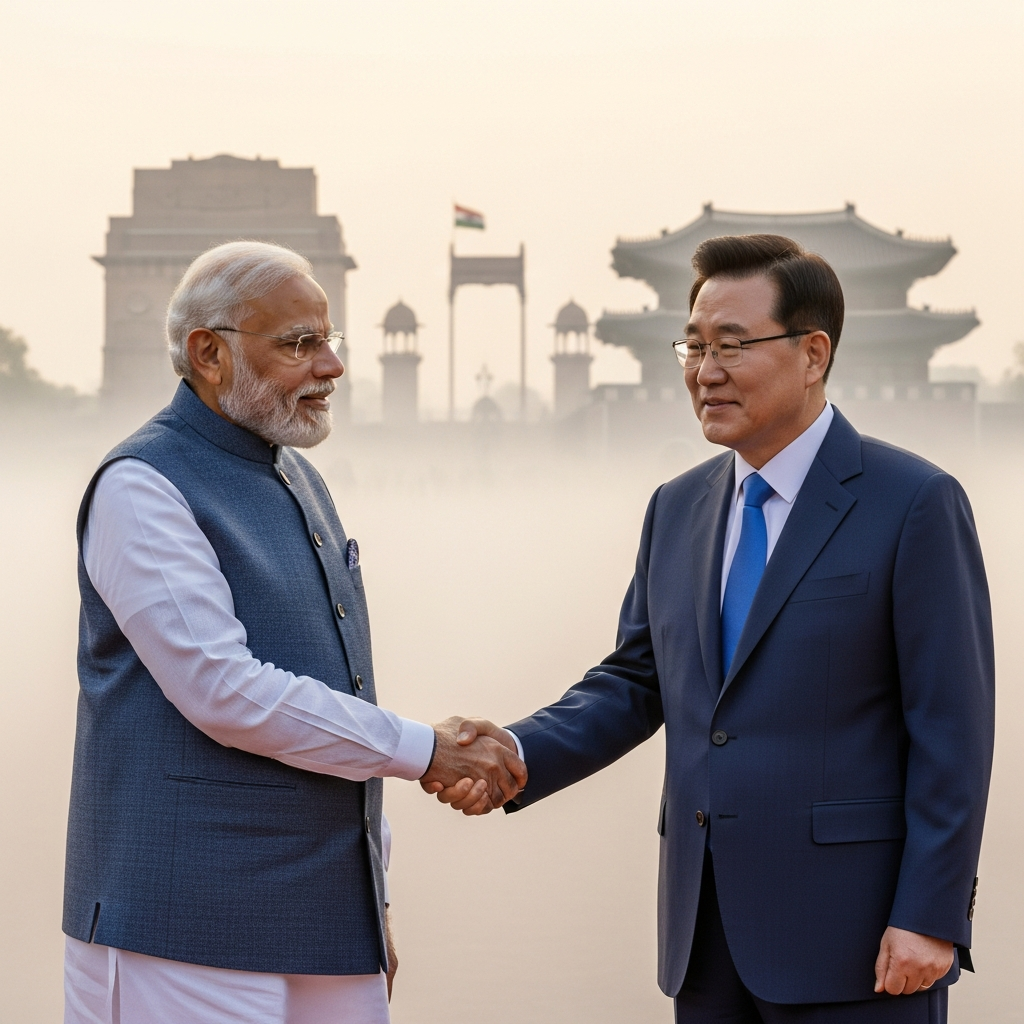
As Prime Minister Modi and President Lee Jae Myung deepen bilateral ties in trade, technology, and defense, two Asian giants are quietly building something the world should pay close attention to.
Diplomacy, at its most honest, is rarely about the speeches. It is about what two countries quietly decide they need from each other — and what they are willing to build together over time. Measured against that standard, the latest round of high-level talks between India and South Korea stands out as something genuinely significant, even if the headlines have not quite caught up to the substance.
Prime Minister Narendra Modi and South Korean President Lee Jae Myung have agreed to substantially deepen bilateral ties across three pillars that actually matter: trade, technology, and defense. It is a partnership that has been growing for years, but one that now — in a world reshaped by supply chain shocks, geopolitical fractures, and the scramble to dominate next-generation industries — has taken on a new urgency and a new ambition.
Two economies that genuinely need each other
Start with economics, because that is where the most immediate logic lives. India–Korea relations have long been warmer in rhetoric than in reality, but the gap between the two is closing — and for good reason. India offers what South Korea increasingly needs: a vast and growing consumer market, an enormous and relatively young workforce, and a government that is aggressively courting foreign industrial investment. South Korea offers what India has been chasing for decades: world-class manufacturing capability, deep expertise in semiconductors, electronics, shipbuilding, and clean energy, and companies with both the capital and the appetite to invest at scale.
The new joint industrial collaboration frameworks announced following these talks are not merely symbolic. They are an acknowledgment that the two economies are, in important ways, complementary — and that a genuine trade partnership in Asia built on those complementarities could be more durable and more productive than either country pursuing the same goals alone. For India, attracting Korean industrial giants into its manufacturing ecosystem is a meaningful step toward the kind of technological depth that ‘Make in India’ has always promised but sometimes struggled to deliver. For South Korea, India represents a diversification away from overdependence on Chinese supply chains and markets that has become, in the current global environment, a strategic imperative.
Technology: the ground where the real competition is fought
If trade is the foundation, technology exchange is where this bilateral relationship has the potential to become truly transformative. We live in a moment when control over critical technologies — artificial intelligence, advanced semiconductors, green hydrogen, space systems, next-generation telecommunications — is increasingly understood as a form of geopolitical power. Countries that can develop, manufacture, and deploy these technologies domestically are insulated. Those that cannot are dependent, and dependence in the current global order carries real risk.
India and South Korea, separately, have significant strengths in the technology domain. India’s software and services sector is globally recognised; its deep pool of engineering talent is among its most valuable national assets. South Korea’s hardware and advanced manufacturing capabilities, meanwhile, are among the most sophisticated in the world. The technology exchange frameworks agreed upon in these talks represent an attempt to combine these strengths — to create partnerships where Indian software expertise and Korean hardware excellence reinforce each other, rather than existing in parallel without connection.
If those frameworks are implemented seriously and not allowed to wither into bureaucratic formality, they could produce outcomes that benefit both nations substantially. Joint research programmes, co-development of industrial technologies, shared investment in emerging sectors — these are the building blocks of the kind of deep, durable technology partnership that defines the most successful bilateral relationships in the world. Modi diplomacy, at its most effective, has often been about building exactly these kinds of multi-layered economic and technological links, and the Korea engagement fits that pattern.
Defense: the quiet but crucial pillar
The defense component of this partnership often receives less attention than it deserves, but it may be the most strategically consequential of the three. Both India and South Korea operate in neighbourhoods where the security environment has become more challenging, not less. India faces persistent pressures along its borders. South Korea lives with the ongoing realities of the Korean peninsula and the broader uncertainties of Northeast Asian security dynamics. Both countries share an interest in a regional order that is stable, rules-based, and resistant to coercion by any single dominant power.
Deepening defense cooperation — through joint exercises, defence technology collaboration, and potentially co-production of military systems — serves both countries’ interests. It also fits into a broader pattern visible across the Indo-Pacific, where like-minded democracies are quietly building new webs of security cooperation that do not depend on any single alliance structure or great power patron.
What this means for Asia — and for global politics
Zoom out from the bilateral details and the picture becomes more interesting still. India and South Korea strengthening their partnership is part of a larger rearrangement of relationships across Asia — one driven by shared economic interests, shared concerns about regional stability, and a shared recognition that the global politics of the next several decades will be shaped in significant part by what happens in this part of the world.
Neither country is seeking confrontation with anyone. But both are making clear, through partnerships like this one, that they intend to be architects of their own futures rather than passive observers of forces beyond their control. That is a healthy instinct — and, if translated into substance rather than merely signal, a genuinely consequential one. The world’s fastest-growing major economy and one of Asia’s most sophisticated industrial powers deciding to build something together is not a minor event. It deserves more attention than it typically gets — and more follow-through than diplomatic announcements typically receive.
The handshake has happened. Now comes the harder, more important work.