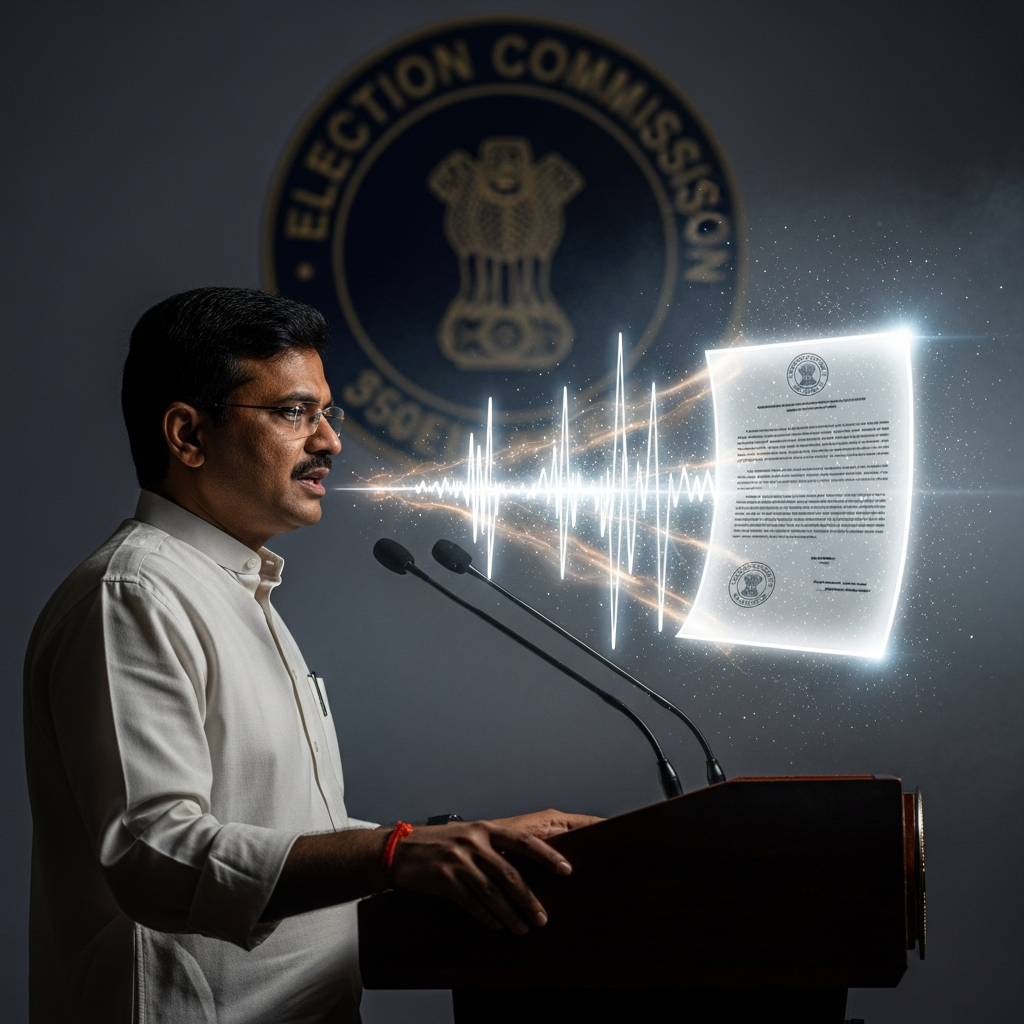
In Indian politics, the line between passionate campaigning and punishable speech has always been razor-thin. This week that line was crossed – at least in the eyes of the Election Commission of India – when a senior opposition leader made remarks aimed at the Prime Minister that led to an official notice from the country’s top electoral authority.
The development has sparked a new debate over the limits of political expression, the neutrality of constitutional institutions and the true meaning of running a clean campaign in the world’s biggest democracy.
What happened, and why it matters The Election Commission of India (ECI) sent a notice to the opposition leader for violating the Model Code of Conduct. The contentious comments were made in the course of a public campaign rally and were deemed to have crossed the limits of permissible electoral rhetoric. While the exact phrasing of the statement is disputed among political parties, the Commission’s intervention sends a strong signal: there are limits to the acceptance of inflammatory campaign speech and these limits will be enforced.
This isn’t the first time the Election Commission has stepped in during a charged electoral season. But each one carries new weight, especially when it involves a figure senior enough in the opposition hierarchy to shape the public narrative. Notices of this kind don’t just address individual conduct — they set tone. They remind every candidate, party worker, and campaign strategist that the microphone comes with accountability.
The Model Code of Conduct: Democracy’s Rulebook
To understand the significance of this notice, it helps to understand what the Model Code of Conduct actually represents. Introduced decades ago as a voluntary framework and since evolved into a rigorously enforced set of electoral guidelines, the MCC kicks in the moment election dates are announced. From that point forward, every public statement, every advertisement, every rally speech falls under its jurisdiction.
The code prohibits personal attacks that appeal to caste, religion, or communal sentiment. It bars statements that are factually misleading or designed to incite hostility. It calls for parties and candidates to compete on policy and vision, not on the politics of personal destruction. In theory, it is the great equalizer of Indian elections, applying the same standard to the ruling party and the opposition alike.
In practice, enforcing it is where things get complicated. Campaign rules exist in a space where legal language meets political passion, and what one side calls legitimate criticism, the other calls a vicious attack. The Election Commission, caught between these competing interpretations, is tasked with making judgment calls that inevitably draw accusations of bias — from whichever side receives the notice.
The Opposition’s Pushback
Predictably, the notice has not been received quietly. The leader has become a rallying point for opposition voices who see the Election Commission’s move as selective enforcement, a tool used more aggressively against government critics than ruling party politicians who they say have made similarly contentious statements on the campaign trail.
This charge of asymmetry is not new to India politics. Every electoral cycle brings fresh allegations that the Commission applies its standards unevenly, and every cycle, those allegations are difficult to either prove or dismiss cleanly. What is clear is that the political controversy surrounding the notice has, in some ways, amplified the original remarks — giving them far more reach than a campaign rally alone ever could.
That is the paradox of formal censure in a media-saturated democracy. Silence something, and you risk making it louder.
What the Election Commission Is Actually Trying to Do
Strip away the political noise, and the Election Commission’s action reflects a genuine institutional concern. Indian elections — the sheer scale of them — are uniquely vulnerable to the power of inflammatory speech. With hundreds of millions of voters spread across linguistic, religious, and caste lines, a single provocative statement at the wrong moment in the wrong constituency can do real damage. The Commission knows this, and its increasing scrutiny over campaign rhetoric in recent elections reflects an effort to stay ahead of that risk.
The body has also been modernizing its enforcement mechanisms — faster response times to complaints, more transparent communication of its decisions, and a broader interpretation of what constitutes a code violation. Whether one agrees with a specific ruling or not, the direction of travel is toward greater accountability, not less.
The Larger Question Nobody Wants to Answer
Here’s what the notice really forces into the open: in an era of 24-hour news cycles, social media amplification, and deeply polarized electorates, can any regulatory framework truly contain the excesses of political speech? The Model Code of Conduct was designed for a different media environment — one where a statement made at a rally in one state took days to travel to another.
Today, a clip from that same rally is on every smartphone screen within minutes. The Commission is enforcing analog rules in a digital world, and the gap between the two is widening every election cycle.
That doesn’t mean the code is irrelevant. If anything, its symbolic value — the signal it sends that someone is watching, that there are consequences — matters more than ever. Politicians who know a notice could land in their inbox before they leave the stage are at least nudged toward a degree of restraint.
A Democracy Checking Itself
India’s elections are messy, loud, and fiercely contested — and that is, in many ways, their strength. But democracy without guardrails eventually eats itself. The Election Commission’s notice to the opposition leader, whatever one’s political sympathies, is the system doing what it is supposed to do: checking itself, holding a mirror up to its own participants, and insisting that the contest remain, at its core, a contest of ideas.
The campaign trail is a stage. The Commission is simply reminding everyone that the audience — and the referee — is always in the room.
When Words Become Warrants: Election Commission Puts Opposition Leader on Notice.