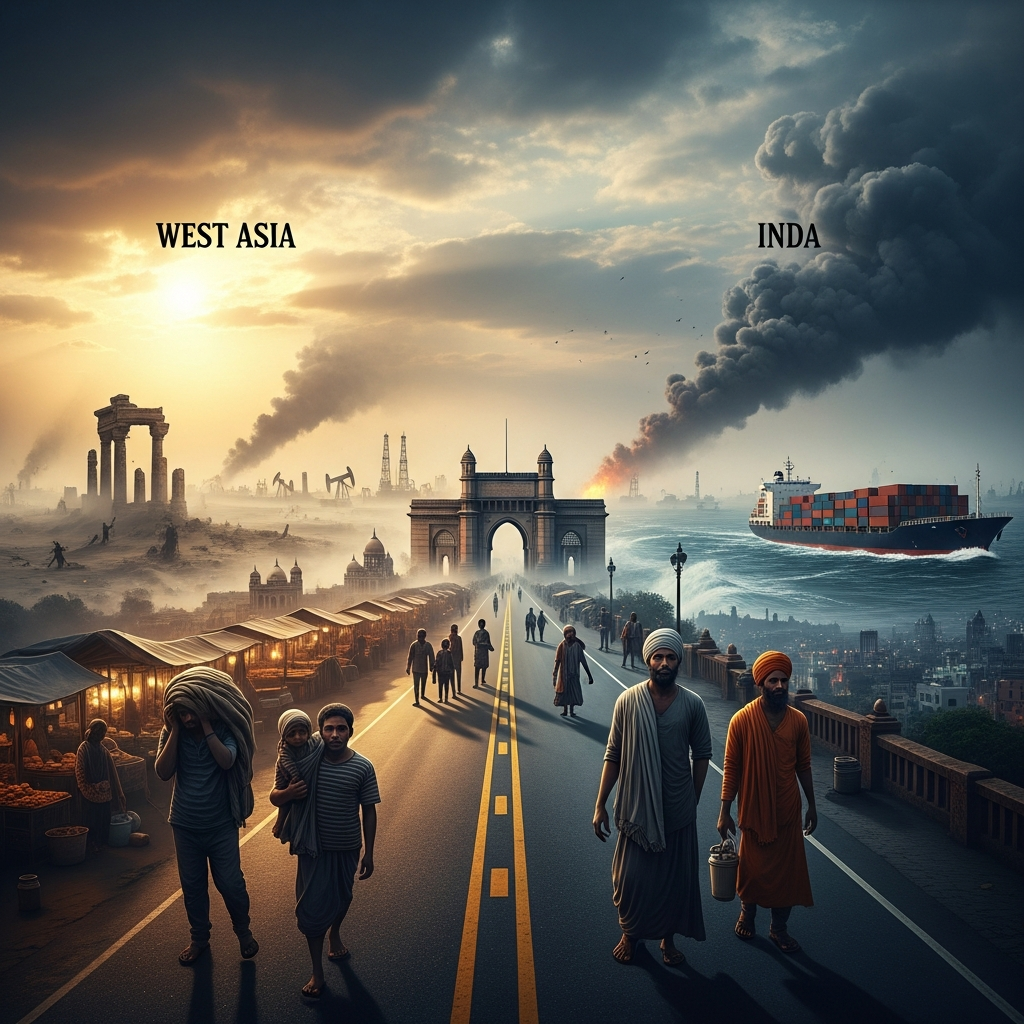
Every time a missile is launched in West Asia, an economist somewhere quietly opens a spreadsheet. That might sound cold — reducing human conflict to numbers and projections — but it reflects a hard truth about how interconnected the modern world has become. What happens in the Persian Gulf doesn’t stay in the Persian Gulf. It travels through oil pipelines, currency markets, shipping lanes, and supply chains until it eventually shows up in the price of cooking gas in Mumbai, diesel in Delhi, and groceries in Chennai.
The latest escalation of tensions in West Asia has once again put India’s economic policymakers on alert. And for good reason.
India’s Uncomfortable Dependence on West Asian Oil
Let’s start with the most direct link: crude oil. India imports roughly 85 percent of its oil requirements, and a significant share of that comes from West Asian nations — Saudi Arabia, Iraq, the UAE, and Kuwait among them. This dependence isn’t a policy failure so much as a geographic and economic reality. West Asian crude is proximate, well-suited to Indian refineries, and — in stable times — competitively priced.
But stable times are precisely what the region is not offering right now. Escalating conflict in West Asia creates what traders call a “risk premium” on oil — an additional cost baked into prices not because supply has actually been disrupted, but because markets fear it might be. That fear alone is enough to push oil prices higher on global exchanges.
When oil prices rise, India feels it quickly and broadly. Fuel costs climb. Transport becomes more expensive. Input costs for manufacturers go up. Farmers pay more for fertilizers and irrigation. The inflation doesn’t stay contained to the pump, it radiates outward across the entire economy touching almost every sector in some form.
Rupee Volatility: The Second FrontOil prices have a direct effect on inflation. But they also put pressure on India’s currency. When oil becomes more expensive, and India has to pay more dollars for a given amount of crude, the demand for dollars rises. That means you need more rupees to buy each dollar – and the rupee weakens.
Rupee volatility is not a worry only for forex traders and finance ministers. A weaker rupee makes imports more expensive across the board — not just oil, but electronics, machinery, chemical inputs, and edible oils. It also increases the cost of servicing dollar-denominated debt held by Indian companies. And it complicates the Reserve Bank of India’s already delicate balancing act between supporting growth and controlling inflation.
In recent weeks, currency markets have already begun to reflect the anxiety. Economic experts monitoring the situation have flagged that sustained West Asia conflict could push the rupee into uncomfortable territory, particularly if global risk appetite falls and foreign portfolio investors pull money out of emerging markets like India in search of safer assets.
The Inflation Risk That Keeps Policymakers Awake
India has made meaningful progress in managing retail inflation over the past few years, but that progress sits on a foundation that West Asian instability can crack quickly. The Consumer Price Index remains sensitive to food and fuel prices — two categories that feel the tremors of any global oil shock almost immediately.
If crude oil prices climb significantly and stay elevated, the RBI faces a dilemma it would rather not confront: raise interest rates to contain inflation and risk slowing an economy that still needs stimulus, or hold rates steady and allow inflation to run a little hotter than comfortable. Neither option is clean. Neither is without consequence.
Economic experts have been vocal in recent days, urging policymakers to resist reactive decision-making and instead build flexible strategies that can adapt as the situation evolves. That is sound advice, but executing it in real time — with global markets moving fast and political pressures mounting — is considerably harder than saying it.
The Global Economy Catches a Cold Too
India doesn’t absorb these shocks in isolation. The global economy is itself under pressure from the West Asia conflict, and a world economy that slows or stumbles creates its own headwinds for India.
Export demand could soften if key trading partners in Europe or East Asia pull back on spending. Freight and shipping costs — already elevated post-pandemic — could climb further if West Asian sea lanes become more contested. Foreign direct investment decisions may be delayed as global investors sit on the sidelines waiting for clarity.
For an economy that has been positioning itself as a manufacturing alternative to China and a destination for global capital, prolonged geopolitical uncertainty is an unwelcome advertisement.
What India Can Actually Do
None of this is to say India is helpless. The country has built up a reasonable cushion of foreign exchange reserves. It has diversified its oil import sources in recent years — Russia has become a significant supplier, particularly after the Ukraine war reshaped global energy trade. Strategic petroleum reserves aren’t without limits, but they offer a short-term buffer.
The government has several tools at its disposal on the policy front, including targeted subsidies, deferring fuel price hikes and RBI interventions in the currency market. The challenge is to use them precisely – to provide relief where it is really needed, without distorting markets or eating into fiscal space that India may need later.
The Bigger Truth About Globalization
West Asia’s tensions are a reminder of what globalization actually means in practice. It doesn’t just mean opportunity and interconnection — it means shared vulnerability. India’s growth story, however strong its domestic foundations, cannot be fully insulated from a world that is increasingly fractious.
Managing that reality — calmly, strategically, without panic — is the task in front of India’s economic policymakers today. The spreadsheets are open. The work has already begun.
The Cost of Conflict: Why West Asia’s Turmoil Is Knocking on India’s Door.