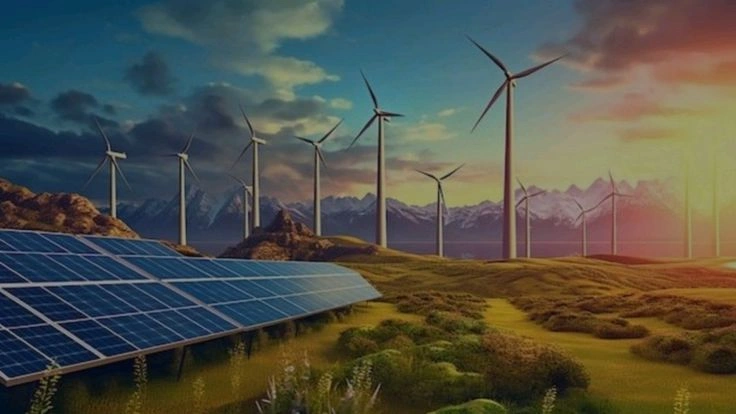
The world is seeing a silent but momentous transformation in its conception of power. By 2026, the global clean energy conversation is shifting from rhetoric to reality with real-world investments, major projects and legislative changes that are overhauling entire electricity grids. Countries are scrambling to obtain renewable capacity – from the deserts of India to Europe’s offshore wind farms to China’s solar-drenched rooftops – not just to hit climate commitments but to guarantee energy independence and industrial advantage in a volatile age.
At the core of this drive is an extraordinary fact: for the first time, the bulk of new power generation being added around the world is coming from renewable sources, predominantly solar and wind. And today analysts and energy institutes estimate that solar alone accounts for almost 80 percent of new electricity capacity, a dominance that has changed the old ‘ifs’ regarding renewables into a ‘when’ for fossil‑fuel‑dominated systems. Governments and corporate investors, who traditionally shied away from instability and intermittency, are now gambling on a mix of technology, storage and smarter grids to make this transformation both practicable and economical.
A New Energy Investment Era
A very significant symptom of the global shift is the flow of money. Recent estimates from the International Energy Agency show worldwide energy investment surpassed $3 trillion in 2025, with almost two-thirds of that going to clean-energy technologies, including solar and wind farms, electric vehicles, battery storage and grid upgrading. Put simply, for every dollar spent on energy today, some 60-70 cents is going to cleaner solutions even as debates about security, price and geopolitics continue to dominate headlines.
This change is now not propelled by a few “green” economies. All three are investing tens of billions in renewables but the momentum is also obvious in rising economies such as India, Brazil and portions of Southeast Asia, China, the United States and the European Union. What was once solely a climate imperative is now as much about industrial strategy, jobs and avoiding the economic shocks of fuel-price swings and supply-chain interruptions.
The energy transformation has turned into a contest in many ways: who can develop the most solar, scale the cheapest storage and update infrastructure the fastest? Those who fall behind could end themselves paying more for imported energy, or missing out on manufacturing and export prospects in solar panels, wind turbines and batteries.
Solar and Wind: The Workhorses of the Transition”
Solar photovoltaic (PV) and wind are the twin engines of the energy transition currently underway. The tale of solar, in example, may be called the “great decoupling”: it is now cheaper than fossil-fuel-based power in most key markets, even without subsidies. As costs decline and installation timeframes shorten, governments and businesses are beginning to view solar less as a novelty and more like a regular infrastructure.
Take China, for example: solar deployment there has been moving at a dizzying pace. According to new analysis, the government has in fact blown beyond its 2030 solar target by hundreds of gigawatts since 2023 alone. This has converted China into the world’s largest installer of solar PV, with rooftop systems, utility-scale farms and large industrial-scale projects all helping quickly reshape the electricity mix.
Wind power, particularly offshore, is also on the rise. New offshore wind capacity additions are estimated at 140 gigawatts over the next decade, with most of the additions occurring in Europe, East Asia and areas of North America. Offshore wind also has the potential to provide substantial amounts of power near coastal towns, decreasing the need for long-distance transmission lines while providing grid stability.
Hydropower, and newer storage technologies like pumped-storage hydropower, are doing a quieter but vital job. Such innovations are helping to provide a more reliable supply of power by offsetting the peaks and troughs of solar and wind, providing power when it is needed, not only when the sun shines or the wind blows.
India’s shift to renewables
India’s rush to clean energy is not some distant trend; it is a domestic imperative. India, one of the world’s biggest energy consumers and a country already struggling with air pollution and climate challenges, has much at stake in its management of the transition.
The numbers make for a compelling story. India has been one of the fastest growing renewable industries in recent years, with solar and wind development exceeding overall electricity demand growth in the first half of 2025. Meanwhile, the country’s coal generation has plateaued or fallen, even as the economy continues to grow. That is a big change from the past, when every boost in GDP was accompanied by a corresponding uptick in coal use.
One flagship project presently attracting worldwide notice is India’s Khavda Hybrid Renewable Energy Park in Gujarat, being developed by Adani Green. Khavda is being billed as one of the world’s biggest renewable-energy hubs, with several gigawatts of combined solar, wind and pumped-storage power. The initiative is not only about power generation but also about demonstrating that large-scale renewables can be incorporated into the system without sacrificing reliability.
Competitive auctions, long-term power purchase agreements and incentives for rooftop solar are also being banked on by Indian officials to expedite the switch. But the road is not without its obstacles. Grid congestion, land-use problems and funding restrictions are ongoing obstacles – especially in places where infrastructure has fallen behind demand. The challenge for India now is not whether to go green but how fast and how fairly it can ramp up renewables while protecting jobs and consumers.
Storage, Grids and the ‘Unseen Backbone’
The actual story of the energy shift is not simply about panels and turbines, but about how electricity is stored, moved and controlled, and it’s happening behind the scenes. Battery storage costs have reduced more than two times in a couple of years and they are currently more than three times cheaper than they were three years ago. This sharp fall is turning batteries from a specialty, pricey add-on to a key component of current power systems.
Cheap storage practically implies solar can be used at night and wind can be “saved” during stilling periods. It also enables enterprises and homes to shield themselves from spikes in prices or outages, which is particularly advantageous in areas with frequent blackouts or rapidly changing tariffs. Today, countries constructing a big number of solar and wind farms are rapidly combining them with storage, generating “hybrid” projects that can operate in a manner similar to traditional power plants, but without the emissions.
At the same time, a quiet revolution is taking place in electrical grids. Many of today’s systems were built around centralized generation from fossil fuels, not around a distributed network of solar roofs, wind farms and electric vehicles. Today’s modernization efforts are focused on digital monitoring, smart-metering, and flexible grid operations that can adjust to real-time variations. That is where technologies like artificial intelligence and data analytics are quietly entering the discourse, enabling grid operators forecast demand, manage congestion and optimize the usage of renewables.
The Geopolitics of Clean Energy
The hunt for renewables is also changing energy geopolitics. In the past, the world’s power has been based on oil and gas pipelines, shipping lanes, and cartels. The strategic levers today are battery supply chains, rare earth materials and ownership of manufacturing capacity.
China, for example, has not only become the world’s biggest market for renewables but a dominating producer of solar panels, wind turbines and batteries. That has made it a crucial node in the global energy-transition architecture, for better and ill. “Chinese production has helped to bring down costs on the one hand, but on the other has prompted concerns about over-reliance on a single supplier, especially in Western democracies.
The United States and the European Union have reacted by introducing industrial-policy measures—tax credits, subsidies and “local content” rules—to promote home manufacturing. The incentives are meant to create jobs, reduce reliance on foreign suppliers and make sure the advantages of the transformation are felt locally, not only in far-off boardrooms or export-driven factories.
But this tug-of-war begs an awkward question: can the world decarbonise swiftly and also break up its supply chains into competing blocs? The history of climate action is a global one; but if every big economy continues to hoard its own tech and resources, does the shift risk becoming slower, more fragmented and more expensive?
The Road Ahead: Realism and Optimism
The improvement is there, but experts say the energy transformation is still not happening fast enough to fulfill generally agreed climate targets. A decade after the Paris Agreement, almost 77 per cent of economies around the world have made some kind of net zero pledge, but implementation is patchy and trailing in many cases. The next five years are largely seen as the critical opportunity for narrowing the gap between ambition and actual decarbonization.
The good news is that renewables are now growing faster than demand is growing. In many places, new wind and solar projects are coming on faster than overall power demand is growing. This means the amount of fossil fuels in the mix is slowly diminishing. It’s a subtle but powerful shift: instead of striving to “outgrow dirty power,” the world is beginning to crowd it out.
But the change is not merely a technical one. It is also a social and political one. Communities that rely on coal mines, refineries or gas plants have to find other livelihoods. Cities will have to rethink transport, buildings and heating. Governments will need to balance the urgency of climate action with the realities of inflation, unemployment and popular pessimism about change.
Here’s another question worth asking: while the globe pours money into clean energy, how much of that investment is actually going to people – workers, small businesses, and low-income households – rather than merely to giant corporations and financial institutions?
Countries Ramp Up Renewable Projects as Global Drive for Clean Energy Gains Momentum