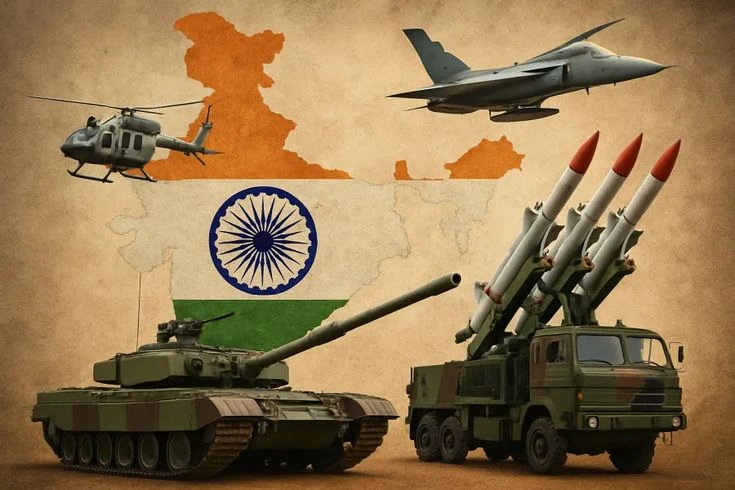
India’s defence research ecosystem is entering a more ambitious phase, with the Defence Research and Development Organisation at the centre of a bigger push for self-reliance, superior technology and speedier military upgrading. The new developments around DRDO clearly indicate a trend. India is not simply modernizing weapons but seeking to construct a deeper and durable defence technology foundation which can sustain future combat, not yesterday’s battlefield.
That important because the nature of warfare is evolving rapidly. Modern defence is not merely tanks, missiles and fighter jets today. It also relies on artificial intelligence, electronic warfare, quantum communication, autonomous systems and modular platforms that can be adapted to varied missions.” India has plenty at risk. Can the country minimize its dependence on imports and still maintain pace with fast-moving global military innovation? That question is at the center of the DRDO narrative today.
More emphasis on self-reliance
The most prominent subject in the recent DRDO advancements is Aatmanirbhar Bharat in Defence. India has been steadily reducing its dependence on foreign suppliers, notably for crucial military technology that affect readiness and strategic autonomy. For long, DRDO has been an integral element of that endeavor, supporting indigenous systems like the Agni and Prithvi missile series, Tejas fighter aircraft, Akash air defense system, Pinaka rocket launcher and a spectrum of radar and electronic warfare weapons.
That heritage is important because defense self-reliance is not merely symbolic. It impacts operational security, long term costs, supply chain stability and India’s capacity to respond swiftly in a crisis. Indigenous development also means opportunities for domestic industry, entrepreneurs, and academic institutions to engage in difficult national security work. In a country of India’s size and strategic concerns, that ecosystem is as vital as the platforms themselves.
New technology focus
One of the largest shifts in the DRDO’s orientation is its expanding concentration on deep-tech sectors. The latest reports have pointed to a focus on artificial intelligence, machine learning, quantum technologies and rapid prototyping in a wider push to change India’s defence research approach. These are not buzzwords. They are the next step in military capabilities.
AI can enhance predictive maintenance, battlefield decision-making, surveillance analysis, and autonomous systems. Quantum communication can improve secure networks. Electronic warfare can enable armed forces detect, jam or protect themselves against the sensors and signals of their enemies. These are the instruments shaping the modern battlefields where knowledge can be as decisive as force.
This change also demonstrates DRDO’s attempt to move away from the old concept of protracted development cycles. The challenge today is speed. The faster you can create, test, modify and induct a system the more important it is to the armed forces.
The importance of modular platforms
Attention was also drawn to India’s recent showing of new indigenous sophisticated armoured platforms with modular architecture, apparently built for both tracked and wheeled variants and adaptable for duties such as infantry combat, reconnaissance and support operations . That matters, because modularity is emerging as a defining concept in modern military design.
Modular systems can be modified for various missions, instead of developing a single platform for a single role. That eliminates waste in development and provides the armed forces more flexibility. In real terms that means a single base platform can be changed to varied terrains, combat roles or mission requirements.
This strategy is particularly effective in India given the country’s diverse operational environment. The army has to consider deserts, mountains, plains, cities and border regions with distinct logistics. Modular systems can be easier to maintain and to deploy. It can also lessen the need to import specialist cars for every situation.
Technology and the expansion of the defence sector
DRDO’s role has gone beyond laboratory research. It’s increasingly serving as a conduit for military users, commercial sector, startups and academic institutions. That paradigm is important if India is to ramp up local defence production and not be dependent on a handful of huge public sector enterprises.
Latest developments also indicate that DRDO will be sanctioning additional projects and handing over technologies to the armed forces through well defined programmes. The direction is clear overall: transform research into deployable capabilities, and do it faster. Of course that’s easier said than done. Delays, procurement problems, integration issues and testing bottlenecks are common problems for defence innovation. But the institutional orientation is encouraging.
This transfer will also benefit the defence industrial base in India. Domestic enterprises receive access to advanced military projects and in return get engineering skills, supply chain depth and export potential. In the long run, that can strengthen India’s standing in the global defence market. It might also mean more jobs and stronger research clusters around defence industrial hubs.
The strategic context
Timing of these advances is key. India is functioning in a tough strategic environment with complex border concerns, increasing competition in the Indo-Pacific and rapid military modernisation by foreign powers. In that sense DRDO is not only a research organisation. That’s a strategic asset.
Countries that control their own defence technologies generally have more strategic freedom. They can update faster, bargain from a stronger position and in a time of crisis, retain operational continuity. That rationale finds expression in India’s drive via DRDO. It’s not just an issue of building gear.” Making leverage is what it is about.
There is a long-term lesson here, too. The number of weapons a country acquires is not the only indicator of defence power. Also, by how much of its defence chain is under its own control. Research, design, testing, production, maintenance and upgrades all count. DRDO is at the core of that chain.
Implications for the armed forces
For the Indian Army, Navy and Air Force, these improvements could, over time, translate into higher readiness and more specialized solutions. Indian operational needs are more likely to be met by Indigenous systems which are adaptable to local conditions than by foreign design assumptions.
Designing technologies with local supply chains in mind also helps the armed forces. Repairs, upgrades and replacements are less likely to be disrupted internationally. This is particularly true in a world where wars, sanctions, shipping problems and export regulations can unexpectedly influence military acquisition.
But the military adoption procedure is never smooth. Testing, user feedback, integration with existing systems and cost control are all still big difficulties. Can India maintain the speed of innovation while assuring reliability in the field? That is the ultimate test, and it will tell how transformational these DRDO-led innovations become.
India’s DRDO Push Signals New Phase in Defence Modernisation