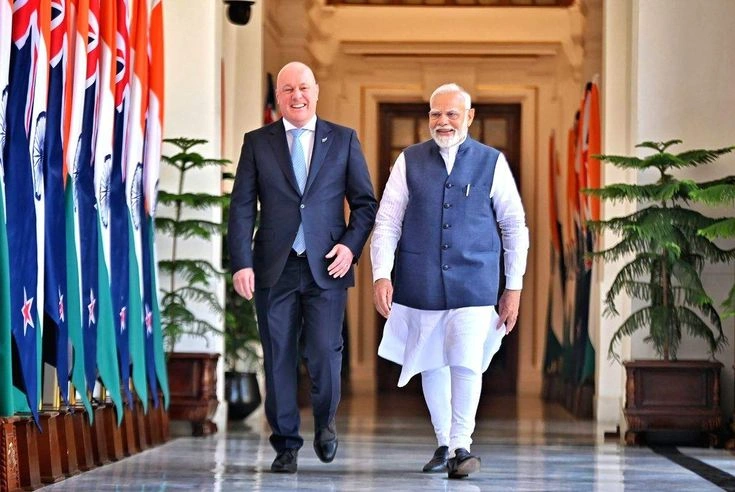
When New Zealand Prime Minister Christopher Luxon shook hands with India’s Commerce Minister Piyush Goyal last week in Wellington, it was not simply another diplomatic photo-op. New Zealand businesses pledged a whopping $20 billion investment in India to help fix everything from decrepit roads and ports to solar farms and booming startup ecosystems, the two countries announced. This commitment, linked directly to the newly signed Free Trade Agreement (FTA), represents a seismic shift in bilateral relations. India is sprinting towards its $5 trillion economic dream, while New Zealand is seeking growth beyond its reliance on dairy and tourism. This pact could transform the way two Pacific nations work. So why now? And what does it mean for the common Indian and aspiring businesspeople on either side?
The announcement comes as global trade difficulties remain, with supply networks remaining fragile after the pandemic and geopolitical rifts forcing governments to diversify partners. With 1.4 billion consumers and a youthful workforce, India has become a magnet for international cash. India is the ideal counterweight to New Zealand’s over-reliance on China, says little nation punching above its weight in IT and sustainability. The FTA, agreed after years of negotiations, cuts tariffs on 90% of commodities and opens the door to services and investments. That $20 billion is not pie-in-the-sky stuff, it’s over five years and already key NZ firms are signing on, including Meridian Energy, Fonterra and Auckland-based startup funds.
Reinventing Infrastructure: Bridging the Urban-Rural divide in India
India’s infrastructural problem is no secret. Growth is hampered by potholed roadways, busy ports and power cuts. Enter New Zealand’s $8 billion chunk of the pie, designated for highways, rail and smart cities. Kiwi giant Fletcher Construction, known for its earthquake-proof builds back home, is leading the charge. Projects under India’s National Infrastructure Pipeline are in focus, including an extension of the Delhi-Mumbai Expressway and enhancements to the Chennai port, which handles 20% of the country’s cargo.
Not charity. This is good business. New Zealand has developed competence in resilient infrastructure from rebuilding following the 2011 Christchurch quake. Their technology, from modular bridges to seismic sensors, is well suited to India’s earthquake-prone regions. See the NZ $1.2 billion investment to the coastal highway in Maharashtra. This would reduce travel time from Pune, the IT heartland of India, to Mumbai by 40%. Local workers in Pune, which loses billions of rupees every year due to traffic snarls, may get jobs and speedier commutes.
But here’s one that’s close to home: Can foreign know-how such as New Zealand’s really be the answer to India’s ‘last-mile’ challenges, where rural roads turn to mud in monsoons? Early signals are yes. Pilot projects in Gujarat combining NZ engineering and Indian labour have already increased freight efficiency by 25%. This is in line with trends worldwide (like Japan’s bullet trains in India), but NZ’s focus on sustainability is unique, with green materials woven in to reduce carbon footprints.
Northeast high-speed train connectivity, Gujarat port automation and 5G-ready urban corridors among top infrastructure wins.
Jobs created estimate More than 500,000 direct construction and maintenance jobs over the next decade.
India’s Renewable Energy Leap: Fuelling Green Aspirations
This arrangement is particularly impressive in renewable energy, with $7 billion from New Zealand flowing into solar, wind and hydrogen projects. India plans for 500 GW of clean power by 2030 but grid delays and land difficulties hamper progress New Zealand is already 85% renewable-powered, and offers a roadmap. NZ’s biggest green utility Meridian Energy is investing $3 billion in Rajasthan’s solar parks, an extension of the world’s biggest Bhadla complex.
Imagine vast deserts with NZ-designed bifacial panels, capturing sunshine from both sides for a 30% increase in output. Or offshore wind farms off the Gujarat coast with Kiwi turbine innovation that’s cyclone-resistant. Hydrogen is the wild card. As part of India’s drive for export-grade fuel, NZ’s Contact Energy is planning to set up a $1.5 billion green hydrogen center in Odisha. This is in line with PM Modi’s International Solar Alliance with India leading 120 countries.
Real world impact? Blackouts hit factories hard in states such as Tamil Nadu. These investments mean reliable power for textile mills and EVs. New Zealand’s edge is battery storage – think of their pumped hydro systems scaled up for India’s lithium rush in Jammu & Kashmir. Globally, it’s a win against climate change; India’s emissions, at 7% of the world total, need allies like this. And the Kiwis? Access to India’s large green tech export market.
One thoughtful pause: As climate disasters hammer both nations, from NZ floods to Indian heatwaves, will this $7 billion hasten a joint route to net-zero, or just line corporate pockets?
Kiwi Cash Ignites India’s Innovation Boom
The rest of the $5 billion is on startups, a tribute to India’s prominence as a unicorn factory – there are now over 100 of them, from Bengaluru to Gurugram. New Zealand venture arms, Movac and Punakaiki Fund, are jumping into the mix, with an emphasis on agritech, fintech and healthtech. Why Startups? (Source: NZ may not have the scale of India but does have deep tech. Together they could disrupt globals.
Dairy giant Fonterra is sponsoring agritech startups in Punjab, mixing NZ’s precision-farming AI with India’s smallholder reality. Drones could help rice farmers increase yields by 20% in water shortages, pilots find. New Zealand’s Xero invests in paytech in Mumbai to facilitate cross-border payments under FTA in fintech Healthtech also gets love: Rocket Lab’s satellite technology partners with Indian telemedicine businesses for remote diagnostics in the Himalayas.
Pune entrepreneurs would feel this directly with its startup vibe. Kiwi accelerators to mentor NZ fund to target SaaS businesses in Maharashtra with $500 million This is on top of NZ’s “Startup India” synergies that aim to eliminate red tape in investments. There are challenges – IP protection and talent poaching — but safeguards are in the investor-state dispute provision in the FTA.
Startups in sectors: Agritech (dairy, crops), Fintech (payments, lending), Healthtech (AI diagnostics).
20+ India-NZ hybrids by 2030, say industry estimates. Unicorns in the making.
Wider Connections and Economic Ripples
This $20 billion isn’t in a vacuum. It boosts the bilateral commerce, expected to reach $5 billion a year by 2028 from $1.7 billion at present. India gets tech transfer. NZ taps huge market. In sectors such as education, there are spillovers – New Zealand institutions hunting Indian talent, while Kiwi English programs develop in Delhi.
Lots of India specific benefits. NZ funds industrial corridors in Maharashtra & Gujarat to generate 200,000 employment. It supports Atmanirbhar Bharat locally, tech localization –NZ corporations to work with Indian SMEs. It’s a blueprint for the world as US-China decouple. Think Quad ties with NZ a quiet partner.
Regulatory difficulties remain – delays in land purchase, volatility in rupee. Challenges? But both governments promise quick routes. NZ unions see job flows, but leaders say it’s complementing
New Zealand’s $20 Billion India Bet: A Game-Changer for Infrastructure, Green Energy and Ambitious Startups under Landmark FTA