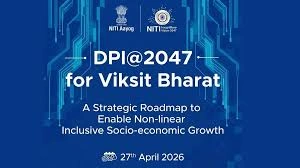
NITI Aayog’s new DPI@2047 roadmap is more than a policy document. It is a signal that India wants its digital public infrastructure to move beyond convenience and inclusion and become a core engine of productivity, jobs, and long-term economic growth.
The roadmap arrives at a time when India’s digital systems already touch daily life in visible ways, from identity and document storage to payments and public service delivery. What NITI Aayog is proposing now is a deeper shift: using those same rails to help small businesses scale, improve access to credit, modernize agriculture, support education and health, and prepare the country for the Viksit Bharat 2047 goal.
A bigger idea than digital access
For years, India’s digital story has been told through familiar names such as Aadhaar, UPI, DigiLocker, and other platform-based services. These systems built trust at scale and helped millions of people join the digital economy. DigiLocker alone had 67.63 crore users and more than 950 crore documents issued by March 2026, showing how deeply digital infrastructure has entered public life.
But DPI@2047 argues that the next phase cannot stop at access. The new challenge is whether digital public infrastructure can actually raise incomes, reduce friction in markets, and make services work better for ordinary people. That is a more demanding test, and a more ambitious one.
What the roadmap proposes
According to the roadmap, India’s digital transformation is being planned in two phases. DPI 2.0, covering 2025 to 2035, is meant to drive livelihood-led growth at scale, while DPI 3.0, spanning 2035 to 2047, is designed to support broad-based prosperity. The immediate focus is clearly on DPI 2.0.
Under this phase, the roadmap identifies eight sectoral transformations. The emphasis is on areas where digital systems can remove bottlenecks that slow down growth, especially in MSMEs, agriculture, education, and health. It also points to key enablers such as credit, decentralized energy, and benefit delivery.
The logic is straightforward. If digital rails can make it easier to find buyers, verify records, access loans, or receive services, then productivity rises. If productivity rises, incomes and opportunities can rise with it. That is the core economic bet behind the roadmap.
Why MSMEs matter here
One of the most important themes in the roadmap is the focus on MSMEs, which remain central to India’s employment and industrial structure. Many small businesses still face the same old hurdles: limited access to formal credit, weak market reach, slow paperwork, and poor integration with digital systems.
DPI@2047 suggests that digital infrastructure can help break some of those constraints. Better data usage, seamless digital transactions, greater interoperability and tech entrepreneurship can enable MSMEs to access bigger markets and operate more efficiently. For a small business owner, this can be the difference between surviving and scaling.
Agriculture and rural growth Agriculture is another big area of focus, and for good reason. The rural economy in India still runs on systems that are often fractured, time-consuming and expensive to navigate. The roadmap sees potential for digital public infrastructure to improve the livelihoods of smallholders, make services more accessible and support better market connections.
This is important because the digital story in India is not just urban or elite. It is increasingly about whether a farmer in a district town or village can benefit from tools that make information, payments, credit, and support easier to access. Isn’t that the real measure of inclusion, after all?
AI as a force multiplier
The roadmap also places strong emphasis on artificial intelligence, but not in the abstract, glossy sense that often dominates tech conversations. Here, AI is framed as a tool that becomes far more useful when paired with trusted, open, population-scale digital infrastructure.
NITI Aayog’s message is that India’s advantage is not only innovation in isolated pockets. It is the ability to connect innovation across sectors and push it into real-world use at national scale. The roadmap highlights AI, digital transactions, stronger human capacity, and the democratization of AI as part of the execution strategy.
That makes the document particularly relevant in the current global AI race. The competition is no longer just about building the biggest models. It is also about who can integrate technology into the economy in a way that improves livelihoods, not just valuations.
A state-led execution model
Another important point in the roadmap is its emphasis on states and districts. NITI Aayog has made it clear that execution cannot be treated as a top-down exercise from Delhi alone. The roadmap calls for district-led demand aggregation and state-driven transformation pathways that can be adapted to local realities.
That approach is practical. India is too diverse for a one-size-fits-all digital plan. What works for a manufacturing cluster may not work for a farm district, and what works in a metro may fail in a smaller town. By pushing implementation closer to the ground, the roadmap tries to make digital reform more usable and more durable.
India’s existing digital base
The reason this roadmap has attracted attention is that India already has a strong digital foundation. UPI has become one of the world’s largest payment systems, while Aadhaar and DigiLocker have made identity and document verification more seamless for millions of people.
That existing base is what gives DPI@2047 credibility. This is not a plan built from scratch; it is a scale-up plan built on a system that has already proven itself in public service delivery and digital finance. The new question is whether the same model can be extended into more sectors with the same level of trust and efficiency.
What it could mean for India
If the roadmap works as intended, the effects could go well beyond tech policy. Better digital public infrastructure could improve access to jobs, help small businesses formalize faster, make public services more predictable, and strengthen the productivity of key sectors. Over time, that could support faster growth without relying only on old-style expansion models.
The broader ambition is to help India move from digital inclusion to digital transformation. That is a meaningful distinction. Inclusion is about bringing people online. Transformation is about changing how the economy works once they are there.
There is also a larger political and economic message in the timing. As India positions itself for Viksit Bharat 2047, the focus is shifting from building digital systems for their own sake to using them as infrastructure for national competitiveness. That is a much tougher standard, but also a more useful one.
The road ahead
The DPI@2047 roadmap is still only the beginning. The real test will be whether governments, industry, startups, and institutions can turn the framework into measurable outcomes on the ground. That means better credit flows, more efficient service delivery, stronger district-level digital adoption, and real gains for MSMEs, farmers, students, and patients.
India has already shown that digital public infrastructure can work at scale. Now the challenge is to make it work for growth at scale. If that succeeds, DPI may no longer be seen only as a tool for convenience or governance. It could become one of the strongest pillars of India’s economic future.