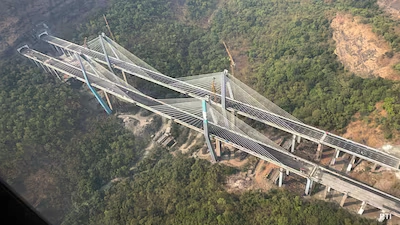
The Mumbai–Pune Expressway, long regarded as India’s first and most heavily used access-controlled highway, has taken a major leap forward with the opening of its long-awaited “Missing Link” upgrade. This 13.3-km bypass section between Khopoli and Kusgaon near Sinhgad Institute shortens the existing ghat stretch by about 6 km and is expected to cut travel time between India’s financial capital and the cultural hub of Maharashtra by roughly 20–30 minutes, officials and engineers say.
For millions who shuttle between the two cities for work, weekend breaks, or logistics, the difference may sound modest. But in the context of an expressway that routinely handles close to 1.2 lakh vehicles during peak periods, those 20–30 minutes translate into fewer jams, fewer accidents, and a noticeable shift in how people plan their lives and businesses across this corridor.
What the “Missing Link” Actually Does
The technical language attached to the Mumbai–Pune Corridor project is dense—tunnels, viaducts, environmental clearances, and toll structures—but the core idea is simple: replace a winding, accident‑prone 19‑km ghat stretch with a straighter, wider, eight‑lane bypass that slices through the Western Ghats on a smoother, safer alignment.
According to the Maharashtra State Road Development Corporation (MSRDC), the Missing Link project shortens the Khopoli–Sinhgad Institute leg from 19 km to 13.3 km, effectively reducing the overall Mumbai–Pune distance by about 6 km. This new alignment includes two long tunnels (roughly 1.75 km and 8.92 km) and two viaducts (about 790 m and 650 m), turning this stretch into one of the most engineered corridors on any Indian expressway.
Engineers explain that the tunnels are designed to bypass steep gradients and landslide‑prone sections that have historically slowed traffic and raised accident rates during the monsoon and winter months. By flattening the profile and narrowing the curves, the route also allows for higher safe speeds—up to 120 kmph on straight segments—without the same level of driver fatigue or risk.
How Much Time Does It Really Save?
Calculating “time saved” on a multi‑lane, mixed‑traffic corridor is never as neat as a stopwatch, but authorities and project‑materials consistently point to a 20–30 minute reduction in typical Mumbai–Pune travel time under normal conditions.
For a driver starting from Mumbai’s western suburbs, the change feels most pronounced just after the Khopoli toll plaza. Instead of climbing the old, serpentine route through Khandala and Kusgaon, vehicles now glide through dedicated tunnels and flyovers, bypassing the densest knots of congestion and the infamous truck‑and‑bus‑heavy traffic that often turns the ghat section into a crawling queue on holidays.
Analysts tracking travel‑time data note that this compression is even more valuable during weekends and festivals, when the Mumbai–Pune run normally balloons by 60–90 minutes. If the Missing Link holds up during peak periods, it could effectively bring weekend travel closer to weekday averages, which raises an interesting question: Might this upgrade quietly turn Pune and its hill‑station suburbs into a closer “second home” belt for Mumbai residents?
Safety, Congestion, and the Khandala Bottleneck
One of the less‑talked‑about but critical drivers behind the Missing Link is safety. The old Khandala–Lonavala ghat segment has long been a hotspot for collisions, especially when heavy vehicles, speeding cars, and wet‑weather conditions combine.
MSRDC and consultants have publicly stated that the existing six‑lane section between Khalapur toll plaza and Khopoli exit already carries traffic volumes meant for a 10‑lane corridor, particularly during peak hours. That structural mismatch has contributed to frequent slowdowns, erratic lane‑changing, and higher accident rates. By widening that 5.86‑km stretch from six to eight lanes and adding controlled‑entry viaducts, the upgrade directly targets this bottleneck.
The new route also reduces the need for rapid braking and sudden acceleration on the old, gradient‑heavy stretches. Engineering studies cited by MSRDC suggest that smoother accelerations and decelerations, combined with better‑designed curves and reduced head‑on‑collision risks, can bring down serious accidents by a measurable margin over time.
Economic and Real‑Estate Ripples
Beyond the time saved for individual drivers, the Missing Link is quietly reshaping the economic geography of the Mumbai–Pune corridor. Analysts in real‑estate and logistics have already begun talking about “Mumbai 3.0” corridors—areas such as Karjat, Neral, and Lonavala that are now positioned to become more attractive residential and second‑home destinations thanks to the tightened travel‑time envelope.
For family‑oriented buyers, a drive that consistently stays under, say, 2 hours (excluding traffic) can transform a weekend hill‑station stay into a practical twice‑a‑month getaway. Weekend congestion may persist, but the capped maximum travel time gives planners and developers something to bank on: predictable commute windows and better‑defined catchment zones.
On the logistics side, shippers and logistics firms see the Missing Link as a potential accelerator for “just‑in‑time” supply chains. The Mumbai–Pune corridor already handles a massive share of industrial and consumer goods moving between the western ports, Mumbai’s industrial belt, and Pune’s manufacturing and IT clusters. With smoother travel and reduced uncertainty in delivery schedules, companies could recalibrate everything from fuel budgets to warehouse planning.
Some logistics operators already estimate that a 20‑minute shrink in transit time can trim fuel use by 8–12% on this stretch, depending on vehicle load and traffic conditions. Over thousands of daily trips, that adds up to noticeable savings and lower carbon emissions—an unintended but welcome environmental side‑effect.
Costs, Environment, and Long‑Term Vision
The Missing Link is not a cheap upgrade. The project, executed under an EPC model and approved at an estimated cost of around ₹4,797 crore (later revised and executed at higher figures depending on materials and scope), reflects the complexity of tunnelling through the Western Ghats and building long viaducts across steep terrain.
Environmental‑impact assessments and forest‑diversion clearances were required for roughly 75 hectares of land, a reminder that every major infrastructure push in India now sits at the intersection of growth and ecological sensitivity. Engineers and planners have argued that the new alignment, despite its footprint, may overall reduce long‑term environmental stress by cutting fuel consumption, idling times, and wear‑and‑tear on vehicles forced to crawl uphill on older roads.
In broader terms, the Missing Link is also a signal of the state’s long‑term intent to keep the Mumbai–Pune corridor competitive. Officials have already floated plans to widen parts of the expressway to 10 lanes by 2030, hinting that the current eight‑lane upgrade is merely an intermediate step in a multi‑decade corridor modernisation programme.
User Experience and Everyday Life
For a typical user, the upgrade changes more than just the clock; it changes planning. A businessman who used to leave Mumbai by 7 a.m. to reach Pune by 9:30 a.m., only to watch that schedule blow out on a rainy Sunday, now has a more predictable envelope. Parents planning a quick visit to relatives or a weekend picnic in Lonavala can look at a 20‑minute reduction in each direction and wonder: “Does this mean we can comfortably do a day‑trip where we used to need a full weekend?”
Tolling arrangements are another subtle but important factor. Early reports indicate that the existing toll structure at Khalapur will continue to apply, and there is no separate “Missing Link toll” for regular passenger cars, which helps keep the benefit primarily in time and convenience rather than in extra charges.
Still, some commuters in Pune and nearby suburbs are asking whether these efficiencies will encourage more vehicles to pour onto the expressway, potentially eroding the time savings over the next few years. After all, India has seen this pattern before: every major corridor upgrade tends to be followed by a surge in traffic, as people who once avoided the route rediscover its value.
Looking Ahead: What This Upgrade Means for Maharashtra
In the larger picture, the Mumbai–Pune Expressway’s Missing Link is more than a road‑patch; it’s a statement about how Maharashtra intends to manage its two largest economic engines. With Mumbai acting as the financial and commercial hub and Pune solidifying its role as a tech, education, and manufacturing centre, the degree of connectivity between them directly affects everything from talent mobility to supply‑chain efficiency.
The successful execution of such a technically complex project—tunnels, viaducts, widened stretches, and environmental safeguards—also boosts confidence in the state’s ability to deliver large‑scale infrastructure without indefinite slippage. If the same model is applied to other congested corridors, from Mumbai–Nashik to Pune–Nagpur, the cumulative effect could be a genuinely metropolitan‑scale network where cities are no longer “linked” by distance but by commute time.
As the dust settles on the Missing Link’s inauguration, one naturally wonders: In five years, will people in Mumbai and Pune remember this upgrade as the moment when their cities truly started to feel like a single, integrated economic region? The answer may lie in whether those 20–30 minutes of saved travel time translate into more homes bought, more cargo moved, and more life decisions made around the idea that, for the first time, the distance between Mumbai and Pune really has shrunk.
Mumbai–Pune Expressway Upgrade Cuts Travel Time by Up to 30 Minutes, Redefining Regional Connectivity