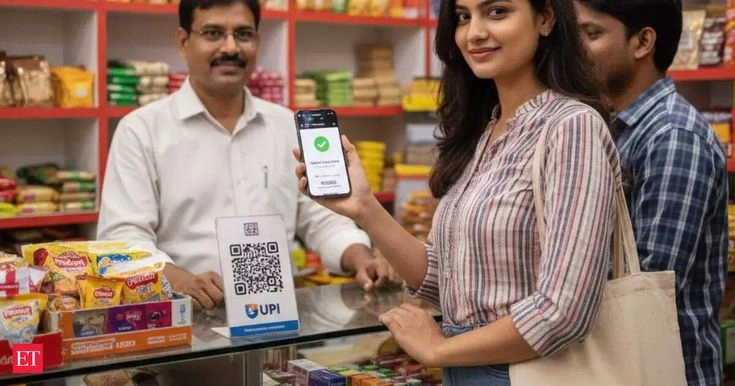
India’s Unified Payments Interface, or UPI, officially closed its fiscal year 2026 with head-turning results. 24,162 crore transactions totaling an unbelievable ₹314 lakh crore. That’s the kind of size that is changing the way the country spends its money everyday.
A year of milestones for UPI
Picture this: UPI was merely a fledgling ten years back, with 2 crore transactions in its first full year. Fast forward to FY26 ending March 2026, and it has risen to approximately 12,000 times that volume. This ain’t some flash in the pan. NPCI data from the National Payments Corporation of India indicates consistent, unrelenting development. Average daily transactions shot up to 66 crore, suggesting millions of people from the busy streets of Mumbai to the far-flung regions are tapping their phones for anything from chai to auto purchases.
What’s different about FY26? March alone saw a record 2,264 crore transactions, valued at ₹29.53 lakh crore. Even at the start of FY27 in April 2026, there were 22.35 billion transactions totaling ₹29.03 lakh crore, showing that the pace is not losing steam. Year-on-year growth? Around 30% in volume, value also increased dramatically, however other sources suggest a little slowdown to 18.5% from FY25’s 30% spike. Clearly, UPI has become the financial heartbeat of India.
What UPI Did to Our Daily Lives
UPI didn’t just expand, it changed habits. It was rolled out by NPCI in 2016 under the RBI and was straightforward. Link your bank account, utilize a virtual payment address and pay quickly. Today, 62% of the volume comes from merchant payments—from street vendors scanning QR codes to huge merchants. with cities such as Pune or Delhi, tiny merchants do not really deal with cash anymore. Country places? That’s where the tale really is.
Think financial inclusivity. Before UPI, millions were unbanked or worried about fees. Now, low-cost (sometimes free) trades entice them in. Cheap data and smartphone growth helped — India has hundreds of millions online presently . With banks, fintechs pouring on, it was dead simple with apps like PhonePe, Google Pay and Paytm. Demonetization in 2016 gave it a kickstart but the continued government push on digital India clinched the deal.
Key FY26 highlights:
Total volume : 24,162 crore transactions
Total value:₹314 lakh crore
Peak month (March 2026): 2,264 crore txns, ₹29.53 lakh crore
66 cr txns daily average
These are not just numbers, these are people moving away from cash for convenience. Ever wondered how a farmer in Maharashtra pays for seeds when there is no bank branch nearby? And UPI makes it possible.
Empowering India’s Digital Economy
UPI’s ascent is hand in hand with the Indian economy. It benefits MSMEs — small shops and startups — by reducing cash handling costs and accelerating payments. Linear regression on NPCI data indicates that time is a strong predictor of volume growth (R²=0.97) with compound annual value growth at about 19.75% recently. Seamless for the consumer, no cards, no PINs most of the time.
UPI is world-leading. We have systems like Pix in Brazil or FPS in Singapore but none at the magnitude of India — 20bn+ monthly txns, 84% of digital retail payments. Calendar 2025 witnessed around 22,000 crore transactions, averaging 60 crore a day. NPCI’s income surplus grew 41.7% YoY at ₹1,552 crore in FY25, a reflection of a strong ecosystem. Pune is a digital hotspot, and UPI is powering everything from freelance employment and food deliveries to stock trades on applications.
But there are problems. Volume goes up, so do fraud efforts, but NPCI and RBI increase security. Interoperability keeps it strong — works with 300+ banks. That means less black money, better tracking of taxes and a real drive for cashless payments, not just discussion of policy, for India.
International Presence and Competition
UPI is not sitting at home. It’s growing internationally — UAE, Singapore and pilots in other places. It handled around $3.4 trillion equivalent in 2025. Cards or wallets abroad, with UPI’s real time, low charge model, wins over. Projections? PwC projects 100 crore daily txns, 90% of retail digital share by FY27.
But growth stalls after peaks, such as April’s small pause for fewer days. Still, increasing 27% YoY, 20.39 billion txns in Feb 2026; TechCircle cites a 12,000-fold increase over a decade. World’s largest real-time system UPI celebrates 10 years
Promoting Small Businesses and Inclusion
Small merchants are fond of UPI. No need for pricey POS devices – just a QR code” Post-‘UPI’, rises in internet transactions: MSME data Women entrepreneurs in rural India are using it to sell from their homes. Leapfrogging financial inclusion. Marginalized groups in formal finance.
Urban-rural mix? 2,163 crore transactions peaked in December 2025. The average daily value crossed ₹95,865 crore in Feb 2026. It’s empowering: A street food seller in Pune pays out the day’s proceeds immediately, without the risk of currency.
Ask yourself: India went from cash-heavy to digital leader – How? UPI simplified. Jio data revolution.
The Road Forward
FY26 lays the groundwork for more. NPCI plans to collaborate globally and add additional features including credit to UPI. It has estimated a growth of USD 87.55 billion by 2030, at a CAGR of 46%. But maintaining? Needs rural infra, cyber protection.
India’s digital payments are not slowing down. “UPI has shown that tech built at home can expand exponentially bringing 1.4 billion people into a connected economy. Value from 0.07 lakh crore in FY17 to ₹314 lakh crore currently – over 4,000 times. What’s next? Maybe UPI in every wallet around the globe. Now it is India’s silent revolution, one scan at a time.
(1456 words)
India’s digital payment revolution gains momentum with UPI transactions soaring to 24,162 crore in FY26