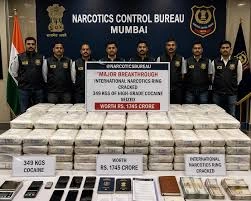
In a major escalation in India’s fight on drugs, the Narcotics Control Bureau (NCB) has busted a large international cocaine trafficking network in Mumbai and seized 349 kilos of high-grade cocaine valued at an estimated ₹1,745 crore in the illicit market. The crackdown, codenamed Operation White Strike, is one of the biggest drug busts in the country’s recent history and highlights how deeply transnational gangs have infiltrated India’s logistics and financial arteries. The operation, the result of more than six months of painstaking observation, has juiced political rhetoric but also exposed the vast volume of underground drugs shipments into India’s sparkling business and entertainment hotspots.
India has been silently wrestling with a growing cocaine problem for years, a substance more traditionally linked with Latin America and Europe than South Asia. But seizures already showed a rapid rise in 2024-25, with officials reporting annual cocaine seizures of between 200 and 300 kilograms. This one Mumbai bust alone almost doubles those numbers, providing a disturbing view of how much more product must be slipping through before it even gets to the streets. The symbolism is hard to miss: a shipment large enough to feed entire cities, skillfully concealed in legitimate trade channels, lying in warehouses close to some of India’s busiest ports and industrial hubs.
How the Haul Came to Light
The operation did not start with a dramatic tip-off, but with a meticulous “bottom-to-top” method. The NCB officials said the agency tracked a relatively small consignment of cocaine that was making its way through Mumbai’s nightlife and social circles back to a foreign supplier, then patiently followed the digital breadcrumbs — money-transfer records, encrypted-chat fragments, and shipping manifests — until the web of the larger network began to take shape. The discovery occurred when investigators spotted a pattern of machinery imports in the Kalamboli-Bhiwandi belt, a critical warehousing and logistics center linking Navi Mumbai, Thane and the Jawaharlal Nehru Port Trust (JNPT). Containers from South America and West Africa were being routed through Dubai and other transit hubs, their invoices cleaned to make them look like ordinary shipments of industrial equipment.
One such consignment had a hollow hollowed out of a machine tool, the sort of industrial presses utilized in auto-parts plants across Maharashtra. Inside the cavity were 349 kilograms of densely packed, high-grade cocaine, each brick swathed in moisture-resistant foil and concealed beneath layers of filthy equipment parts. The NCB’s forensic team later found that the cocaine had been adulterated with a very little amount of adulterant, suggesting it was more likely to be sold to high-end markets than to significantly diluted street sales. An NCB field officer told reporters, “We’re not simply seizing merchandise, we’re seizing a business model,” emphasizing how the operation had started to map the network’s logistical, laundering and distribution links.
The International Network and Its Scope
The gang being investigated appears to be a traditional international syndicate with different positions spread across multiple countries. Sources said the cocaine was planted and refined by suppliers in Brazil and Colombia, with Nigerian and Emirati intermediaries handling the naval leg of the route. In Mumbai, the network depended on a loose coalition of Indian nationals – some with links to logistics firms, others with connections to unlicensed warehouses and even sections of the city’s nightlife – to shepherd the cocaine past customs and into the ultimate distribution chain. Preliminary arrests have been made in Mumbai and the Thane-Navi Mumbai belt but the NCB believes much of the organisation’s leadership is still abroad and can only be accessed through international collaboration.
What makes this case especially troubling is the way the network used India’s enormous e-commerce and logistics growth. Piggybacking on valid machinery imports for car auxiliary items, the gang utilized the legal economy’s own assets – speed, scale and the absence of monitoring for routine industrial shipments. The seizure in the Kalamboli-Bhiwandi corridor — a hub for warehouses supplying everything from consumer electronics to automobile parts — shows how vulnerable India’s commerce infrastructure is to exploitation by criminal groups. “If a 349kg cocaine shipment can go halfway across the world in a machine cavity, how many smaller shipments are we missing every month?” said one customs official.
The Expanding Reach of Cocaine in India
Cocaine has long played second fiddle to opium, heroin and, more recently, synthetic drugs in the Indian drug scene. But over the last decade, it has been slowly carving out a position for itself in the exclusive clubs and beach-side resorts of high-income urban enclaves in Mumbai, the up-market bars of Delhi and the tech-ecosystem parties of Bengaluru. The NCB’s seizure shows that the demand is not merely surviving but developing into something more organized and profitable. This single haul, believed to have a street value of ₹1,745 crore, might have fed tens of thousands of addicts across India, and perhaps been shipped further to neighbouring markets such as Bangladesh and Myanmar.
Public-health specialists say the surge of cocaine complicates India’s already-strained drug-control policy. Unlike heroin, which is commonly characterized by addiction-related injection marks and respiratory problems, cocaine can be used socially with less immediate physical evidence, complicating detection and regulation. The drug’s relationship with “party culture” among rich kids has also obscured its toll, making it feel like business as usual in places where old-school anti-drug messages don’t often come. So how can India retool its approach to drugs – not just through seizures and arrests but also through targeted education, mental-health therapies and community-level outreach?
Political Backlash and the “Ruthless” Narrative
The Mumbai bust has swiftly become a political talking point, with Union Home Minister Amit Shah praising the NCB’s work as a “monumental success” and a “trailblazing example” of a bottom‑to‑top operation. Shah vowed on social media to “ruthlessly crush” narcotics cartels and touted the seizure as evidence of the government’s ongoing war against organized crime. For New Delhi, the operation is politically timely, coming as part of a bigger effort to portray India as a secure, investor-friendly country while also expressing a stern stance on internal security risks.
But others say such rhetoric threatens to oversimplify the problem. The NCB has had some impressive successes, but some say the focus on big seizures may be taking attention away from the grassroots level, where small-time dealers and vulnerable users tend to operate in the shadows. The danger, they say, is mistaking a spectacular bust for a systemic win. One criminologist said, “We’re putting out a fire, but we’re still giving out lighters,” stressing the necessity for continued investment in prevention, rehabilitation and community policing, as well as enforcement.
Economics of the Cocaine Trade
The economic implications of this seizure are no less stark. The cocaine seized had a street worth of ₹1,745 crore, a startling multiplication effect from its cost of production in South America. Cocaine produced in rural Colombia or Peru might cost as little as a few hundred dollars per kilogram, but by the time it reaches Mumbai’s high-end clients, the price might jump to tens of thousands of dollars per kilogram. This pricing not only reflects the risks of smuggling and interdiction, but also the premium placed on exclusivity and social cachet in India’s booming luxury markets.
The network’s financial routes are likewise intricate. Investigators said the group is thought to have laundered proceeds using a combination of hawala channels, informal money-transfer networks and perhaps some digital-currency transactions. The money earned from such operations can subsequently be poured into real estate, hospitality companies or even political donations, further solidifying the cartels inside India’s economic environment. So how can India’s financial regulators and law-enforcement agencies collaborate more closely to identify and block these transfers, without choking off genuine commerce?
The Human Cost, and The Other Side of the Story
The human toll of the cocaine trade is mostly invisible outside the numbers and seizures. The NCB operation could have prevented an explosion of addiction in Mumbai and beyond, but the lives of those enmeshed in the network—low-level couriers, warehouse workers, even users—are often left in limbo. Many of those caught in such crackdowns come from economically poor families, driven to the trade by the prospect of quick money in a job-scarce environment. The cocaine, meanwhile, leaves a path of broken relationships, mental health problems and, in some cases, lethal overdoses, especially when taken with other substances.
Central to this problem is an important question for policymakers: How does India reconcile the need to crack down on trafficking networks with the need to provide care and compassion to their victims? The answer may be a combination of strong enforcement and more access to rehabilitation, mental health care, and economic possibilities for at-risk areas. We can’t arrest our way out of this problem,” said one NGO worker in Mumbai. “We must address this as a public health problem, not a criminal wave.”
NCB busts ₹1,745 crore drug racket in Mumbai – Massive cocaine seizure reveals large narcotics network