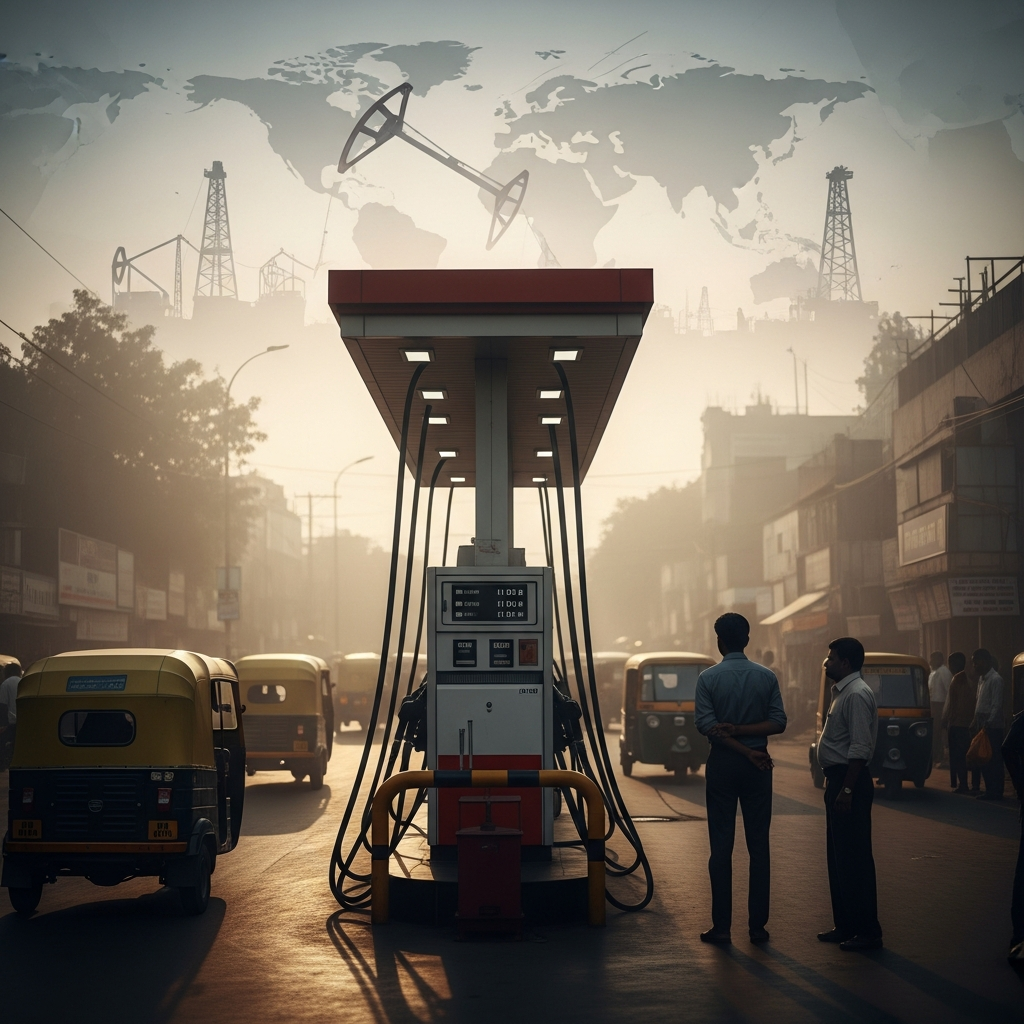
Walk into any petrol station in Delhi or Mumbai today, and the pump meter will read exactly what it did yesterday. Petrol at ₹94.77 per litre in the capital. Diesel unchanged. The LPG cylinder sitting in your kitchen still costs what it did last month. For the average Indian household, it feels like business as usual.
But beneath that calm surface, the world’s energy markets are anything but quiet.
Fuel prices in India have remained one of the most closely watched — and surprisingly stable — policy outcomes in recent months, even as global oil markets reel from some of the most intense geopolitical turbulence in years. What’s holding the line? And how long can it hold?
A World on Edge — But India Holds Firm
The trigger for the current global energy crisis traces back to West Asia, where military escalation involving the United States, Israel, and Iran has sent shockwaves through international supply chains. Iran’s Revolutionary Guard Corps declared the Strait of Hormuz — the narrow waterway through which nearly 20% of the world’s oil supply passes — a conflict zone. Several tankers have been attacked, insurers have withdrawn coverage, and global shipping costs have surged by roughly 30%.
The result? Crude oil has crossed $107 per barrel as of early May 2026, having earlier touched multi-year highs above $120. For a country like India, which imports the vast majority of its crude oil, this is the kind of global shock that historically sends fuel prices spiralling.
And yet, at the pump? Silence.
India’s government balancing act
It is not by chance that the Indian government decided not to change the prices of petrol and diesel – it is a deliberate, and politically significant, policy choice. Retail fuel prices have been more or less frozen since April 2022, a period of nearly four years during which global oil markets have seen several cycles of volatility.
This stability comes from a mechanism that transfers the burden of global price swings to state-run oil marketing companies — Indian Oil Corporation, Bharat Petroleum (BPCL) and Hindustan Petroleum (HPCL). These companies absorb losses when global oil prices are high and recover margins when they fall. Right now, with crude well above $100, they are absorbing — heavily. Industry estimates suggest these firms are collectively losing thousands of crores daily as they sell at controlled prices.
Government sources have indicated that India currently holds around 25 days’ worth of crude oil and refined fuel stocks, which provides a buffer. Officials are also actively diversifying import sources, reducing dependence on Hormuz-route shipments by sourcing more from non-affected regions.
For now, the math works. But it is a delicate equation.
LPG: A Tale of Two Cylinders
The picture is slightly more nuanced when it comes to LPG rates. The government has so far protected domestic household LPG cylinder prices, keeping them stable for most consumers. That’s the good news for the millions of Indian families who cook on gas every day.
The commercial side, however, tells a different story. The price of a 19-kg commercial LPG cylinder has been revised upward sharply — by around ₹993 in the latest round of revisions. In Delhi, that cylinder now costs ₹3,071.50, up from ₹2,078.50. In Mumbai, it has crossed ₹3,024. This marks the third such commercial hike since February, when geopolitical tensions first began intensifying.
The ripple effects are already being felt. Restaurants, dhabas, catering services, and small food businesses — which depend almost entirely on commercial LPG — are facing a serious cost squeeze. For the hospitality sector, already navigating post-pandemic recovery, these increases are far from trivial. What gets protected at the household level often reappears quietly in the price of your next meal out.
The Inflation Equation
Here is the uncomfortable truth that economists keep returning to: fuel and inflation are inseparable in India. Diesel, in particular, is the lifeblood of the country’s logistics network. Trucks, buses, freight carriers — virtually the entire supply chain of food, goods, and raw materials runs on diesel. When diesel prices move, so does nearly everything else.
This is precisely why the government has been so reluctant to pass on global price increases to retail consumers. A diesel price hike doesn’t just affect the person filling up a car — it feeds through to vegetable prices, courier charges, construction costs, and consumer goods on supermarket shelves. In a country managing inflationary pressures alongside a slowing global economy, the government policy of absorbing the shock at the oil company level — rather than passing it to consumers — is a conscious inflation management strategy.
The Reserve Bank of India, which monitors fuel price movements closely when setting monetary policy, has also kept a watchful eye. Any significant retail fuel price hike could complicate the RBI’s inflation trajectory calculations considerably.
How Long Can This Last?
Experts are increasingly candid: the current stability is not indefinite. Several analysts have flagged the possibility of a retail petrol and diesel price revision of anywhere between ₹5 to ₹28 per litre, depending on how long the geopolitical crisis persists and how much further oil prices climb.
The key variables are the Strait of Hormuz situation, the trajectory of the US-Iran conflict, and India’s ability to continue sourcing crude from alternative suppliers at manageable rates. If the crisis deepens or alternative supply routes face their own disruptions, the government may have no choice but to allow some price correction at the pump.
Aviation turbine fuel, commercial diesel, and industrial LPG have already been revised to reflect market realities. Retail fuel is the last major price point still being held.
What It Means for You
For now, the ordinary Indian consumer remains insulated. Filling up your vehicle costs the same it did last year. Your gas cylinder at home hasn’t changed price. But the global pressures are real, and the buffers are finite.
Watch the news from West Asia. Watch crude oil benchmarks. And perhaps, for the first time in years, watch the petrol pump price board just a little more carefully than usual.
The calm is genuine — but it is also managed. And managed calm, by its very nature, requires effort to maintain.
Fuel Price Stability in India: A Calm Surface Over Turbulent Waters.