There is something quietly extraordinary about the Andaman Islands on any given day. The water is the kind of blue that makes you stop mid-sentence. The coral reefs hold a universe that most people never get to see. The air smells of salt and stillness. For decades, those who knew about these islands guarded that knowledge like a private treasure.
This week, the secret is very much out.
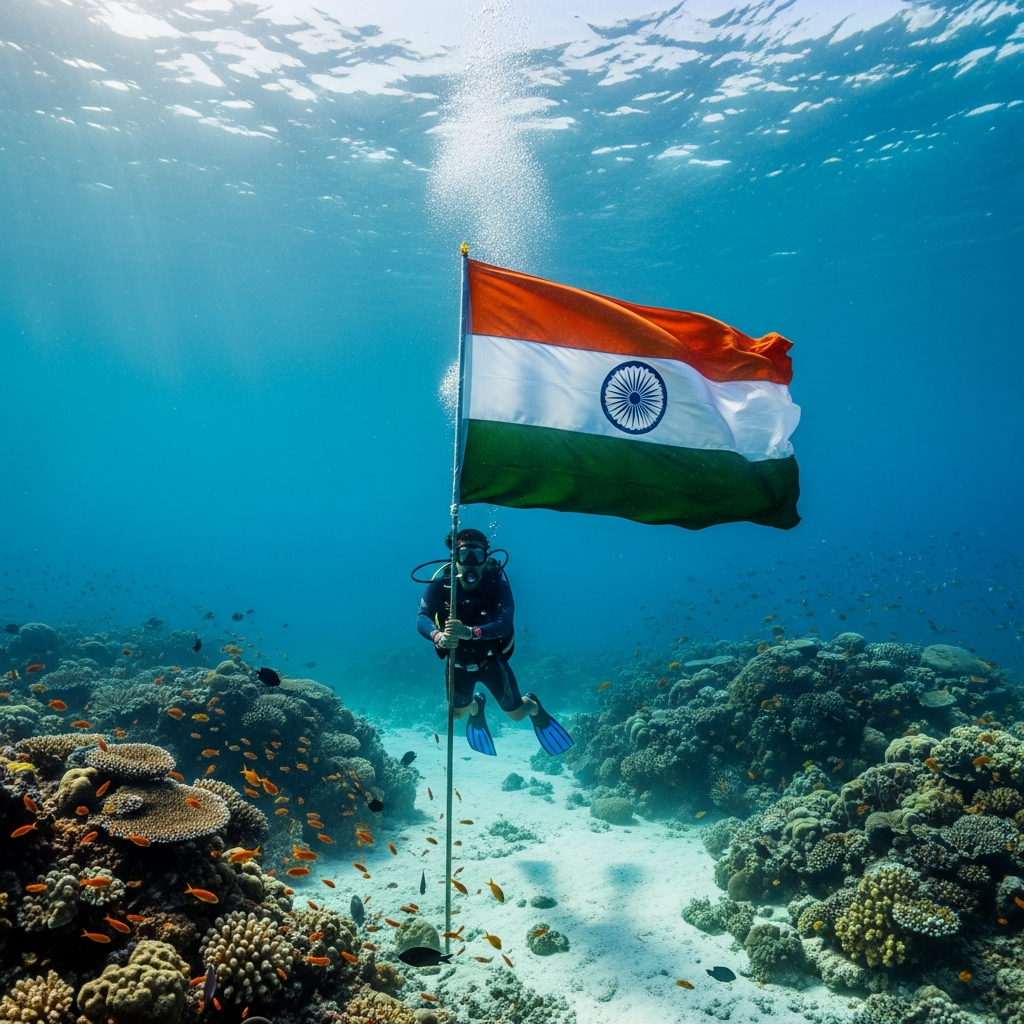
The Andaman and Nicobar Islands have become the stage for one of the most visually spectacular — and symbolically powerful — events in Indian adventure tourism history. On May 2 and 3, 2026, the Union Territory administration attempted two prestigious Guinness World Records beneath the waves of Swaraj Dweep, in an initiative that blends patriotism, marine conservation, and a clear-eyed ambition to put Andaman tourism firmly on the global map.
The Records: Ambition on a Grand Scale
The first attempt, held on May 2 at the iconic Radhanagar Beach, was for the Largest National Flag Unfurled Underwater. This wasn’t a symbolic gesture with a small flag and a few divers — this was a full 60-metre by 40-metre Indian Tricolour, covering a total area of 2,400 square metres, deployed beneath the sea. To give you a sense of the scale: that’s roughly the footprint of eight standard badminton courts, submerged and unfurled in open water. The logistics alone were incredible, planning the exact timing of trained divers, support staff, underwater camera crews and safety divers in open ocean conditions.
The second record attempt, on May 3 near the Lighthouse at Swaraj Dweep Jetty, aimed for the Tallest Human Stack Underwater — a formation of divers stacked vertically to a minimum height of 20 metres beneath the surface. This isn’t a feat you rehearse casually. Perfect buoyancy, coordinated placement of bodies, incredible breath control and the kind of teamwork that only comes from serious training are needed to make a human stack of 20 metres under the waves.
Presiding over both events was Lieutenant Governor Admiral D.K. Joshi, who didn’t just attend in an official capacity — he participated in the water himself. That detail alone says something meaningful about the seriousness and spirit driving this initiative.
More Than a Record: A Statement About India Travel
It would be easy to see these events purely as a publicity stunt — two dramatic moments engineered for viral footage and newspaper front pages. But there is a deeper logic at work here, and it deserves to be taken seriously.
India travel narratives have long been dominated by the golden triangle, the backwaters of Kerala, the ghats of Varanasi. These are magnificent destinations, but they represent only one dimension of what India offers. The Andaman and Nicobar Islands — with their crystalline waters, thriving coral ecosystems, and world-class dive sites — have long existed in the shadow of more famous destinations despite having everything a serious adventure traveller could want.
By associating the islands with globally recognised Guinness World Records, the administration is making a calculated bet: that international visibility will translate into international footfall. The goal, explicitly stated, is to position Andaman as a world-class hub for scuba diving and marine tourism, competing directly with established diving destinations in Southeast Asia and the Caribbean. That’s not a modest ambition. It’s exactly the kind of thinking these islands need.
Eco-Tourism at the Heart of It All
What gives this initiative real weight — beyond the spectacle — is its commitment to eco-tourism and marine environmental awareness. The waters of the Andaman and Nicobar Islands are home to some of the most biodiverse coral reef systems in all of Asia. Hawksbill turtles glide through these reefs. Dugongs are still spotted here. The seagrass meadows and mangrove forests form ecological buffers that protect both marine and terrestrial life.
Bringing global attention to this ecosystem is a double-edged responsibility. Done carelessly, increased tourist numbers can damage the very environment that makes a destination worth visiting. But the Andaman administration has been deliberate about framing this not as mass tourism promotion, but as sustainable and responsible tourism. New safety protocols have been developed. Local dive guides are being trained to international certification standards. The goal isn’t to flood the islands with visitors — it’s to attract the right kind of visitor, one who comes with curiosity and leaves with a commitment to protection.
The environment is not the backdrop to these events. It is the subject. When a 2,400-square-metre flag unfurls beneath those waters, the message isn’t just about national pride — it is an invitation to look down, to pay attention, to understand what is at stake if we stop caring for our seas.
What It Means for the Islands
The economic ripple effects of initiatives like this tend to be underestimated until they’re already happening. Hotels, local restaurants, water sports operators, boat captains, dive schools — the entire ecosystem of Andaman tourism stands to benefit from even a modest increase in international visibility.
More meaningfully, the islands’ youth are being drawn into certified diving and maritime careers, building a generation of local professionals rather than depending on outsiders to manage their own natural wealth. The cultural exchange that comes with a more cosmopolitan tourism presence — travellers from across India and around the world engaging with local crafts, food, and traditions — is quietly valuable in ways that don’t show up in footfall statistics.
And when the Lieutenant Governor joins divers beneath the water to attempt a world record, there is a message sent to every young person on these islands: your home is worth celebrating, worth protecting, worth showing the world.
A Blue Frontier
The Andaman and Nicobar Islands have always been exceptional. What’s changing now is the world’s awareness of that fact.
Whether or not the Guinness records are officially confirmed, the images of a massive Tricolour floating beneath the Andaman Sea — with trained Indian divers holding the frame — are images that travel. They invite questions. They spark curiosity. They make people search for flight tickets.
Where the Tricolour Meets the Tides: Andaman’s Underwater Record Bid That’s Bigger Than Any Trophy.