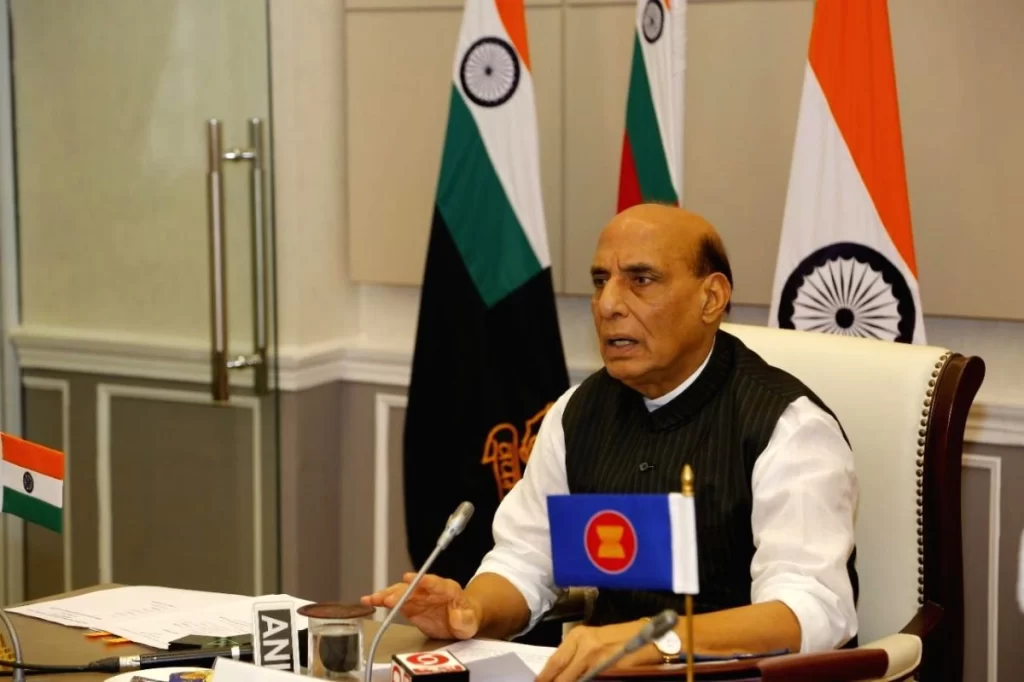
India’s Defence Minister Rajnath Singh did not mince words during the recent SCO Defence Ministers’ Meeting in Bishkek, Kyrgyzstan. In an address on April 28, 2026, he reiterated India’s zero tolerance approach on terrorism, saying Operation Sindoor proved that terror hubs had no place to hide.
The Bishkek Gathering: Key Players in the SCO Come Together
The heads of the 10 member states of the Shanghai Cooperation Organisation (SCO), namely China, Russia, India, Pakistan, Kazakhstan, Kyrgyzstan, Tajikistan, Uzbekistan, Iran and Belarus attended the SCO Defence Ministers Meeting. The event was hosted by Kyrgyzstan in the Ala-Archa State Residence. Heads of defence agencies, the SCO Secretary-General and the head of the Regional Anti-Terrorist Structure were in attendance.
The talks discussed regional security issues like terrorism, extremism, separatism, transnational crime and even cyber dangers. Ministers discussed how to increase confidence through joint military exercises, exchanging experiences and improving cooperation channels. It’s a huge occasion – 2026 marks the SCO’s 25th anniversary and with global tensions on the rise, the group’s position feels more important than ever.
Rajnath Singh, India’s voice, was a mix of hardline rhetoric on terror and a call for peace. His words were not just rhetoric, they were connected to genuine events that were rocking the region.
India’s Stern Response: Reverberations Of Operation Sindoor
Last year, remember the attack at Pahalgam? On April 22, 2025, the Pakistan-based Resistance Front, affiliated to Lashkar-e-Taiba, massacred 26 tourists in Jammu and Kashmir targeting them by religion. Pakistan’s denial made India act. Operation Sindoor, which took place on May 7-8, 2025, hit terror camps on the other side of the border, making it clear that these sanctuaries are not safe.
Singh put this at the forefront in Bishkek. Operation Sindoor proved India’s resolute determination that the epicentres of terrorism are no longer immune to legitimate retribution, he said. He warned of state-sponsored cross-border attacks and that there was no tolerance for double standards. Why is this relevant now? Recent anniversaries like Pahalgam keep the wounds fresh with attacks like these and SCO nations realize that ignoring them risks escalation.
Singh’s remark to Operation Sindoor has some notable points:
TRF etc terror groups must be held accountable, no excuses.
Safe havens are dismantled whether or not they are politically motivated.
India’s move is a precedence for collective action.
This was not mere bravado. This was tied to SCO’s basic struggle against the ‘evils’ of terrorism, separatism and extremism, Singh said.
Zero Tolerance: No Exceptions, No Safe Havens
Singh’s bottom line? Terrorism has no passport, no religion – Nations must stand united. He stressed the necessity to eradicate hideouts and to oppose any “political exceptions” protecting offenders. Support was provided for the SCO’s Regional Anti-Terrorist Structure, in particular the joint statement by India’s chair on combatting radicalisation.
He cited last year’s Tianjin Declaration as a sign of unity, but said consistency is the ultimate test. “Consistency is the ultimate test of collective credibility,” Singh said. In this drive for no double standards, there was much finger-pointing at cross-border support – often directed at Pakistan – and that hit home.
It’s personal for India. Decades of violence by groups supported from abroad have taken lives and frayed relations. But Singh said it more generally: Can the SCO convert security challenges into building bricks for peace? If members respond decisively, his statements suggest yes.
India’s Vision: Philosophy and Cooperation for Peace
Singh also portrayed the SCO as a force for stability beyond the harsh line on terror. He called for equality, respect and trust among members invoking Vasudhaiva Kutumbakam, the world is one family. India commits to fully supporting SCO objectives, ranging from joint exercises to discussion.
He questioned the international order: Do we need a new one, or a more orderly world where dignity trumps disputes? He echoed Gandhi in saying that power must be used to defend the weak, not crush them – an eye for an eye blinds everyone. In a world of upheaval, strife and inward turns, Singh wants compassion, not competitiveness.
This is related to defence co-operation. The meet authorized plans for military ties for 2026-2027, based on expert groups in Bishkek. India feels the SCO is building ties amongst armed forces for a collective response to common threats.
Regional Stakes: SCO and What It Means for India and Beyond
SCO provides for India a platform to confront terror and, at the same time, balance its connections with rivals like Pakistan and China. Border tensions, proxy battles make each meeting important. With Iran’s addition and Belarus’s fresh entry, the SCO covers Eurasia, influencing global energy, trade and security.
Picture this: In a world of cyber dangers and extremism crossing boundaries is regional unity better than individual efforts? Recent SCO talks suggest yes, with an emphasis on practical initiatives such as drills. India’s bid is in line with its rising weapons exports and technology sharing that bolster its influence.
India’s neighbourhood is also getting hot. Drugs and weaponry travel freely, Kashmir attacks reverberate into Central Asia’s instability. Singh’s appeal for no abettors or shelters is to close such gaps.
Reactions and Ripples: A Loud Message Heard
The speech went down well. Singh’s “sharp warning”, particularly on terror epicentres, was picked up by the media. SCO supports counter-terror unity, condemns strikes like Pahalgam Subsequently, bilateral talks were held with counterparts and meetings with the Indian community in Bishkek.
India’s no-tolerance barbs were not subtle. Pakistan’s presence made it sharper. But the emphasis remained communal, with all ministers underlining the need to create trust. More coordinated efforts, such anti-terror exercises, are expected as 2026 unfolds.
Looking Ahead: The Path to Stability for SCO
Rajnath Singh left Bishkek with a clear agenda: crush terror with no mercy, establish confidence through action and give priority to peace. India’s pledge is bright – Operation Sindoor is commitment, philosophy is collaboration.
There are challenges ahead, from geopolitical rifts to rising dangers. But if the SCO lives up to its role, it might stabilize a fragile area. Will members match words with action? India is betting on it. It is working toward a world where discourse wins over devastation. “Let’s make this a period of prosperity, not war,” Singh said.
The Bishkek meeting was not all chatter. It reasserted SCO’s muscle on terrorism while creating avenues for defence relationships that matter. This unity is a lifeline for countries like India which face attacks daily. And the stakes could hardly be higher with the world watching.
Rajnath Singh at SCO Meet Takes Firm Stance Against Terrorism, Calls for Global Defence Unity