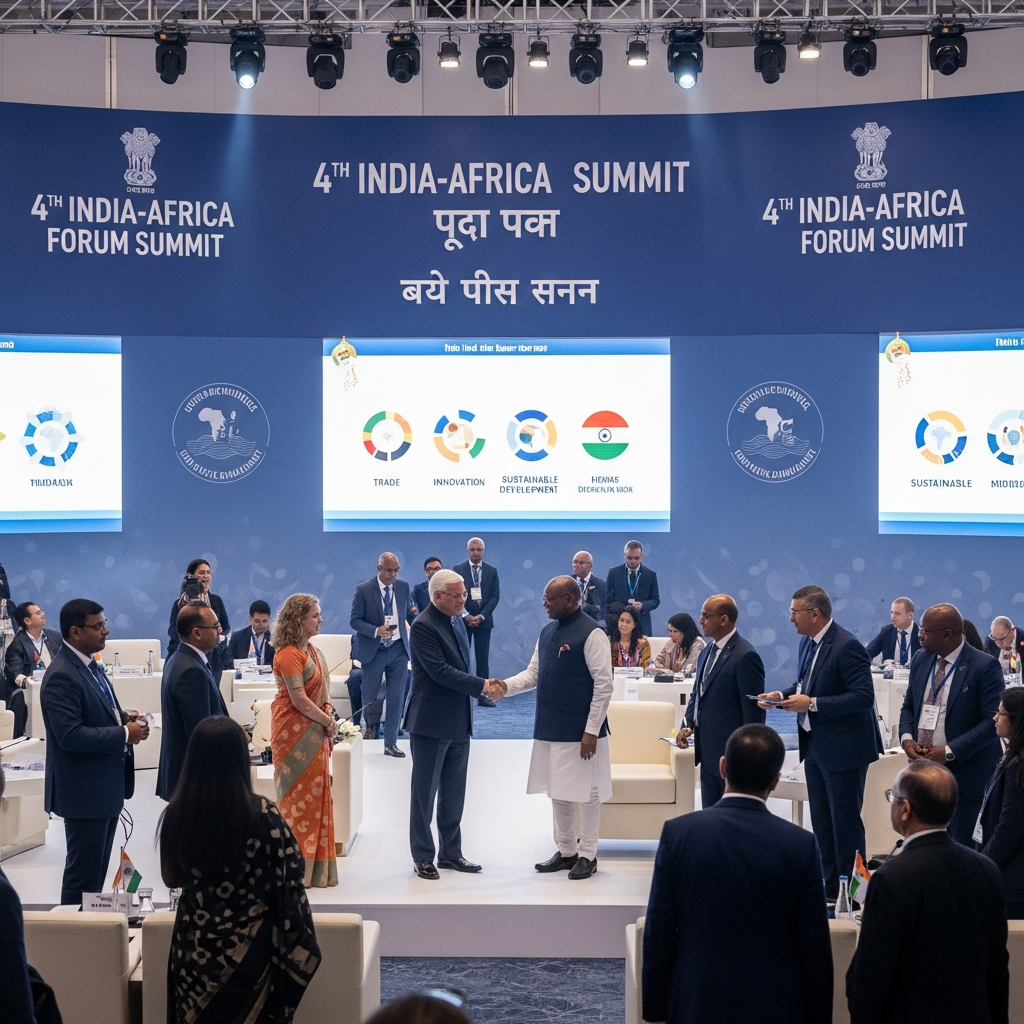
After ten years of waiting, New Delhi is ready to bring African leaders back to the table. The 4th India-Africa Forum Summit isn’t just a diplomatic event — it’s a statement of intent.
When the third India-Africa Forum Summit took place in New Delhi back in 2015, it was hailed as a turning point. More than 40 African heads of state gathered on Indian soil, pledging cooperation, trade, and a new kind of partnership between two of the world’s most dynamic regions. Then, for a decade, the follow-through remained patchy, the momentum uncertain. Now, with the 4th India-Africa Forum Summit set for May 2026, India is signalling loudly that it means business — and this time, it wants the world to notice.
4th
India-Africa Forum Summit
10
Years since the last summit
54
African nations invited
More than a photo opportunity
Summits of this kind can easily become ceremonial affairs — handshakes, joint declarations, press conferences, and then very little action. But the 2026 summit carries a different weight. India has spent the past few years actively reshaping its global posture. From its successful G20 presidency in 2023 to its growing role in multilateral institutions, New Delhi has made it clear that it no longer wants to play a supporting role in world affairs. The India-Africa summit is part of that larger ambition.
The agenda is ambitious and, notably, practical. Leaders from both regions are expected to finalise long-term frameworks covering infrastructure development, clean energy, digital technology, and food security. These aren’t vague aspirations — they are areas where both sides have complementary strengths and genuine urgency. Africa needs infrastructure. India has builders. Africa is developing digital economies at an extraordinary pace. India has one of the world’s most mature tech ecosystems. The match, at least on paper, is compelling.
“India is no longer content to watch from the sidelines. The Africa summit is part of a deliberate, decade-defining push to expand influence across the Global South.”
Why Africa, and why now?
The honest answer is that India recognises what the rest of the world has been scrambling to acknowledge: Africa is the next great frontier of global growth. With a population projected to reach 2.5 billion by 2050 and a median age well under 25, the continent represents an unmatched combination of human capital, natural resources, and consumer market potential. China understood this early and invested heavily — roads, ports, railways, loans, and soft power — over the past two decades. The West has been playing catch-up. And India, despite cultural and historical ties that run far deeper than most outsiders appreciate, has often been a hesitant suitor.
That hesitation now appears to be over. The India-Africa diplomatic push comes at a strategic moment — one where many African governments are actively diversifying their partnerships, wary of over-dependence on any single major power. India, with its democratic credentials, diaspora networks across East Africa and beyond, and a reputation for technology transfer rather than pure extraction, has a genuine value proposition to offer. The summit is an opportunity to convert that goodwill into lasting trade partnerships and investment commitments that benefit both sides.
Technology and innovation at the centre
One of the most significant themes expected to emerge from the summit is cooperation in technology and digital infrastructure. India’s own digital transformation — from the Unified Payments Interface (UPI) that now handles billions of transactions monthly, to Aadhaar’s biometric identity system, to the rapid expansion of broadband — has created a body of practical knowledge that is directly applicable to African contexts. Several African nations have already expressed interest in adopting India’s digital public infrastructure models, and the summit is expected to formalise several pilot programmes in this space.
Innovation in agriculture and pharmaceuticals is also on the agenda. India is one of the world’s largest producers of generic medicines, and African nations have long relied on Indian pharmaceutical exports for affordable healthcare. A fresh wave of investment in Africa in this sector — especially in partnerships for local manufacturing — could dramatically improve healthcare resilience across the continent. India’s agricultural know-how, developed through decades of managing food security for a population of 1.4 billion, also has direct lessons for African nations facing climate-related disruptions to farming.
Infrastructure and sustainable development
Infrastructure will be the headline act. India’s global strategy in recent years has leaned heavily on positioning itself as an alternative to Chinese-style debt-driven development. The summit is expected to introduce new financing mechanisms — potentially through India’s development finance institutions — that emphasise softer loan terms, greater local employment, and technology transfer. Whether these commitments translate into bricks-and-mortar results will determine how the partnership is judged in the years ahead.
Sustainable development is also woven into the summit’s framing. India has been a leader of the International Solar Alliance and has positioned itself as a leader of the global energy transition. Africa, with its vast solar potential and growing energy deficit, is a natural partner in this mission. Joint projects in renewable energy could be among the most tangible and visible outcomes of the summit – the sort of cooperation that ordinary people in both regions can see and benefit from directly.
A relationship built to last — if the work follows
The India-Africa relationship has always had genuine warmth at its core. India’s independence movement inspired anti-colonial struggles across Africa. Mahatma Gandhi’s own political consciousness was forged on South African soil. The Indian diaspora, spread across Kenya, Tanzania, Uganda, South Africa, and beyond, forms a living bridge between the two regions. These are not the kinds of ties that can be manufactured by a diplomatic summit — they are pre-existing foundations that the summit can build upon.
What the relationship has often lacked is consistent follow-through at the institutional level. Pledges made at previous summits have sometimes gone unfulfilled, and Africa investment targets have been missed. The 2026 summit will be judged not just by the ambition of its declarations but by the implementation architecture it puts in place — the monitoring mechanisms, the joint working groups, the timelines, and the accountability frameworks that turn announcements into action.
For now, the fact that the summit is happening at all, after a decade’s gap, is itself significant. It tells African leaders that India is serious, and it tells the world that New Delhi sees the continent not as a charity case or a resource mine, but as a partner of the future. Whether that vision is realised will depend on the months and years that follow. But as an opening statement of intent, hosting the 4th India-Africa Forum Summit is exactly the kind of bold diplomatic move that India has been learning to make.
India to Host Major Africa Summit After a Decade — What This Means for the Future.