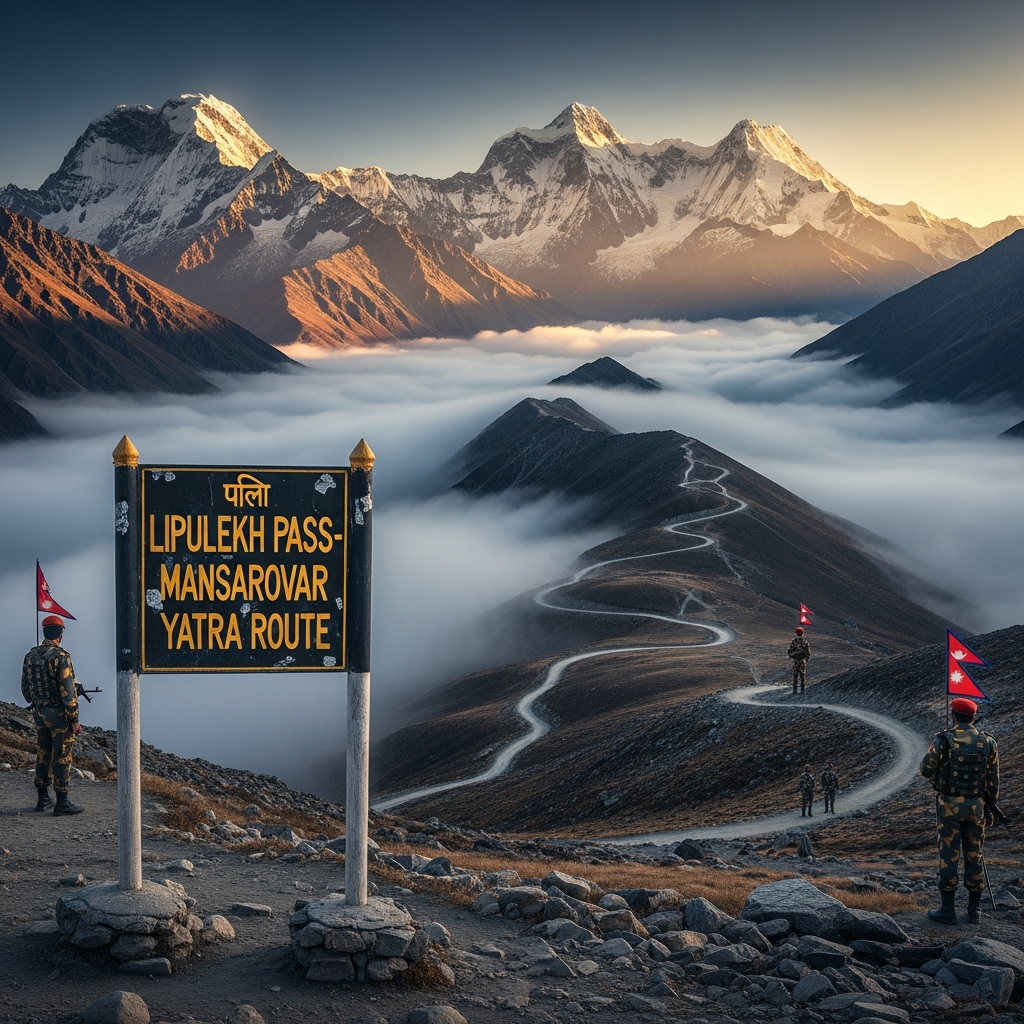
A pilgrimage route to one of Hinduism’s holiest sites has reignited a territorial dispute that neither India nor Nepal has fully resolved. The Lipulekh row is about far more than which road pilgrims walk.
Few journeys carry as much spiritual weight as the Mansarovar Yatra — the annual pilgrimage to Lake Mansarovar and Mount Kailash in Tibet, sacred to Hindus, Buddhists, Jains, and followers of the Bon tradition alike. For centuries, devotees have endured punishing altitudes and unpredictable mountain weather to complete this trek. The route they take has always mattered — but rarely has it mattered quite as much politically as it does today. Nepal’s latest objection to India’s use of the Lipulekh pass for the Yatra has thrust an ancient spiritual journey into the heart of a modern territorial dispute — one that neither New Delhi nor Kathmandu has managed to fully put to rest.
Background — What is Lipulekh?
Lipulekh is a high-altitude Himalayan pass located at the tri-junction of India, Nepal, and China (Tibet). India considers it part of the Pithoragarh district of Uttarakhand. Nepal, however, claims it as part of its Sudurpashchim Province, a position it reinforced when it published a revised political map in 2020 that included Lipulekh, Kalapani, and Limpiyadhura within its borders.
The road that opened old wounds
The current friction can be traced back to 2020, when India inaugurated a new road link through the Lipulekh pass — a route that significantly cut travel time for Mansarovar Yatra pilgrims heading into Tibet. India celebrated this as an infrastructural achievement and a gift to pilgrims who had for years endured far more arduous paths. Kathmandu saw it differently. Nepal’s government protested sharply, calling the road construction an encroachment on Nepali territory. The relationship, already strained, grew colder. A new Nepali map was published. Diplomatic exchanges turned pointed. And the border tension that had simmered for decades moved firmly into public view.
Now, with India again routing the Mansarovar Yatra through the Lipulekh pass in 2026, Nepal has renewed its objections. India, for its part, has called the protest unjustified, standing firm on its position that Lipulekh falls within Indian territory. The two governments are, in essence, talking past each other — each anchored to its own reading of history, maps, and treaties that were never designed to resolve questions this complicated.
“When a pilgrimage route becomes a flashpoint, it tells you something important — that the political wounds beneath the surface have never properly healed.”
Maps, treaties, and contested history
The India-Nepal dispute over the Kalapani region, of which Lipulekh is a part, is not a new invention. Its roots lie in the Sugauli Treaty of 1816, signed between Nepal and the British East India Company, which defined the Mahakali River as the boundary between the two territories. The trouble is that the river’s source has been interpreted differently by each side — and those differing interpretations have compounded over nearly two centuries into the territorial disagreement we see today. Neither country is being unreasonable by its own reckoning. That is precisely what makes the dispute so intractable.
India’s position has been broadly consistent: it administers the Kalapani region and has done so for decades, including maintaining a military presence there since the 1962 India-China war. Nepal’s counterposition — that Indian administration does not equal Indian sovereignty — has gained considerable domestic political traction, particularly after the 2020 map episode. What was once a quiet dispute that diplomats managed carefully has become, for Nepal’s political class, a matter of national pride and territorial integrity.
Geopolitics in the Himalayas
It would be a mistake to view the Lipulekh dispute in isolation. The broader geopolitical environment in the Himalayan region has become more complex in recent years. China’s deepening ties with Nepal through trade, infrastructure investment and the Belt and Road Initiative have altered India’s strategic calculus. New Delhi has long considered Nepal to be firmly within its sphere of influence, linked by culture, religion, open borders and deep people-to-people ties. That relationship remains real, but it is no longer unchallenged.
Every time border tension flares between India and Nepal, analysts note that Beijing is watching carefully. China has its own territorial claims in the wider Himalayan region and a clear interest in ensuring that Nepal’s relationship with India remains complicated. That does not mean Kathmandu’s complaints over Lipulekh are externally manufactured — Nepal’s territorial concerns are genuine and homegrown. But the geopolitical environment in which the India-Nepal dispute plays out has undeniably become more charged, and both sides know it.
What gets lost in the dispute
Lost somewhere in the diplomatic back-and-forth are the pilgrims themselves. The Mansarovar Yatra is not a political act for the tens of thousands of devotees who undertake it each year. It is a deeply personal spiritual journey — often the journey of a lifetime. The route through Lipulekh is faster, safer at certain altitudes, and has made the pilgrimage accessible to many who could not manage the older, more demanding paths. For them, the Yatra is about faith, endurance, and arrival at one of the most awe-inspiring places on earth. The geopolitics, from that vantage point, can feel very far away.
And yet, the geopolitics matter — precisely because they shape what is possible. If the India-Nepal dispute over Lipulekh continues to fester without a negotiated resolution, the risk is not just diplomatic friction. It is the gradual erosion of what has historically been one of South Asia’s most close-knit bilateral relationships. India and Nepal share a border, a civilisational heritage, family ties across communities, and economic interdependence that no map dispute should be allowed to permanently corrode.
A dispute that needs honest dialogue
The Lipulekh row will not resolve itself through press statements or competing maps. It requires patient, sustained diplomatic engagement of the kind that both governments have so far found politically uncomfortable to pursue. Boundary commissions, joint technical committees, and treaty reinterpretation exercises are unglamorous work — but they are the only tools that can produce durable outcomes. India calling Nepal’s objections unjustified, and Nepal publishing new maps in response, is not a conversation. It is two countries shouting across a mountain pass.
The Mansarovar Yatra will continue, as it should. The pilgrimage is older than any of these borders, and its significance transcends them. But the border tension that surrounds it is a reminder that in the Himalayas, geography and politics are inseparable — and that between India and Nepal, the most consequential journeys may not be the ones pilgrims make to Tibet, but the ones diplomats have yet to begin.
A Sacred Path, A Political Storm — Nepal’s Objection to the Lipulekh Route.