Experts gathered at a recent academic forum didn’t just discuss a shifting world order — they described one already in motion. The question is no longer whether the old structures are crumbling, but who gets to shape what comes next.
There is a particular kind of awkwardness that settles into a room full of geopolitical analysts when someone asks them to predict the future. They hedge. They caveat. They reach for historical analogies and then immediately question whether those analogies still hold. But at a recent academic event drawing together strategists, economists, and foreign policy thinkers from across the globe, there was something notably different in the air — not prediction, but observation. The global power shift, several speakers made clear, is not a forecast. It is a fact already unfolding beneath our feet.
3rd
India’s projected GDP rank globally by 2030
G20
India held the 2023 presidency, shaping the agenda
5+
Major emerging economies rewriting trade rules
The old map no longer fits
For most of the post-World War II era, global power followed a fairly legible map. The United States sat at the centre, flanked by its Western allies, and the architecture of international institutions — the IMF, the World Bank, the UN Security Council — reflected that arrangement. The Cold War complicated the picture, but even the Soviet-American rivalry was ultimately a bipolar story. When the Soviet Union collapsed in 1991, American unipolarity seemed, to many observers, like the permanent new condition of the world. History had ended. The West had won. The map was settled.
That confidence looks rather different now. The rise of China as a genuine peer competitor to the United States has been the most dramatic element of the global power shift, but it is far from the only one. Across Southeast Asia, Latin America, the Middle East, and Africa, emerging economies have been quietly accumulating diplomatic leverage, economic weight, and strategic independence that earlier generations could not have imagined. The multipolar world that scholars had theorised for decades is no longer a thought experiment. It is the operating reality within which every government on earth now makes its decisions.
“We are not watching a power transition — we are watching a power diffusion. And diffusion is far harder to manage than any clean handover between great powers.”
Emerging economies rewrite the rules
What makes the current global power shift distinctively complex is that it is not simply a story of one hegemon replacing another. It is, as several analysts at the forum observed, a story of fragmentation. The BRICS grouping — which now includes more members than its original five — represents emerging economies that share little in ideology or governance model but share a common desire to reshape global institutions in ways that give them greater voice. The Shanghai Cooperation Organisation has expanded steadily. Regional trade agreements have proliferated. And the dollar’s dominance as the world’s reserve currency, while still formidable, faces challenges from multiple directions simultaneously.
This is not merely an academic observation. It has real consequences for how wars are financed, how sanctions work (or stop working), how development lending flows, and how international norms around sovereignty, intervention, and human rights are contested and renegotiated. The emerging economies driving these changes are not uniform in their ambitions — some want reform of existing institutions, others want to build parallel structures — but together they represent a collective assertion that the post-1945 order was designed by a particular set of winners for a particular set of purposes, and that the rest of the world was never adequately consulted.
What analysts mean by “multipolar world”
A multipolar world is one in which power — economic, military, and diplomatic — is distributed among several major players rather than concentrated in one or two. Unlike bipolarity (the US-Soviet Cold War) or unipolarity (post-1991 American dominance), multipolarity is characterised by shifting coalitions, issue-by-issue alignments, and the absence of a single dominant organising logic in international affairs. Most experts consider it more unstable, but also more representative of the actual distribution of global capacity today.
Where India fits — and why it matters
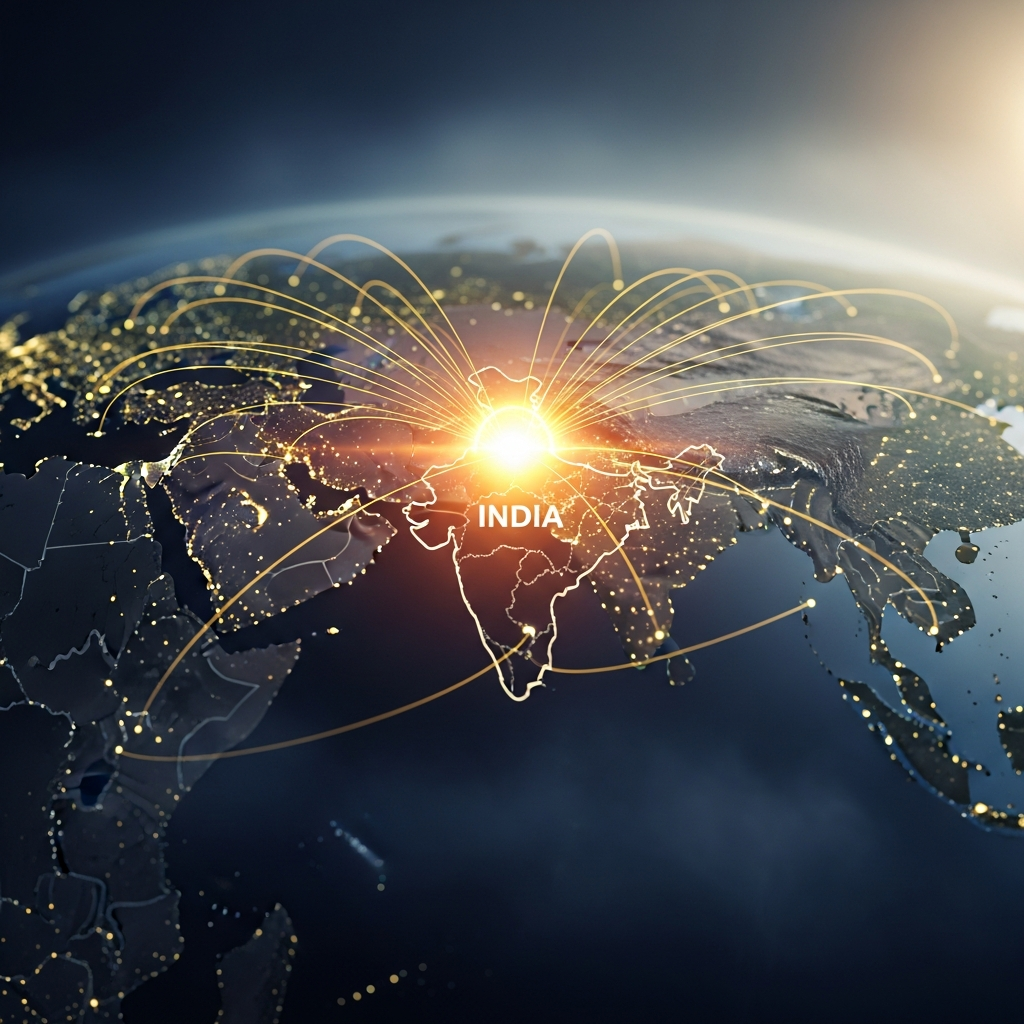
Few countries have positioned themselves more deliberately in this evolving landscape than India. The India role in the multipolar world is, by design, that of the indispensable swing state — the large, influential democracy that refuses to be fully claimed by any bloc. India maintains close defence ties with the United States while buying Russian energy. It is a founding member of the Quad while also participating in BRICS and the SCO. It hosted the G20 with a bold agenda focused on the Global South while simultaneously deepening its bilateral relationships with European partners. This is not confusion or inconsistency. It is strategy — and increasingly, it is being recognised as such.
India’s geopolitics are grounded in what its foreign policy establishment calls “strategic autonomy” — the principle that a country of India’s size and civilisational depth should not subordinate its interests to any external power’s preferences. In a unipolar world, strategic autonomy was a difficult position to sustain. In a multipolar world, it becomes a genuine source of leverage. When every major power needs partners and none can fully dictate terms, a country that is courted by all and beholden to none is in a remarkably strong position. India, at this particular historical moment, is that country.
Power without precedent
What makes this global power shift genuinely unprecedented is its texture. Previous transitions — from British to American dominance, from multipolarity to bipolarity after 1945 — happened in a world where information moved slowly, economies were more nationally contained, and the tools of power were primarily military and industrial. The current transition is happening in a world of instantaneous global communication, deeply integrated supply chains, climate interdependence, and artificial intelligence that is already reshaping economic productivity in ways no country fully understands yet.
This means the competition for global influence is being fought on terrains that did not exist a generation ago — semiconductor supply chains, undersea data cables, satellite constellations, carbon credit markets, and AI governance frameworks. Emerging economies that master these new domains will accrue power in ways that traditional military or economic metrics will not capture. The analysts at the forum were largely agreed on this point: the countries that shape the rules of these new arenas will have outsized influence in the world that is coming, regardless of where they rank on conventional measures of hard power.
No inevitability, only choices
It would be tempting to read all of this as an iron tide — as though the global power shift were a geological process, indifferent to human decisions. But the more honest reading is more demanding. Transitions between world orders are not smooth or inevitable. They are shaped, moment by moment, by the choices that governments make — about whom to align with, which institutions to build or undermine, which norms to uphold and which to challenge. The multipolar world being born right now could produce a more representative and resilient international order, or it could produce a more chaotic and conflicted one. That outcome is not predetermined.
What the recent forum made clear is that the analysts watching this shift most closely are neither optimistic nor pessimistic. They are, above all, alert — to the fragility of existing arrangements, to the ambition of rising powers, and to the extraordinary, still-open question of whether humanity can manage a global power transition without the catastrophic conflict that has historically accompanied such moments. The world is rebalancing. The harder question — the one that no academic event can fully answer — is whether we are wise enough to balance it well.
The World Is Rebalancing — And This Time, It Might Actually Stick.