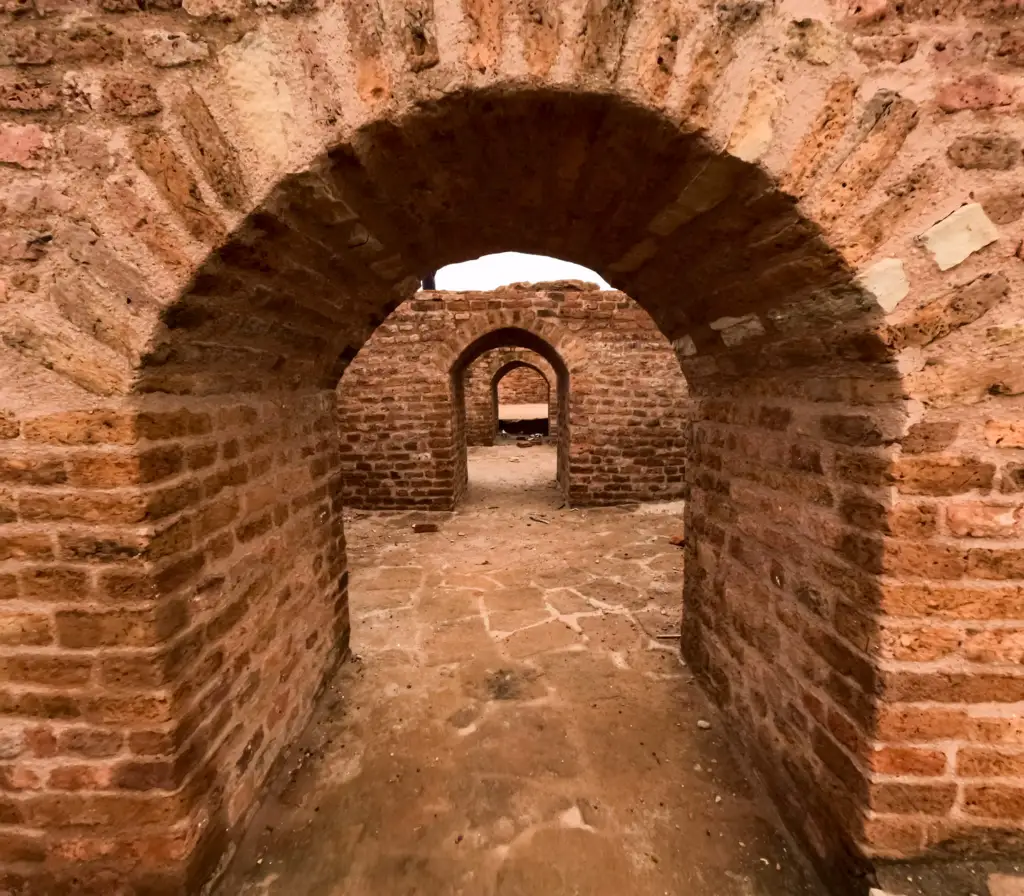
Udayan Fort, a historic fort popularly known as Udyan Fort, located on the banks of Yamuna about 40 km from the district seat of Kaushambi in Uttar Pradesh, is finally getting its due. There’s a buzz around government consent to restore it, promising not just to conserve a 2,500-year-old relic, but to lure tourists to this underappreciated gem of India’s past.
Echoes of a Forgotten Empire
Kaushambi was not always a tranquil district in Uttar Pradesh. The 6th century BCE saw it as the capital of the Vatsa Mahajanapada, one of the 16 great kingdoms that comprised ancient India before the advent of empires like the Mauryas. Udayan Fort is a silent testimony to that time, connected to King Udayana, a king known for his military skills and, strangely, his romantic stories.
The fort ruins are a tale of grandeur. Excavations that began in 1949 uncovered a vast walled city that extended up to 6 km, with three gates facing east, west and north, and a number of moats that held invaders at bay. It was no small thing inside the palace; a central hall with a massive dome, encircled by rooms, all of stone and plaster without a shred of wood. Occupations date from c. 390 BCE to 600 CE, and the palace developed in at least six phases to the 2nd century CE.
What became of all that? Excavations uncovered a thick layer of ash, pointing to a cataclysmic fire that likely consumed the complex. Visitors today witness brick bastions and ruins close to the border of the Yamuna, but more lies buried, waiting to be carefully excavated.
The Legendary King Udayana King Udayana was not an ordinary warrior king. The stories portray him as a romantic at heart, swept into power in an era of chaos. Udayana was born into the Vatsa branch of the Kuru dynasty (yep, the same dynasty that the Mahabharata belongs to) and had a rough start at life. Orphaned at a tender age, he was brought up in forests where he learned music, combat and statecraft from sages, before he ascended his throne in Kaushambi.
His romance with Vasavadatta, daughter of Ujjain’s King Pradyota, reads like a Sanskrit blockbuster. Udayana was captured by Pradyota’s army, but he converted the daughter of his captor to his side by his teaching in music. They ran off together, cementing a political alliance that fed the flames of Udayana’s conquests. The rediscovery in the early 1900s of plays like Bhasa’s Svapnavasavadattam and Pratijnayaugandharayana has shown this drama of love, war, and loyalty. His tales are also woven into the epic Kathasaritsagara and Harsha’s Ratnavali, making him a favourite in the ancient literature.
Udayana also saw the Buddha. Initially he was hesitant, but he adopted Buddhism, made it the state religion and even gave out a gilded Buddha statue. His rule was a combination of might and culture and he converted Kaushambi into a thriving hub of trade and thought.
A Fort That Needs Saving
Udayan Fort has not aged gracefully. The ASI-protected site today has three main bastions, of which two are fast eroding, especially the one near the river entrance. The structures have been undermined by erosion from the Yamuna, the weather and negligence, and they risk collapsing altogether.
The situation was urgent, ASI’s assistant conservation officer Karmveer Tiwari had said in previous pronouncements. The government has now signed off on a more specific proposal advocated by the department. Work on the damaged bastion will commence shortly, with rigorous adherence to archeological regulations to preserve authenticity; there are no shortcuts in this process.
This is not an isolated event. A state-wide drive: Uttar Pradesh has spent Rs 25 crore on the conservation of 10 historical sites. Kaushambi’s initiatives are in tune with national heritage drives where sites like this get priority to prevent urban development and climate risks.
The Restoration Plan Breathing New Life
The restoration work at Udayan Fort will initially focus on stabilization. Engineers intend to shore up bastions using conventional materials, remove debris, and install protective barriers to ward against floods. The task? Keep it safe for visitors without affecting its ancient nature.
While experts disagree on the timeframes, popular folklore explicitly associates the fort with the rule of Udayana in the 6th century BCE. However, archaeologists like B.B. Lal say that major construction happened much later, after the 12th century CE. Whatever way, the site represents a layered history of centuries, from Vatsa rulers to medieval layers.
This is seen as a template for others by local officials. Momentum is seen in similar work at surrounding Buddhist locations, such as the Buddha Theme Park in Kosam Inam (68% complete, Rs 22.93 crore budget).
Key restoration priorities:
Stabilise the bastion on the riverside to avoid erosion by the Yamuna.
Preserve brick walls and gates using lime mortar.
Install signs and paths to provide safe access.
Landscape moat areas to recreate the original fortified sense.
Kaushambi’s Tourism Awakening
And here’s when Uttar Pradesh becomes interesting. The heritage of Kaushambi is not simply the fort. There are the Ashoka pillars, the ancient stupas and even eco-projects such as the Alwara Lake (Rs 4.4 crore renovation). Kaushambi is becoming part of Buddhist circuits with Vande Bharat trains connecting Varanasi, Prayagraj and Khajuraho drawing tourists.
Restoration could change the district. Udayan Fort now serves as a picnic spot for locals and history aficionados, with children playing cricket amongst the remains. But better access means picture guided tours of Udayana’s love affairs, boat excursions on the Yamuna, cultural fests. It’s listed modestly on TripAdvisor, but that might change fast.
Economically it is a boon. Heritage tourism produces jobs – guides, artists, restaurants selling local crafts. Studies have shown the potential of Kaushambi in the cultural circuits but the roads and lodging are still deplorable and a challenge. But the spill-over from the Kumbh Mela fame of nearby Prayagraj gives a hint of what’s conceivable.
This fits into the wider vision for India. The government has its eyes on $50 billion in tourism earnings by 2030, with heritage sites expected to spearhead the charge. Restoration may increase footfall – Jaipur’s forts or Delhi’s Red Fort are examples of this – and Udayan could do the same, especially for domestic travellers from surrounding towns.
But will the tourists come? And that’s the question in the air as diggers prepare. If marketed well, Kaushambi might be the new hotspot of Uttar Pradesh, mixing history with adventure
Challenges on the Ground
Restoration has its rough patches. Money is tight, and ASI is running hundreds of sites. Skilled labor for the ancient techniques is hard to come by. The floods of the Yamuna are still a danger; one strong current might erase years of work.
The locals are worried too. “Farming communities nearby deserve benefits, not loss of land. Infrastructure lags behind – no expensive hotels, only basic stays. It’s about promoting without crowding, look at sustainable models like Bhimbetka caves.
Successes elsewhere encourage us. The dedication is evident from the allocation of Rs 25 crore for 10 sites in UP and community involvement—training villagers as guides—could help overcome gaps.
Restoration of Udayan Fort (Kaushambi): A New Dawn for Heritage and Tourism