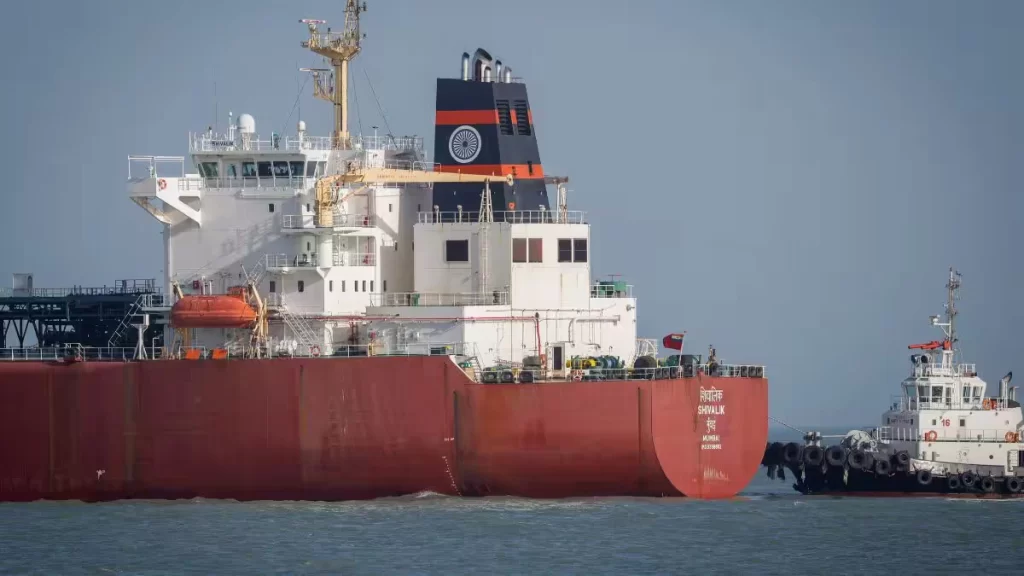
As tensions rise in West Asia, the Indian Navy has discreetly taken on one of its most vital peacetime missions in recent years: protecting the country’s energy lifelines. India has launched a carefully calibrated campaign named Operation Urja Suraksha, under which it is sending frontline warships to escort India-bound cargo boats, mainly crude oil tankers, LNG and LPG carriers, through the Strait of Hormuz, one of the world’s most crucial maritime chokepoints.
This is not your average naval practice. This is a high-stakes, calculated drill to keep the fuel pumps fuelling, factories working and homes filled with cooking gas even while the geopolitical landscape of the Gulf gets turbulent. For a country that imports almost 80% of its oil and an ever-increasing share of its gas, safeguarding maritime supply lines is as vital as guarding a border.
Operation Urja Suraksha What is ?
Operation Urja Suraksha, “Energy Security”, is a dedicated maritime security mission being undertaken by the Indian Navy to defend the India bound energy shipments traversing the strait of Hormuz. The operation has been ramped up amid rising regional tensions that have already interrupted shipping channels, shaken markets and fuelled global fears of another energy bottleneck.
The strategy designated 20 high-priority ships transporting liquefied natural gas, liquefied petroleum gas and crude oil for safe transit and a total of 22 boats. They included LPG specialist carriers such as Pine Gas and Jag Vasant, which carried around 92,000 tons of LPG, crude carriers such as Jag Laadki and LNG-oriented vessels such as Shivalik and Nanda Devi.
The Indian Navy has dispatched more than five frontline warships including destroyers and frigates to escort these boats safely out of the Strait and into the wider Arabian Sea. Sometimes the escorts go further, beyond Hormuz, creating a tiered security grid that holds back any threats to India’s western ports.
Why India is worried about Hormuz
The Strait of Hormuz is the passage between the Persian Gulf and Arabian Sea and is one of the world’s most critical oil transit chokepoints. Much of the world’s seaborne oil, particularly shipments headed to Asia, moves through this small channel. This is not an option for India – it is a requirement.
If the strait becomes unstable or worse, partially shut, the prices worldwide can soar overnight and the supply systems can start to break. India is already susceptible to fuel-price shocks, and cannot sustain extended delays. Any serious interruption in petroleum or gas supplies would send shock waves through power plants, refineries, factories, and even the network of LPG cylinders used by the typical household.
In that sense, Operation Urja Suraksha is less about dramatic military posturing and more about defending India’s economic lifeblood. The Indian Navy essentially acts as a floating traffic controller and a security umbrella to ensure that crucial tankers do not get stopped, delayed or redirected owing to fear of mines, ambushes or unclear navigation in contested seas.
How the Navy Keeps the Corridors Safe
The operation is being conducted with a blend of low-key deterrent and high-precision cooperation. The Navy is not advertising every move, keeping data tight, reducing the risk of targeting and avoiding giving clues to the vessel timetable to adversaries. Meanwhile, behind the scenes, it’s intense cooperation.
Indian destroyers and frigates stand ready to escort priority ships as they exit the Iran-controlled choke point at Hormuz and enter the Gulf of Oman and the North Arabian Sea. These warships carry sensors, surveillance systems and armaments which can detect and respond to threats from the air, from the sea surface and even underwater.
Naval teams are also using new hydrographic charts to map the bottom and locate safe shipping paths through limited and vulnerable waters. Ship crews are then directed in real time, with route-specific instructions, to steer clear of shallow patches, underwater hazards or locations where mines or other dangers have been reported.
This dual protection — physical escort plus comprehensive navigational support — has already shown visible benefits. Several LPG carriers and crude oil tankers have safely transited across the strait and are now making their way to Indian ports, notably Mundra and Dahej in Gujarat. Several successful escorted transits took place in late March and early April 2026, including the ninth LPG-carrying tanker, Green Asha, which transited Hormuz under Navy observation and is likely to reach India within a day or two of its voyage.
Domestic Supply Chain Relief
From a domestic standpoint, what are these escorted arrivals? They are more than tanker movements; they are energy-stabilization activities. In India there have been spot shortages and fears about LPG availability lately, with hoarding and black marketing in some areas adding to the problem.
Every successful escort takes the strain off. The arrival of an LPG carrier of about 46,000 tonnes, like Greensanvi, in Gujarat helps to add to the country’s buffer stock, refilling of commercial and industrial storage terminals and indirectly supporting refilling of the domestic cylinder networks. The administration has officially declared that these actions are helping to normalize domestic LPG distribution and reduce supply limitations
At the same time, the activity is not only about gas. Indian ports are being used to bring in crude oil tankers like Jag Laadki and others so that refineries may continue to operate at near full capacity. This in turn drives the production of petrol, diesel, jet fuel and other distillates that keep India’s cities, logistical chains and aviation sector on the move.
Inter-ministerial and inter-agency coordination
Operation Urja Suraksha is not a merely naval operation. It is a nexus of defence, energy and foreign policy. The Indian Navy works closely with the Ministry of Ports, Shipping and Waterways, which handles commercial shipping and port activities, and the Ministry of Petroleum and Natural Gas, which deals with fuel supplies and pricing.
Defence Minister Rajnath Singh has been kept informed and examined the unfolding scenario to identify hazards to India’s maritime supply systems. Inter-ministerial coordination allows the government to reconcile security imperatives with business realities, knowing whether to press for faster transits, redirect vessels, or ramp up diplomatic outreach to key Gulf partners.
India has also begun to provide navigational directions and maritime-safety advice to friendly countries utilizing the same route, so enhancing regional cooperation and helping to minimise the possibility of accidents or violence at sea. In a context of little confidence, the importance of these small confidence-building tactics can be as significant as hardware.
Why This Matters for India’s Global Role
Apart from the urgent fuel-security element, Operation Urja Suraksha is quietly building India’s maritime-security profile. New Delhi has often spoken of itself as a “net security provider” in the Indian Ocean, but this operation is a practical proof of that concept. India is no longer waiting for a crisis to emerge, but is pre-positioning its naval forces to protect its own commerce and, in turn, the stability of regional energy markets.
India’s focus on energy vital ships, LNG, LPG, oil, also reflects an understanding of the tightness of India’s growth to seaborne energy imports. Such escort operations, especially in contested areas, will bolster the Navy’s ability to conduct them and may drive greater investments in surveillance, hydrographic expertise and long-range naval aviation linkages.
But it also poses problems. How much can India stretch its naval resources without over stretching itself? Can India maintain such a high tempo escort regime for months or will it have to rely more on other fleets and regional partnerships? These are not trivial challenges for a country that already devotes enormous assets to piracy and illicit trade patrolling in the Indian Ocean.
Energy Security in a Turbulent World
Operation Urja Suraksha is in many respects a representation of India’s new energy-reality. While promoting renewable power and domestic development, the country remains largely reliant on imported oil and gas. That dependence, and a more multipolar and turbulent global order, imply that India can no longer assume its marine supply lines are secure.
Should Hormuz become a flashpoint again, India will likely be forced to choose between expanding the extent of Urja Suraksha, seeking more international naval coordination, or diversifying its energy sources and suppliers. But for now, the message is plain. As long as the energy lifelines of India depend on the sea, the Indian Navy will stay there, discreetly, to keep them running.
Journalists and experts can ask: Is this a momentary crisis response or the start of a more permanent Indian naval “energy-escort doctrine”? That question may, in the long run, be as vital as the number of ships safeguarded under Operation Urja Suraksha, because it will determine how India defines its security goals in an era where energy and trade lines are as strategic as any war.
India is buffeted by the volatility in West Asia, and the real soundtrack to the country’s energy security in the 21st century may be the peaceful hum of naval engines in the Arabian Sea.
Operation Urja Suraksha: Significance of India’s Naval Escorts