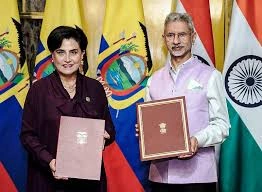
India’s talks with Ecuador on a possible Preferential Trade Agreement, or PTA, mark a quiet but meaningful step in New Delhi’s push to widen commercial ties across Latin America. The discussion is not just about tariffs and trade flows; it is also about healthcare, agriculture, digital technology and critical minerals, which gives the proposed pact a broader strategic edge.
A fresh push in bilateral ties
The latest round of engagement came during Ecuadorian Foreign Minister Gabriela Sommerfeld Rosero’s visit to New Delhi, where she met External Affairs Minister S. Jaishankar and other senior Indian officials. According to reports based on the Ministry of External Affairs, both sides discussed a roadmap for a PTA and agreed to deepen cooperation in healthcare, pharmaceuticals, agriculture, trade and investment, digital technology, cultural exchanges and capacity building.
This matters because India and Ecuador have had a long-standing but relatively modest trade relationship. The two countries have discussed a preferential trade framework before, including earlier feasibility work and formal talks under the Joint Economic and Trade Committee process. What makes the current moment different is the wider policy push on both sides and the willingness to connect trade with development and sectoral cooperation.
Healthcare at the core
One of the most important parts of the discussion is healthcare. India’s pharmaceutical sector is already a major export strength, and officials on both sides have talked about scaling up Indian pharmaceutical exports to Ecuador.
There is also a regulatory angle. The talks reportedly included the possibility of Ecuador recognising Indian Pharmacopoeia Commission standards, which would help promote regulatory cooperation in medical products. That could matter for faster approvals, greater confidence in product quality and wider access to affordable medicines in Ecuador.
A health cooperation memorandum between India’s Ministry of Health and Family Welfare and Ecuador’s health ministry has also been discussed. In plain terms, this is the kind of quiet policy work that often shapes how affordable healthcare solutions travel across borders. And in a world where medicine supply chains still face disruptions, who would not want more stable and reliable channels for essential drugs?
Agriculture and farm trade
Agriculture is the other major pillar in the talks. Both countries have signaled interest in strengthening cooperation in farm trade, food supply chains and broader agricultural exchange.
That makes sense. Ecuador’s economy has strong links to agricultural exports, while India has expertise in farm productivity, food processing and agri-tech. There is clear room for collaboration in seeds, irrigation, post-harvest systems, value-added food products and agricultural technology.
The broader trade picture also matters here. India’s current exports to Ecuador include engineering goods, drugs and pharmaceuticals, chemicals and electronic goods, while imports from Ecuador include crude oil, gold, teak wood and other commodities. A PTA could help diversify this basket and push both countries beyond their usual commodity-heavy trade patterns.
Digital and technology ties
Digital technology is becoming an increasingly important part of India’s external economic partnerships, and Ecuador is now part of that story. The two sides have discussed cooperation in digital technology, digital infrastructure and capacity building, alongside trade and investment.
This is not a throwaway item in the talks. Digital cooperation can include e-governance, public digital systems, fintech, training and startup partnerships. India’s experience with digital public infrastructure has made this area especially attractive to partner countries, and Ecuador appears open to exploring those possibilities.
There is a broader lesson here. Trade today is no longer only about goods crossing borders. It is also about data, platforms, standards and the ability to build systems that make commerce faster and cheaper. That is exactly why digital cooperation has become part of modern trade diplomacy.
Critical minerals and supply chains
Another important thread in the conversations is critical minerals. Reports say the two sides discussed strengthening supply-chain partnerships involving copper and gold.
This is strategically relevant for India, which is looking to diversify access to minerals needed for manufacturing, energy transition and industrial growth. For Ecuador, such cooperation could bring more investment interest and stronger integration into global value chains.
At a time when supply chains are being rethought across the world, this part of the relationship could become more important than it first appears. It links trade policy to industrial strategy, which is exactly where many governments want their external engagements to go.
Development partnership grows
Trade talks were only one part of the visit. India also agreed to provide grant assistance of up to Rs 12 crore to Ecuador over five years for socio-economic development projects, through Quick Impact Projects.
That is not a huge amount in the context of global trade, but it is symbolically significant. It shows that India wants its ties with Ecuador to rest on development cooperation as well as commerce. The arrangement was formalised through a memorandum of understanding on grant assistance for Quick Impact Projects.
Ecuador has also decided to join the International Solar Alliance and the International Big Cat Alliance, adding another layer to the relationship. These decisions suggest that the two countries are aligning not only on business, but also on global environmental and conservation platforms.
Trade numbers and room to grow
The current trade base is still small compared with India’s commerce with larger partners, but the direction of movement is clear. The MEA’s bilateral brief notes that in 2023-24, bilateral trade stood at USD 1.42 billion, with crude oil making up more than half of the value in the last two financial years.
That dependence on a narrow set of goods is exactly why a PTA can be useful. It can encourage broader product categories, reduce friction for select sectors and create a more balanced trade relationship. Indian exports to Ecuador already include drugs and pharmaceuticals, chemicals and electronic goods, which means there is a ready base for expansion.
A simple way to look at it:
India’s strengths: pharmaceuticals, engineering goods, chemicals, digital services.
Ecuador’s strengths: crude oil, cocoa, cut flowers, seafood, minerals.
Shared opportunity: move beyond commodity trade into higher-value goods and services.
The larger strategic picture
The India-Ecuador engagement also is part of a larger diplomatic pattern. India has been steadily deepening ties with Latin American countries through trade, investment and multilateral cooperation, while Ecuador is seeking diversified partnerships beyond its traditional economic networks.
There is also a geopolitical undertone. Ecuador’s decision to move toward the India-led International Solar Alliance and International Big Cat Alliance signals openness to India’s multilateral agenda. For India, that is valuable because it reinforces its image as a partner that can combine commerce, development and global cooperation in one package.
So the story is bigger than a PTA. It is about whether India can turn a relatively small bilateral relationship into a multidimensional partnership with real commercial, health and technology dividends. And perhaps the more interesting question is this: can smaller, focused trade pacts deliver faster results than large, complicated free trade negotiations?
What comes next
The immediate next step will likely be more technical discussion on the scope of the PTA, the list of products that may get preference and the regulatory issues that need to be settled. Health cooperation, standards recognition and the design of trade concessions will all matter if the talks are to move beyond diplomatic goodwill.
For now, the direction is clearly positive. India wants broader market access, Ecuador wants stronger ties with a major Asian economy, and both sides see value in connecting trade with practical cooperation in health, agriculture and digital systems. If the talks keep moving, the India-Ecuador relationship could become a useful example of how a modest PTA can serve much larger strategic goals.
India, Ecuador move closer to preferential trade pact as health, farm and digital ties take center stage