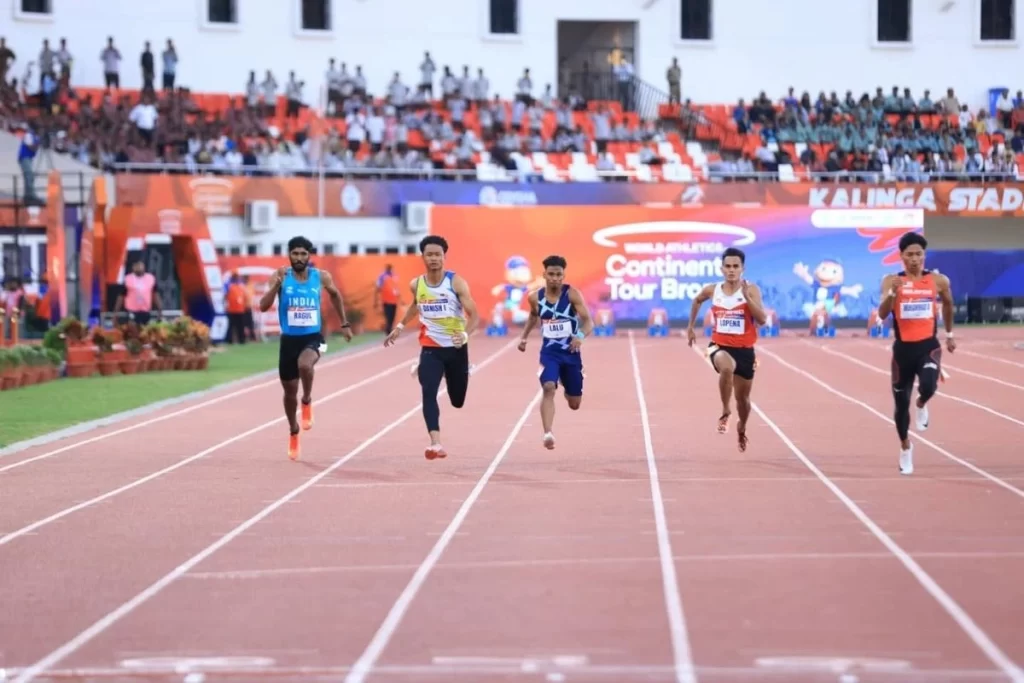
The dust has fallen at the Botswana National Stadium in Gaborone, leaving behind a path of high-stakes competition and a bitter reminder of the tough climb that awaits Indian athletics. The Indian contingent, a 21-member squad with hopes of world domination, found itself on the outskirts of the finalist circle in all five events when the 2026 World Athletics Relays closed on May 3. The results may look like a setback at first glance but they are a must-have and honest mirror for a nation that has set its eyes on the lofty objective of hosting and excelling in the 2036 Olympic Games.
Is the quest for the elite global sports participation just the pursuit of the medals or is it really about the hard and sometimes unseen work of closing the gap between national potential and international performance? For a country which has experienced a boom in investment and institutional backing, this outing in Gaborone is more than simply a scoreboard update, it is a key diagnostic tool for the Athletics Federation of India (AFI) and the athletes themselves as they look into the future.
Anatomy of the Campaign.
The road to Gaborone started with real impetus. The squad landed in Botswana with the weight of expectation led by sprinting talent like Animesh Kujur, who has been turning heads in the Indian Athletics Series in New Delhi. The squad competed in five particular events: the men’s and women’s 4x100m relays, the men’s 4x400m relay and the mixed 4x100m and 4x400m.
Getting these athletes to the starting blocks was a logistical undertaking in itself, underlining the government’s commitment to put Indian competitors on the world stage. But the reality of international relay racing is brutal. Unlike individual events, where raw speed usually takes precedence, relays require a finesse, a seamless handoff and a strategic rapport forged by extensive and regular competition with the world’s best.
Participation: 21 members of Indian contingent.
Events: Men’s/Women’s 4x100m, Men’s 4x400m and Mixed 4x100m/4x400m
All teams failed to make the final heats.
Not going forward doesn’t mean there is no skill on the track, but there are the technical demands of the discipline. When you’re watching the world’s best sprinters, it’s easy to forget that these races are won in the margins – the inches lost on a slightly mistimed handoff or the pause in the acceleration coming into a bend.
The Road to 2036 and Further
The continued concentration on relay events is a strategic play in India’s long-term athletic strategy. With the 2030 Commonwealth Games and the eventual objective of the 2036 Olympics approaching, the government has made a clear and firm pivot to science-led preparation. That means world-class infrastructure, and a system that discovers talent earlier, with data-based performance analysis.
What does this mean to the average athlete in India? It suggests that the era of occasional flashes of genius is probably over. Instead there is a move towards a standardised, institutionalised approach, as seen in sporting powerhouses such as the United States or Jamaica. The recent assessment meeting held by Union Sports Minister Dr. Mansukh Mandaviya on the 2026 Asian Games in Aichi-Nagoya highlights this intention. “The committee is looking into every detail from acclimatization to specific dietary support to ensure that athletes are treated as professionals and not just participants.
The shift to this professional framework is a balancing effort. It needs:
Deploying dedicated medical and recovery support teams.
Replicating foreign competitive conditions to minimize the “shock” of foreign venues.
Ensuring continuity of coaching and support staff far in advance of the actual event days.
Looking Back on World Aims
Why does a relay team’s performance at a single international meet matter so much to a country of over a billion people? Because athletics is typically the pulse of a nation’s sporting health. When an athlete runs on the track in a place like Gaborone, they’re not simply sprinting for the finish line. They’re running for the power of the system that put them there.
The gap between Indian sprinters and the global elite is closing but still a hurdle. “Events like the World Athletics Relays give exposure to Indian athletes to high pressure conditions where the level of competition would encourage them to progress immediately. Without these experiences, no amount of domestic training can replace the sensory and psychological demands of international racing.
Looking at the route of successful sporting nations, they didn’t get to the podium overnight. They welcomed the failures, tweaked the training techniques, and continued showing up until it became second nature. The lessons India drew from the 2026 Relays are not signals of loss but inevitable data points to help shape the preparation for the Asian Games ahead and beyond.
Looking Forward to the Future
With the squad now preparing to head home, the attention will likely turn to post-meet analysis. Coaches will watch the film and analyze every exchange, every stride length, to see where the seconds went. This kind of self-awareness is what differentiates the top from the average .
The fact that this is not a flash-in-the-pan era in the Indian sports culture is evident from the top-level commitment, the oversight by high-level committees and the huge funding allocation. It is a systemic development. The challenge now is to guarantee that this support trickles down properly, so that there’s a pipeline of athletes ready to go the minute they hit the world stage.
seldom is the road to international sporting success a straight one. A broken road, a trial of limitations, the disappointment born, a procedure repeated again and again. The 2026 World Athletics Relays was a reality check for India but also an important step towards maturity on the international circuit. Whether these will become gold in the future only time will tell but the hunger to be competing at the very top is more evident than ever. As we move through the rest of 2026 and look ahead to the Asian Games, the improvement made by these athletes will be a yardstick of just how far India has really come.
Beyond the Podium: What India’s World Athletics Relays Campaign Taught Us