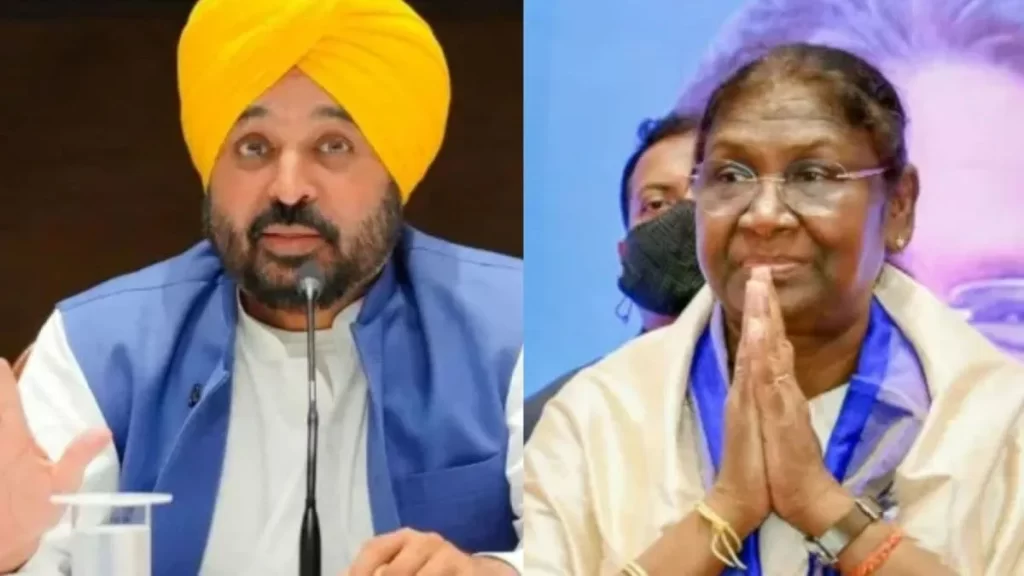
Punjab Chief Minister Bhagwant Mann is set to meet President Droupadi Murmu on May 5, directly taking the state’s political turmoil to the highest constitutional office and reigniting a furious national conversation over defections, party loyalty, and the very meaning of “mandate” in Indian democracy. The meeting comes just days after seven Rajya Sabha MPs—six of them from Punjab—quit the Aam Aadmi Party (AAP) and formally aligned with the BJP, an exodus that has shaken the opposition’s Rajasthan‑bound strategy and exposed glaring grey areas in the anti‑defection law.
What Exactly Is at Stake?
At the heart of the discussion is a deceptively simple question: if voters backed AAP in Punjab, do they still “own” Rajya Sabha seats even when the party’s own MPs walk away? Those seven MPs, including prominent names such as Raghav Chadha and Harbhajan Singh, were originally elected to the Upper House on the strength of AAP’s sweeping victory in the Punjab Assembly, where the party holds 94 of 117 seats. Their switch to the BJP is technically being treated by the Rajya Sabha chairman as a “merger” of a faction, which under the Tenth Schedule can shield MPs from disqualification if two‑thirds of the party’s Rajya Sabha members move together.
But Mann is arguing that this legal slop isn’t enough: for him, this is not just a matter of constitutional technicality, but of democratic legitimacy. Speaking publicly, he has demanded the President use her powers to “recall” these MPs and, in his own words, to push for a “right to recall” mechanism so that voters can formally revoke the mandate of representatives who abandon the party they were elected under. In practice, such a power does not currently exist; the idea is more political symbolism than actionable law, yet it has already sparked a wider debate about how representative democracy can keep pace with the reality of party‑hopping.
Why Punjab Feels This So Deeply
Punjab’s attachment to this issue is not random. AAP’s 2022 landslide in the state was sold as a revolution against corruption, patronage, and “old‑style” politics, and the defection of seven MPs—especially high‑profile ones—has been framed inside the party as a betrayal of that promise. Mann’s government has repeatedly highlighted Punjab‑specific issues such as its strict anti‑sacrilege (“beadbi”) laws, aggressive action on drug trafficking, and investment in education and healthcare as benchmarks of its pro‑state mandate.
When powerful Rajya Sabha MPs up and join the BJP, what many in Punjab see is not just a change of party labels, but an overriding of the people’s choice by Delhi‑centric power equations. Mann’s argument to the President is likely to lean heavily on this: if the state’s legislature overwhelmingly supports AAP, how can the Union government allow those very MLAs’ votes to be represented by MPs who now share a platform with the party that has been rejected by Punjab voters in successive elections? It’s exactly this dissonance between the state’s mandate and the national‑level arithmetic that has turned a group of defections into a constitutional flashpoint.
The Anti‑Defection Law in the Crosshairs
The anti‑defection law, embedded in the Tenth Schedule, was introduced in the 1980s to discourage horse‑trading and ensure party discipline. Under normal circumstances, an MP or MLA who voluntarily gives up party membership, or votes against the party whip, risks disqualification. But there is a major loophole: if two‑thirds of a party’s members in a House decide to merge with another party, all of them are exempt from disqualification.
That is precisely what the Raghav Chadha‑led group is claiming has happened with AAP’s Rajya Sabha wing. The BJP and its allies argue that this is a valid merger, not individual defections, and that the Rajya Sabha chairman has the final say in deciding whether the move qualifies. Critics, however, point out that this exception has been repeatedly exploited to enable mass defections while still staying on the “right” side of the text. In Punjab’s case, AAP leaders such as Sanjay Singh have already moved or threatened to move disqualification petitions against several of the MPs, arguing that the split is not a genuine ideological merger but a calculated political realignment.
Legal experts are divided. Some constitutional scholars say the Tenth Schedule’s two‑thirds rule is so broad that it essentially permits orchestrated defections as long as the numbers add up. Others argue that the spirit of the law—to prevent back‑room deals and protect voter choice—is being hollowed out, and that the current case may force the judiciary or Parliament to revisit the provision.
What the President Can—or Can’t—Do
Unlike the Supreme Court or the Election Commission, the President of India does not have direct power to disqualify MPs or cancel their membership. That lies with the Speaker or Chairman of the respective Houses, acting on petitions under the Tenth Schedule or the Representation of the People Act. What the President can do, however, is underline political and moral pressure, ask for clarifications, and use the office’s symbolic weight to flag concerns about the erosion of democratic norms.
Mann’s decision to meet Murmu alone—state MLAs have been asked to wait outside Rashtrapati Bhavan—suggests he wants to position this as a constitutional appeal rather than a partisan spectacle. His likely agenda:
Emphasize that Punjab’s overwhelming Assembly majority for AAP has not changed, and that the public mandate should not be subverted by the movement of MPs elected on that mandate.
Advocate a wider debate on a “right to recall” or other mechanisms by which assemblies or states can remove or question the continuance of MPs whose political loyalties have changed.
Emphasise how such defections can distort Upper House mathematics in Delhi and possibly impact key legislative and policy discussions that have a bearing on states such as Punjab.
Whether Murmu will issue any formal direction remains unclear; more realistically, the meeting may be recorded as a strong note of concern, one that can be cited by Punjab and other opposition‑ruled states if future disputes arise.
The Larger Shadow Over Indian Federalism
Zooming out, the Punjab‑BJP‑AAP triangle is not the first episode to expose the tension between state mandates and national party arithmetic. Earlier in the decade, Punjab itself saw chaotic defections in the Assembly, with speakers and courts repeatedly called in to decide whether splinter groups qualified as legal mergers under the anti‑defection law. In recent years, Rajasthan, Madhya Pradesh, and Karnataka have also witnessed similar power‑play scenarios, where the numerical strength of a chief minister was tested less by the people and more by the shifting loyalties of a handful of MLAs.
What makes this Rajya Sabha episode different is that the stakes are not just about who sits in Chandigarh’s Vidhan Sabha, but about who defines India’s federal narrative in the Upper House. If state‑based parties can reliably have their Rajya Sabha delegations poached through “mergers” or mass defections, smaller states and regional parties risk being structurally downgraded in the national conversation. Punjab, with its distinct history, language, and agrarian‑economy concerns, is particularly sensitive to this kind of dilution. Mann’s outreach to the President, therefore, is as much a message to other states as it is an appeal to the occupant of Rashtrapati Bhavan.
Political Messaging and Public Sentiment
Inside Punjab, the defection has already triggered a mobilisation campaign. The AAP government has moved a confidence motion in the Assembly and repeatedly stressed that the party remains strong and united at the mass level, even as national‑level faces jumped ship. Party leaders point to rural outreach, local governance reforms, and record‑high approval ratings in recent state‑level surveys to argue that the “real” AAP is still rooted in the ground, not in the corridors of the Rajya Sabha.
At the same time, BJP leaders have framed the shift as a natural consolidation of like‑minded forces, arguing that individual MPs are free to pursue their political destiny and that the party system should not be imprisoned by rigid loyalty tests. This clash of narratives—“party as a movement built on principles” versus “party as a coalition of individual ambitions”—is what gives the anti‑defection debate its emotional charge.
For ordinary voters, the confusion is real. If a party wins 94 out of 117 seats on a promise of clean governance, but then loses almost all its Rajya Sabha representation in a single move, how are they supposed to read the system’s integrity? Does the ballot box still matter when backroom deals can reverse its verdict in Parliament? These are the questions that will likely echo in the hours after Mann’s meeting with the President, even if the formal powers of the Office remain limited.
Punjab CM’s President Meet Deepens Rift, Revives Anti‑Defection Debate