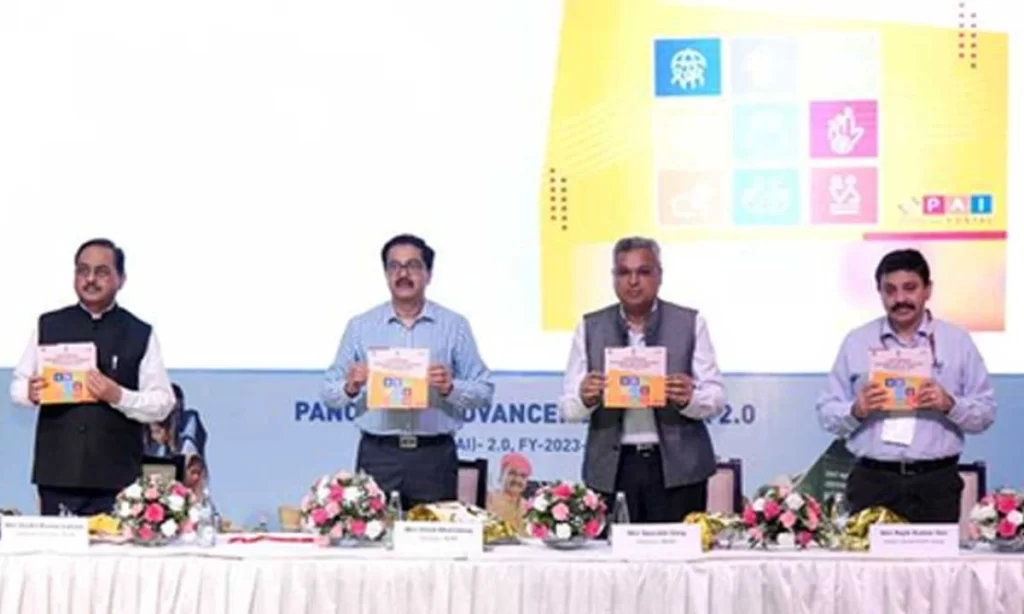
24 April 2026, the Ministry of Panchayati Raj released the Panchayat Advancement Index (PAI) 2.0 Report for FY 2023–24, a crucial step towards transparent, data-driven rural governance. This is the first time that a country-wide “report card” has been prepared for grass-root institutions, evaluating each panchayat on a scale from Achiever (A+) to Beginner (D). The system will cover 2.6 lakh Gram Panchayats (GPs) throughout 33 states and Union Territories. The index assesses progress in poverty reduction, health, water, infrastructure and governance. With a participation percentage of 97.3% as opposed to 80.79% in PAI 1.0, the index highlights the shining stars like Tripura, Kerala and Odisha, while pointing out weaknesses in lagging regions. What is the instrument that can make India’s 6,65,000 villages engines of growth? Let’s get it crackin’.”
PAI 2.0: The secret sauce of the metrics
PAI 2.0 narrows the 17 global SDGs to 9 local themes, measured through 150 indicators and 230 data points, against 516 indicators in PAI 1.0. The themes are Poverty Free Livelihoods, Healthy Panchayats, Child Welfare, Water Security, Environment, Infrastructure, Social Justice, Women Empowerment and Good Governance. Data is auto collected from programs like MGNREGA, PMAY-G, AMRUT etc at the national level and comes to a single integrated site and is reviewed by Gram Sabhas for transparency. They then churned out scores on real time dashboards and no GP reached the top A+ grade – suggesting room for excellence even with improvements.
Winners, Laggards and the Reality of the “Performer”
The figures are of a nation that is young. 3,635 GPs are Front Runners (A: 75-90) and 1,18,824 (45.7%) are Performers (B: 60-75). Tripura is leading the pack with 80 per cent of its 1,176 GPs being in Front Runner status with micro-enterprise programs and digital literacy. Kerala’s 10% in top tiers: Health camps, women-led self-help groups Irrigation projects sustain Odisha’s 9% high performers. But giants like Uttar Pradesh and Bihar are further behind, with thousands in “Aspirant” and “Beginner” ranks due to delayed finance. Is this index a prod or a dig at dozing administrations?
Field Study: The Grassroots Effect
PAI’s work on livelihoods in Dhalai district of Tripura has resulted in establishment of clusters of 1,200 women artisans, increasing revenue by 40% through e-marketplaces. Anganwadi revamp helped Kerala’s Kottayam GP cut child malnutrition by 30%: PAI Meanwhile, waterborne illnesses in Jagatsinghpur GP of Odisha reduced by 25%. The PAI data suggested that water quality was patchy. This technology is now with 268,000 GPs in rural India for evidence based planning, however the barriers like digital divide and gender disparities still exist. Will PAI 2.0 be able to bridge them by 2030?
What This Means For India And More India’s rural budget has jumped 211% to ₹2.73 lakh crore (2026-27), fueling roads, toilets and jobs. PAI 2.0 delivers on funding to targets, poverty down to 5.3% and multidimensional poverty to 11.28% (2022-23) It is a global leader in SDG localization – a model for nations like Bangladesh or Nepal. But the boycott in West Bengal (0 GPs on PAI) and capacity issues in the North East show dissent. Can PAI 2.0 Help Villages Stay in the Loop as AI Reshapes Cities?
The Future: Data Point by Data Point Panchayats Empowered
PAI 2.0 is not only score card – it is a catalyst for accountability, a tool to inspire residents to demand for better roads, clinics and schools. It delivers democracy to the grassroots level with local language dashboards and Gram Sabha audits. Will candidates in India’s 2027 panchayat elections wave PAI scores? The data says yes. Today, 2.6 lakh beacons light up India’s rural road. Where now?
Panchayat Advancement Index 2.0 Tracking India’s Grassroots Governance Revolution On National Panchayati Raj Day