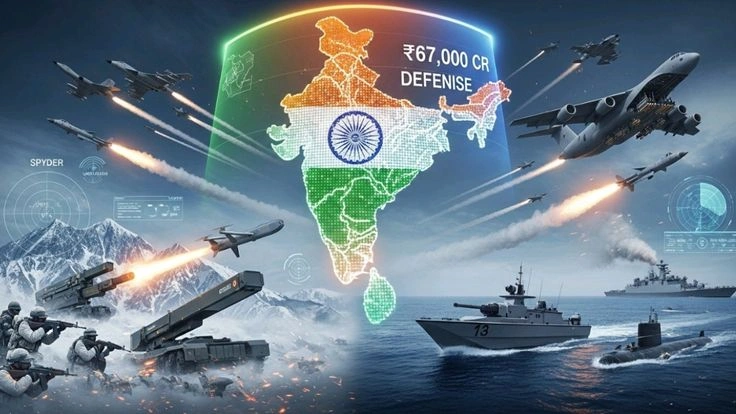
India’s defence conversation is shifting fast, and the new keyword is not just firepower — it is innovation. Defence Minister Rajnath Singh’s remarks at the North Tech Symposium in Prayagraj this week put that change in sharp focus, stressing that future conflicts will reward countries that can adapt quickly, build indigenous technologies and deliver the element of surprise on the battlefield.
At a time when warfare is being reshaped by drones, sensors, artificial intelligence and hybrid tactics, India is positioning technology as the centre of national security planning. The message is clear: the next war may not be won by the biggest arsenal, but by the fastest learner.
Why the message matters
Singh’s comments matter because they come at a moment when global conflict patterns have changed in plain sight. He pointed to the Russia-Ukraine war as proof that warfare can evolve dramatically within a few years, moving from tanks and missiles to drones, sensors and other smart systems. That shift is not theoretical anymore; it is the reality defence planners are building for.
India has been talking about self-reliance in defence for years, but the tone now is more urgent and more operational. The emphasis is not just on building at home, but on building systems that are unpredictable, networked and useful in real combat conditions. And that raises an obvious question: in a battlefield shaped by algorithms and rapid adaptation, can old playbooks still work?
The tech shift in warfare
The defence minister highlighted a broad set of emerging domains that will define future warfare, including artificial intelligence, machine learning, quantum technologies, hypersonic weapons, directed energy systems, and space and underwater capabilities. These are not niche research topics anymore. They are becoming core military priorities worldwide, especially as armies look for faster decision-making and more precise targeting.
India’s own armed forces are moving in that direction too, with greater interest in AI-based decision support, drone swarming, real-time analytics and cyber-enabled operations. The bigger point is that modern warfare is no longer just about what a weapon can destroy. It is also about how quickly a force can see, decide and act before the other side does.
For India, that means the defence sector must work across several fronts at once:
Faster R&D and procurement.
More indigenous manufacturing.
Better integration of sensors, drones and data systems.
Stronger private-sector participation.
A sharper focus on asymmetric and surprise capabilities.
Operation Sindoor and indigenous systems
Singh referred to Operation Sindoor as a recent example of India’s growing confidence in indigenous defence technology. He said the operation showed how homegrown systems like BrahMos and Akash contributed to India’s operational strength. That point is important because it links research not to abstract policy, but to battlefield effectiveness.
The larger narrative here is about credibility. India has spent years trying to prove that indigenous systems can stand up to operational demands, not just lab tests or exhibition halls. When the government points to a real operation as evidence, it signals a new stage in the self-reliance drive.
This also changes the tone of the public debate. It is no longer enough to ask whether India can make defence equipment domestically. The harder question is whether India can make it faster, smarter and in a way that keeps adversaries guessing.
Production and exports are rising
The innovation push is being backed by strong numbers. Singh said India’s domestic defence production reached a record Rs 1.54 lakh crore in FY 2025-26, while defence exports touched an all-time high of Rs 38,424 crore. Those figures matter because they show that the ecosystem is scaling, not just surviving.
That growth also reflects wider participation from the private sector, which Singh credited as an important driver of the progress. For years, India’s defence manufacturing was dominated by public-sector players. Now the mix is broader, more competitive and more connected to global supply chains.
The export achievement is a major point. It demonstrates that Indian defence companies are not just producing for internal needs but are also securing buyers abroad. In a market where trust, performance and delivery timelines matter, that is a meaningful sign of maturity.
The innovation ecosystem
A major part of India’s defence strategy now rests on innovation platforms such as iDEX, ADITI and the Technology Development Fund, which Singh highlighted as key drivers of industry participation. These initiatives are designed to bring startups, researchers and smaller firms into the defence fold, which is vital if India wants fresh ideas instead of slow, top-heavy systems.
The North Tech Symposium itself reflected that ambition. It brought together 284 companies showcasing indigenous defence technologies, with an explicit focus on collaboration between technology, industry and soldiers. That mix is important because future defence innovation will likely come from ecosystems, not isolated institutions.
The broad direction is also visible in infrastructure efforts like the Defence Industrial Corridor in Uttar Pradesh, which Singh cited as part of the expanding ecosystem. Regional industrial clusters matter because defence manufacturing depends on supply chains, testing facilities, skilled labour and easier procurement pathways, not just headline announcements.
What future conflicts may look like
The phrase “future warfare” can sound vague, but the examples are becoming easy to spot. Drones can swarm targets, sensors can track movement in real time, AI can help process battlefield data, and cyber tools can disrupt communications before a shot is fired. In that kind of environment, surprise is not a bonus; it is a strategic necessity.
Singh’s argument was simple: the side that can create unexpected responses will hold the edge. That means military capability is no longer measured only by stockpiles or platform counts. It is also measured by adaptability, deception, electronic resilience and the ability to integrate new systems quickly.
This is where India’s challenge becomes more complex. It must modernise while still managing traditional threats along its borders, from high-altitude deployments to maritime security and internal surveillance needs. Can one defence ecosystem do all of that at once? That is the real test ahead.
India’s strategic context
India is not building this capability in a vacuum. The global security environment has become more uncertain, and the pace of military innovation has accelerated in several countries. That puts pressure on India to keep pace in areas such as AI warfare, drone systems, hypersonic platforms and space-based assets.
At the same time, the government wants India to emerge as a major defence manufacturing hub, not just a large buyer of imported systems. That ambition is now tied to a broader economic story as well. Defence production and exports are no longer just strategic metrics; they are also industrial and employment indicators.
For the Indian audience, this has another layer. Defence innovation is increasingly linked with local industry, startup ecosystems and jobs in advanced manufacturing. What used to sound like a remote military subject is now part of India’s technology and economic story.
What to watch next
The next phase will be judged less by speeches and more by delivery. India’s defence sector will need to convert innovation into field-ready systems, faster procurement cycles and practical integration across the services. That includes AI-enabled surveillance, drone swarms, cyber defence and indigenous platforms that can be deployed at scale.
There is also a clear need to sustain momentum beyond one symposium or one set of strong production figures. The real question is whether India can keep this pace over several years, across changing threat environments and budget pressures. If it does, the country could move from being a large defence market to a truly influential defence power.
For now, the signal from Prayagraj is unmistakable: India wants future wars to be met with speed, surprise and homegrown technology. And in a world where battlefields are becoming more digital by the day, that may be the only realistic way forward.
India’s defence push turns to tech edge as future wars demand surprise, speed and smarter systems