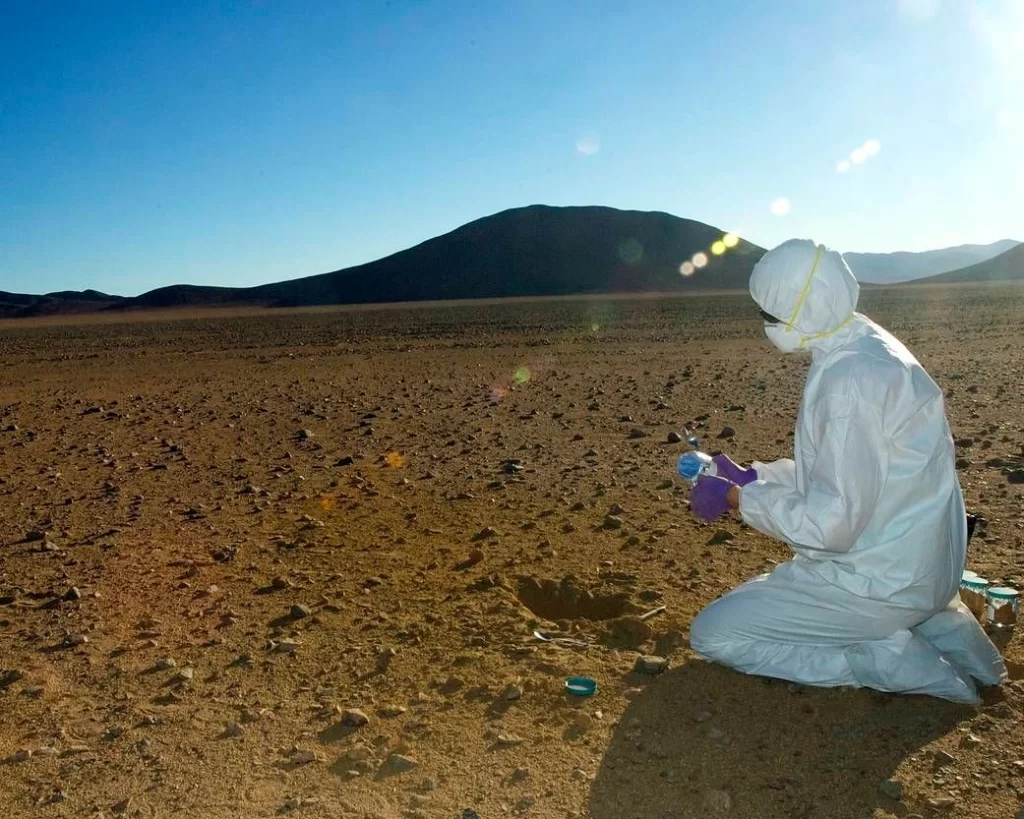
Scientists have found a bustling community of microbes living two meters below the cracked, sun-baked surface of the Atacama Desert in Chile, in conditions more similar to those on Mars than anywhere else on Earth. This “microbial oasis” questions what scientists thought we knew about where life may cling to life, and it’s creating new excitement for the search for extraterrestrial biology.
The Atacama is not simply any desert. It is the most arid place on earth, with some parts seeing less than a millimeter of rain a year. But bacteria and archaea buried deep under hypersaline soils rich in salts such as halite, perchlorate, and anhydrite not only survive—they flourish. These salts deliquesce, drawing in very little amounts of moisture from the atmosphere and producing ultra-thin layers of water, just a few microns thick, on the surfaces of crystals, which is why researchers have called it an oasis. That’s enough for these hardy microorganisms to break down, proliferate, and establish a working community, all without the need for sunlight or oxygen.
The Brutal Reality of the Atacama Desert
Picture a setting where the fog from the Pacific hardly penetrates inland, stopped by towering coastal mountains, leaving immense expanses of salt flats and rock that look like another planet. The Atacama, which spans over 105,000 square kilometers of northern Chile, has core sections like the Yungay Valley that are so parched they have become NASA’s favorite training ground for Mars rovers. Radiation levels here are similar to those on the surface of the Red Planet, UV rays cut through thin air, and temperatures swing drastically from cold nights to blistering days.
Life at the top? Few. Surface bacteria cling to life in shallow soils, but they’ve been found 2.6 feet down before. This new find brings it to two meters—and points to far deeper ecosystems, up to four meters in some studies—separate from surface turmoil. Spanish and Chilean teams used equipment like the SOLID life detector to drill into the hypersaline substrates and uncover this hidden world. SOLID’s biochip, packed with 450 antibodies, can detect biomolecules such as DNA, proteins and sugars in real time, showing that they are not dead leftovers but living cells.
What drives it? Those hygroscopic salts absorb humidity, reducing the water-freezing point to permit briny coatings even at -20°C. Microbes consume organic traces in the soil in the dark, recycling nutrients. It reminds us that extremity doesn’t mean sterility. Life adapts.
How Scientists Found the Underground Oasis
The breakthrough came from a Spanish-Chilean partnership headed by Victor Parro at Spain’s Center of Astrobiology (INTA-CSIC) and teams from Chile’s Catholic University of the North. In 2011, their research, still being referenced in 2026, employed a device called SOLID, originally created for Mars missions, to gather samples as deep as five meters. In labs, they revived bacteria with water, taking photos with electron microscopy and confirming activity.
Main microbial players: Actinobacteria (hardy adapters ) Firmicutes ( spore-formers ) Chloroflexi Cyanobacteria (upper layers)
Detection edge: iDNA analysis finds living organisms when prior approaches only found ghosts.
Depth gradient : Diversity decreases with salt accumulation and lack of water below 80 cm.
Not lab anomalies; samples “came to life” with water, showing metabolic potential.
Atacama: Why Does it Matter for Space Exploration
We have been “camping on Mars” here at NASA since ARADS and other teams tested rovers and drills amid dead test trees. Perchlorates—found in Atacama soils and Martian regolith—kill surface life, but could protect underground holdouts. Orbiters have detected saline deposits on Mars, hinting at similar hypersaline patches underneath where brines might persist.
Instruments like SOLID could drill Martian subsurfaces, where salts may preserve biosignatures. Even without living cells, high salinity can preserve molecules for eons—like ancient Earth bacteria preserved in this way. Recent Atacama gas research have detected volatiles emitted by bacteria in salt flats, a huntable signature for orbiters or landers. In ultra-dry soils spotted nematodes have been found by the University of Cologne in 2026, extending the analog.
For India, this rings true, with the ISRO targeting lunar south pole water and Mars Orbiter Mission legacy. Indian scientists are collaborating to search for extremophiles in the arid valleys of Antarctica, an analogy to the connections between the Atacama and Mars. Can Rajasthan’s Thar Desert, another hyper-arid place, have such oases? The discoveries put the squeeze on astrobiology around the world, feeding into missions such as NASA’s Perseverance or others that will return samples in the future.
But here’s a thought: life on Earth burrows two meters deep. How deep would we have to dig on Mars to locate it, or its traces?
Secrets ofSurvival for Desert Extremophiles
These bacteria don’t go it alone: They make communities suited to horrific chemistry. Deep: dominated by actinobacteria, decomposing organics anaerobically. Firmicutes spores may survive drying and will germinate when they come into contact with wetness. Nitrate is used for denitrification by halophiles such as those in Halobacteriaceae that love brine.
Deliquescence is the key, no rain needed. Salts draw in fog moisture, producing livable niches. Similar groups have been found in frozen Arctic soils or deep ocean vents, research shows, suggesting common tactics among extremophiles. The 2017 Atacama flood was a resilience test. Microbes bounced back, adjusting to salt shocks.
Links to the real world? Biotech looks to them for terraforming Mars or drought resistant crops. Knowledge of microbial water harvesting could encourage water-scarce farming in dry India.
Broader Implications and Unanswered Questions
This discovery is rewriting limits and implications. Life in the Atacama previously only reached up to 30cm, but it is now possible to reach 2-4 meters, protected from surface UV and radiation. It fuels hopes for subsurface Mars life, but hurdles remain: How varied are these oases? Do they cycle globally?”
Climate change is a competition. Atacama drying due to 150 million years of geophysical upheaval; today’s warming could decrease habitats or expose more. global scale – some estimates say that 97% of the bacteria reside in the subsurface. It highlights the deep biosphere of the Earth on
Gems like enzymes or remediation technology could be bio-prospected from the Thar or Ladakh cold deserts in India. Such analogues are what Chandrayaan follow-ups such as PRL Ahmedabad are looking at.
What if , in waiting for our drilling , Mars has a parallel calm biosphere ? These Atacama bacteria say yes – and they are telling us where to look.
Scientists discover microbial life two metres underground in Chile’s Atacama Desert, boosting hopes for future Mars-life research.