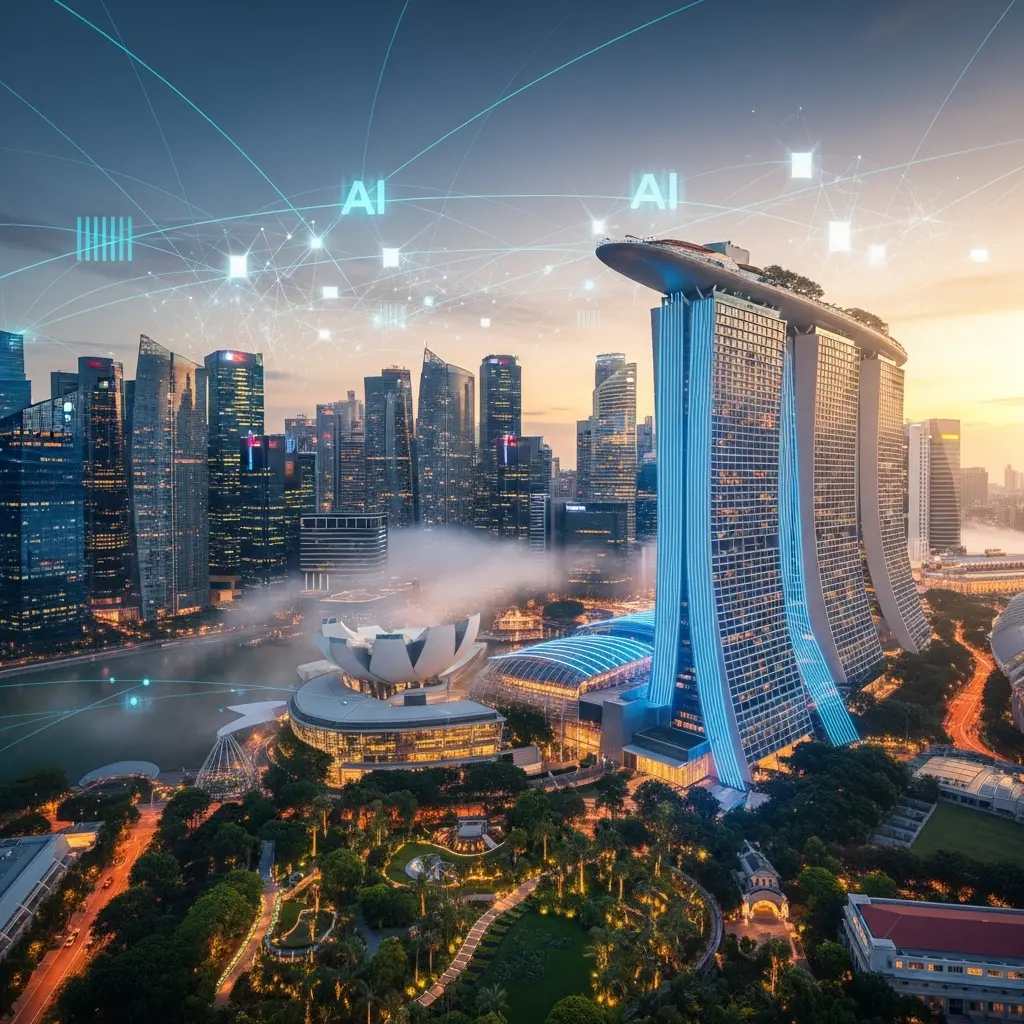
Singapore has always punched above its weight. Its latest move — a sweeping AI growth strategy — suggests it has no intention of stopping now, even as the competition from Washington and Beijing intensifies.
Singapore doesn’t do things quietly, and it doesn’t do things halfway. The city-state’s latest economic announcement — a comprehensive AI growth strategy designed to pull in global technology companies and cement its position as the region’s premier AI hub — is proof of both. If the plan works the way its architects intend, Singapore could become the address of choice for AI companies looking to plant a flag in Asia without having to choose sides between Washington and Beijing.
That geopolitical sweet spot is, in many ways, Singapore’s oldest and most valuable asset. For decades, it has made itself indispensable to global business by being reliably neutral, scrupulously well-governed, and strategically positioned at the crossroads of East-West trade. The new AI strategy is, at its core, an attempt to carry that legacy into the intelligence age.
“Singapore isn’t trying to out-muscle the US or China on AI — it’s trying to out-smart them by becoming the one place both sides trust enough to do business.”
What the Plan Actually Contains
The strategy, as outlined by government advisers, rests on three interlocking pillars. The first is infrastructure: a major push to expand data centers, high-speed digital connectivity, and the clean-energy supply needed to power it all sustainably. AI is famously power-hungry — training large models and running inference at scale consumes enormous amounts of electricity — and Singapore’s commitment to integrating clean energy into this build-out is both environmentally responsible and strategically smart. It makes the city-state’s AI investment proposition far more appealing to companies that have their own sustainability commitments to honour.
The second pillar is talent. Singapore’s workforce is already among the most highly educated in Asia, but the government recognises that AI requires a specific and fast-evolving skill set. The strategy places significant emphasis on training programmes — both for fresh graduates entering the workforce and for experienced professionals looking to upskill. Getting this right matters enormously. Infrastructure and investment will only take you so far; ultimately, AI development runs on human expertise.
The third pillar is partnerships. Singapore has long understood that a city of fewer than six million people cannot go it alone. The new plan doubles down on international collaboration — with research institutions, with foreign governments, and with private sector players from across the globe. For AI companies Singapore hopes to attract, this signals something important: that doing business here means plugging into a network, not just a location.
The Southeast Asia Opportunity
Singapore’s AI ambitions are inseparable from the broader Southeast Asia technology story, and that story is genuinely exciting. The region is home to over 670 million people, a rapidly expanding internet-connected population, and some of the world’s fastest-growing consumer markets. Experts believe Southeast Asia will be one of the fastest-growing AI markets globally over the next ten years — driven by demand in everything from financial services and healthcare to agriculture and logistics.
Singapore’s pitch to AI investment in Asia is essentially this: if you want access to that growth, we are the safest, smartest, most connected gateway. The legal frameworks are clear. Intellectual property is protected. The regulatory environment, while firm, is predictable. And the proximity to markets in Indonesia, Vietnam, Thailand, and beyond is unmatched.
Business groups in Singapore have welcomed the strategy warmly, and it’s easy to see why. For local companies, a government that is actively courting the world’s leading AI firms means access to partnerships, technology transfers, and talent pipelines that would otherwise be hard to build. The rising tide, in this case, really could lift a lot of boats.
Competing With Giants
Of course, ambition has to be weighed against reality. Competing with the United States and China on AI is not a modest goal. Both countries have vastly larger pools of research talent, far greater government and private investment budgets, and deep ecosystems of universities, labs, and companies that have been building AI capabilities for years.
Singapore’s answer to this gap is, characteristically, not to try to match the giants dollar-for-dollar — but to be better at certain things. Regulatory clarity. Political stability. A trustworthy judicial system. Openness to foreign talent and capital. These are the areas where Singapore’s AI policy can genuinely differentiate, and where it can make itself irreplaceable rather than merely competitive.
There’s also the question of timing. The global AI industry is still in a formative phase. Infrastructure is being built, standards are being set, and companies are still deciding where to locate key operations. Singapore is making its move at a moment when those decisions haven’t all been locked in yet — which is exactly the right moment to be bold.
Looking Ahead
What Singapore is attempting is, ultimately, a bet on its own model: that good governance, strategic openness, and relentless pragmatism can compete with sheer size. It has made that bet before — in finance, in logistics, in biomedical research — and won each time. There’s no guarantee the AI chapter will end the same way. But if Southeast Asia’s technology boom unfolds anything like analysts expect, being the region’s most trusted AI address will be worth a great deal.
The city-state has always known how to position itself for what comes next. On the evidence of this strategy, it hasn’t lost that instinct.