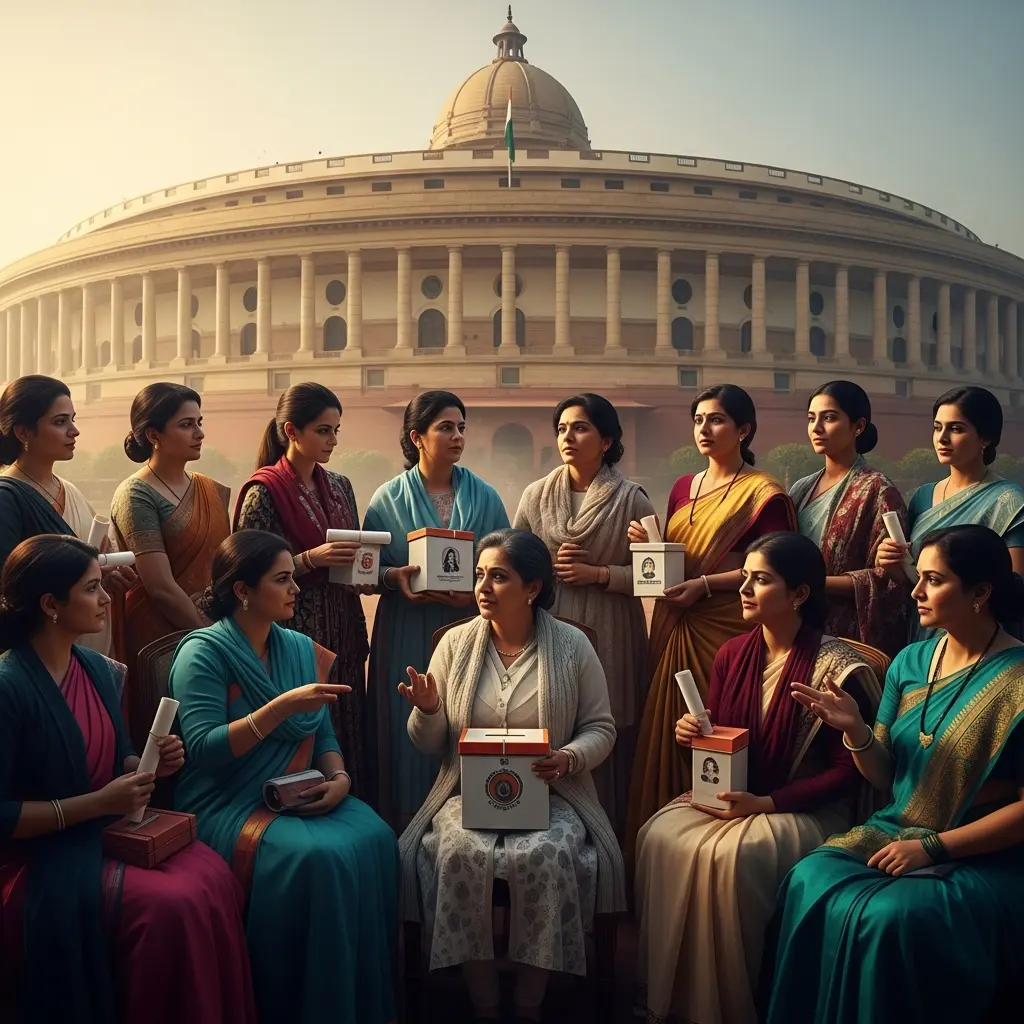
The Nari Shakti Vandan Adhiniyam has been passed. Now comes the harder part — turning a historic piece of legislation into lived political reality for half of India’s population.
Some laws change the mood of a country the moment they pass. The Nari Shakti Vandan Adhiniyam — India’s Women’s Reservation law — was one of those. When Parliament finally cleared the legislation reserving one-third of seats for women in the Lok Sabha and state assemblies, the cheers in the chamber weren’t just political theatre. They were the sound of a debate that had dragged on for nearly three decades finally reaching its conclusion.
But passing a law and implementing it are two very different things in India. As policymakers now work through the practical mechanics of bringing the women reservation in India framework to life, a more complicated — and more interesting — conversation has begun. Who benefits? When exactly does this take effect? And will reserved seats translate into genuine political power, or just a different way of distributing the same old influence?
“Reservation guarantees a presence. It doesn’t automatically guarantee a voice. The difference between the two is where the real work begins.”
What the Law Actually Does
At its core, the Nari Shakti Vandan Adhiniyam mandates that 33% of seats in the Indian Parliament — specifically the Lok Sabha — as well as in state legislative assemblies, be reserved for women. Importantly, this reservation is also within the existing quotas for Scheduled Castes and Scheduled Tribes, meaning that women from historically marginalised communities are specifically brought into the fold, and not considered as an afterthought.
The seats designated as reserved will rotate after each delimitation exercise — the periodic redrawing of constituency boundaries — so that no single constituency remains permanently reserved. This rotation mechanism is designed to prevent the creation of “women’s seats” that become permanently lower-status in the political imagination, a trap that has undermined reservation systems elsewhere.
The law’s implementation is formally tied to the next delimitation process, which requires an updated Census as its foundation. With the Census now underway after years of delay, the timeline for actual elections under the new framework is coming into clearer focus — though most analysts place full implementation no earlier than the early 2030s.
Why This Matters Beyond the Numbers
The case for gender representation in Indian politics isn’t just about fairness in the abstract — though that would be reason enough. It’s about what happens to policy when the people making it more closely reflect the population they serve. Research from India’s own panchayat system, where women’s reservation was introduced at the local level decades ago, offers some genuinely striking evidence: constituencies led by women saw measurably greater investment in public goods like water access, sanitation infrastructure, and girls’ education.
Scaling that effect to the national Parliament and state assemblies is not a simple extrapolation — politics at the top is a different arena, with different pressures and a different cast of actors. But the underlying logic holds. When women make up half the electorate and bring deeply different lived experiences to questions of healthcare, safety, economic participation, and family policy, their presence in the rooms where decisions are made is not a symbolic luxury. It is a functional necessity.
Supporters of the political reforms in India emphasize this point consistently. Policymaking diversity isn’t just a values statement — it’s an argument about outcomes. Laws designed without women’s full participation have a long track record of failing women in practice, however well-intentioned they may be on paper.
The Complications
Honest coverage of this law requires acknowledging the genuine tensions that surround it. The first is the implementation timeline. Tying the reservation to delimitation — itself tied to a Census — creates a lag that critics argue is unnecessarily long. Women who would benefit from the law are being asked to wait for bureaucratic processes to complete, and in Indian politics, timelines have a way of slipping.
The second tension is more structural. Reservation guarantees numbers, but not necessarily autonomy. India has seen, at the local panchayat level, the phenomenon of “proxy” representatives — women who technically hold the seat but effectively serve as stand-ins for male relatives who wield the real influence behind the scenes. Ensuring that the women elected to Parliament under this framework have genuine independence requires changes in political culture that no law can fully mandate.
That’s not an argument against the law — it’s an argument for taking seriously the work that needs to accompany it. Political parties have begun preparing strategies to identify, train, and elevate women candidates. The quality of that preparation, and the seriousness with which parties back female leadership with real resources and winnable constituencies, will determine much of what the Nari Shakti Vandan Adhiniyam actually delivers.
What Comes Next
India’s women have always been present in public life — as voters, as activists, as administrators, as entrepreneurs, and as leaders in every field outside the one formal institution most responsible for shaping national direction. That gap between women’s contributions to Indian society and their representation in Parliament has been one of the country’s quietest contradictions.
The women’s reservation law in India does not resolve that contradiction overnight. Nothing could. But it redraws the floor. It establishes, in constitutional terms, that the Indian Parliament must look more like the country it governs. Getting from that principle to that reality will take sustained effort — from parties, from civil society, from voters, and from the women who will step into those seats and prove, as so many have before them, that the hesitation was never really justified.
The law has passed. The harder, more important chapter is only just beginning.