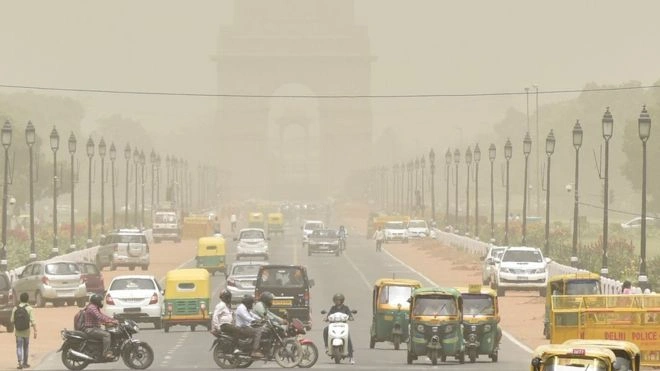
Real-time air quality data has once again placed Delhi among the world’s top ten most polluted cities with PM10 levels driven by relentless construction dust from the capital’s massive metro and infrastructure expansion — raising hard questions on what the cost of modernisation really looks like.
— ## When the Air Revolts Against You
There is something quietly disturbing about a city that can’t take a clean breath – not even on days when there are no crop fires burning in Punjab, no Diwali fireworks going off, no thick fog blowing in from the north. In Delhi, foul air has become such a norm that many inhabitants have stopped noticing the faint grey cloud hanging on top of the cityscape. But the data never lies, and the evidence right now is profoundly concerning.
Real-time air quality monitoring systems recorded Delhi’s Air Quality Index at 500, the most hazardous reading imaginable, with PM10 concentrations over 800 micrograms per cubic metre, as of early April 2026. For comparison, the World Health Organisation recommends an annual mean PM10 level of no more than 15 µg/m3. Delhi was clocking levels over 58 times that recommendation in that single occurrence. This is not a seasonal glitch. That’s a structural crisis.”
Of course, the city’s air quality concerns are nothing new. IQAir’s 2025 World Air Quality Report has placed Delhi as the world’s most polluted capital for the eighth consecutive year. Its yearly average concentration of PM2.5 was reported at 82.2 µg/m3, more than 16 times the WHO’s recommended safe level. In 2025, the city recorded the country’s highest yearly average PM10 concentration at 197 µg/m³, over three times India’s own national threshold of 60 µg/m³, an analysis by the Centre for Research on Energy and Clean Air (CREA) said. That year, the city failed to meet the national standard for PM10 on 285 days out of 365.
— ## The Dust the City Builds In Its Own Lungs
Vehicle emissions, industrial activity and seasonal stubble burning from nearby Punjab and Haryana often hog headlines, but there is a less-talked about contribution that has progressively grown to be increasingly significant: construction dust. And notably the kind generated by Delhi’s ambitious metro and infrastructure construction programme – one of the largest urban development projects anywhere in the world.
Continuous coarse particulate matter is generated collectively by massive metro expansion, road widening projects, flyovers and residential growth in the National Capital Territory. PM10 – particles with a diameter of ten micrometres or less – rise readily from dry earth, open building sites and newly shattered concrete. PM2.5 can reach deeper into the lungs because it is finer . PM10 is dangerous because of sheer volume . At the levels that are now being seen in Delhi, it irritates the eyes, nose and throat, it aggravates asthma, it destroys the airways. Chronic exposure over months or years increases the risk of chronic obstructive lung illness, bronchitis, and cardiovascular strain.
A peer-reviewed study published in late 2024, on the impact of metro infrastructure work on Delhi’s air quality found that PM10 and PM2.5 levels near active construction zones frequently surpassed both National Ambient Air Quality Standards and WHO standards. In these zones, there were also higher quantities of nitrogen dioxide from the construction machinery operations and vehicle emissions.
Complaints about dust due to construction sites of the Delhi Metro Rail Corporation (DMRC) increased to 2,180 in 2024 from 945 in 2022 and 1,378 in 2023. It was no accident. 2023 and 2024 were the years of the most extensive phase of metro expansion activity around the city. Dozens of sites were active simultaneously across different phases of network development.
— ## Rules, Reality and Enforcement: Penalties
The Delhi government has not been twiddling its thumbs. Authorities cracked down on fourteen Delhi Metro construction sites in a series of enforcement actions for breaching dust pollution regulations. The sites were slapped with an environmental compensation charge of Rs 50,000 each, along 42 other big projects across the city. In December 2025, Delhi Chief Minister Rekha Gupta publicly warned the DMRC, at a high-level review meeting, that any further violations of dust control norms would invite strict action — a statement that reflected both genuine pressure and the uncomfortable reality that the violations were still occurring.
The DMRC, for its part, has come up with a credible response. The company erected 82 anti-smog guns and 19 water tankers at project sites by the end of 2025, installed 30 anti-smog guns on rooftops and deployed mist spray systems at 131 metro stations to curb airborne dust. It also began enforcing Delhi’s 14-point dust management policy at all building sites and increased inspections – doing 1,189 site visits in 2025.
At least in part, the effort seems to be working. Dust-related complaints at DMRC sites declined substantially in the first four months of 2026, from 640 in the corresponding time in 2025 to only 24 – a reduction ascribed by the company to greater monitoring, better compliance at project sites and a faster complaint resolution procedure. In the same period of 2026, there were only 307 inspections needed, demonstrating that sites were generally complying with regulations and did not need repeat visits.
There is real progress. But it has to be understood in context. Not a single clean air day has been observed in Delhi so far in 2025. The metro sites’ upgrades are important but they are one strand of a much wider, knotted problem.
— ### The Larger Picture of Pollution: A City Under Siege
Delhi’s air quality dilemma is not one problem but eight or nine crises at simultaneously, each with its own timescale and each requiring a separate response. This is the difficulty in finding a lasting solution.
A 2016 source apportionment study (whose conclusions remain largely relevant today) indicated that road dust accounted for 56 per cent of PM10 pollution in Delhi, with concrete batching contributing 10 per cent, and industrial sources another 10 per cent. Vehicles contributed 9 per cent to the PM10. For the finer PM2.5, a 2023 research by the Delhi Pollution Control Committee revealed that burning of local organic waste — wood, cow dung, agricultural residue used for heating — contributed 24 per cent during winter while the transport sector contributed around 23 per cent.
Seasonal weather patterns just add to the mess. Delhi lies in a bowl-shaped depression in the Indo-Gangetic Plain. From October to January , cold air settles near the surface with warmer air above . This is called a temperature inversion . This traps pollutants close to the ground . The wind begins to die away. Smoke, dust, car exhaust. It all adds up. On the worse days, AQI regularly reaches 400. In the December 2025 episode, the index touched 433, which led to cancellation of over 40 flights at Indira Gandhi International Airport, stoppage of building activities and schools and offices resorting to work-from-home operations.
There is another equally critical reason that is often underappreciated: the dry conditions after the monsoon departure leads to dust storms and resuspension of road dust on a large scale. This was one of the major reasons for the pollution disaster in April 2026: extreme dry heat, low humidity and high winds, which carried dust from months of construction activity back into the air. It was not PM2.5 but PM10 that surged since the pollutant was coarse dust, not combustion.
— ### Policy Promise and Real Ground
In 2019, India began the National Clean Air Programme (NCAP) with an ambitious target – a 40 per cent reduction in PM10 concentrations across 131 cities by 2026, or compliance with national air quality requirements (60 µg/m³ for PM10, 40 µg/m³ for PM2.5), whichever is earlier. The image seven years on is fairly mixed.
A CREA research from early 2026 showed that in 2025-26, 89 of the 96 NCAP cities with enough monitoring data were still above the national PM10 standard. During the NCAP period, PM10 levels in Delhi fell by 17 per cent – a good improvement but well short of the 40 per cent target. CREA’s review found that the programme’s initial target is “no longer possible to achieve within its present timeframe.”
There have also been questions about where the money goes. The NCAP has devoted 64 per cent of its budget to road dust reduction, a noteworthy concentration considering that road and construction dust dominated PM10. Only 15 per cent of financing has gone to cutting biomass burning, 13 per cent to controlling car emissions and only 1 per cent to fighting industrial pollution. Critics say this does not match the real source profile of Delhi’s air.
Then there is the wide difference between Indian standards and WHO guidelines. If Delhi were to fulfill the target, even reaching the NAAQS goal of 60 µg/m³ for PM10 would be three times more than the WHO recommended annual mean of 20 µg/m³. A city can fulfill its own national standards and still be actively harming its inhabitants – a point that does not get nearly enough attention in public discourse.
Can you develop a world class metro network and still keep the air clear? Cities like Singapore, Tokyo and Seoul have done it, but they have tougher baseline environmental regulation, wetter climates and significantly less population pressure. Delhi’s difficulty is another level.
— ### The Hidden Human Cost Behind the Numbers
Every AQI number has a body behind it. Every spike in PM10 means a child’s lungs constricting, an older person coughing harder, a commuter ingesting particulates for two hours at an open-air bus stand.
According to a research published in August 2022 by the US-based Health Effects Institute, Delhi’s air pollution is among the worst in the world, based on an analysis of air quality in 7,000 cities worldwide. Poor air quality in Delhi has, according to one estimate, irreparably damaged the lungs of 2.2 million children. India as a whole has the world’s highest death rate from chronic respiratory disorders including asthma, according to the World Health Organisation. Air pollution kills about two million people per year in India.
A more recent study published in Scientific Reports in late 2025 that tracked respiratory deposition of particulate matter in Delhi over five years found that peak PM10 readings of 826.7 µg/m³ were recorded during the period, and that daily respiratory deposition doses for commuters during evening travel hours were up to 23 per cent higher than during morning periods — meaning that the body’s exposure to harmful particles is not evenly distributed across the day, and that evening commuters in Delhi bear a disproportionate burden.
These are not abstract figures. They reflect lived experience — the everyday math that millions of Delhiites do on when to venture out, if a mask is worth it, whether it is safe to let kids play in the park.
— ## Next Steps
A real step forward is the DMRC’s 22.23-km freshly commissioned metro route; more public transport equals fewer private vehicles on the road, which should, over time, reduce one of the key components of Delhi’s pollution load. The early 2026 data on dust complaints from metro sites is promising, and should be acknowledged.
But the air quality crisis is very much in play. CREA has urged NCAP to focus on PM2.5, stronger emission control and a regional airshed based approach – treating Delhi’s air as a regional problem and not city-focused, given how much pollution from adjacent states flows into the capital. There is also an obvious need for better use of clean air funds: Delhi was one of the worst performers in India, having spent only 33 per cent of its allocated NCAP funds.
The tale of clean air in Delhi is not one of lack of effort, but of a gap between goal and outcome. It’s a testament to the size of modernising a 32 million-strong city, at speed, with every crane and earthmover adding to the burden while constructing for a cleaner tomorrow. Real-time air quality measurement has made the situation public in a way that was not conceivable ten years ago—and visibility, at minimum, fosters accountability.
What Delhi needs now is better data, not just better sanctions. It requires enforcement that is consistent rather than reactive, policy targets calibrated against WHO standards rather than lenient national benchmarks, and a genuine recognition that infrastructure development and environmental protection are not opposing goals — they are, or should be, the same goal.
Until such clarity pervades both policy and practice, Delhi will continue to create its future out of dust – and breathe it too.
—
Delhi’s Poisoned Sky: The Capital Chokes on Its Own Ambition