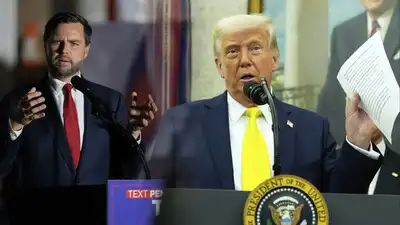
A newly disclosed account from a White House official says President Donald Trump placed a sealed letter addressed to Vice President JD Vance inside the Resolute Desk drawer — a private contingency note meant to guide the vice president should circumstances force an abrupt transfer of power. This revelation, shared publicly by a senior aide in a podcast interview, has stirred fresh debate about presidential continuity, the symbolism of behind-the-scenes planning, and how modern administrations handle worst‑case scenarios.
Why this matters now
The existence of a sealed instruction draws attention because it sits at the intersection of constitutional process and personal politics. The U.S. Constitution and the Presidential Succession Act lay out formal, institutional steps for presidential succession; a private letter, while nonbinding, signals the president’s intent and priorities to his chosen successor — and in this case, it also sends a clear political message about whom Trump trusts to carry his agenda forward. Given the high political temperature in Washington and the global consequences of sudden leadership changes, even symbolic preparations matter to allies, markets and domestic actors alike.
What was revealed, and who said it
The disclosure came during an interview in which Deputy Assistant Sebastian Gorka said there is “a letter in the drawer in the Resolute Desk that is addressed to the vice president should something happen to him.” Gorka framed the note as part of routine precautionary measures and presidential protocols, rather than something out of the ordinary for a president mindful of security risks. Multiple outlets have since reported versions of the same account, all attributing the detail to the White House source’s public remarks.
Separating legal reality from political theater
Legally, nothing in a private letter can change the constitutional line of succession: if a president dies, resigns or is removed, the vice president immediately assumes the presidency and takes the oath of office; if the vice president is unavailable, the line proceeds to the Speaker of the House, the president pro tempore of the Senate, and cabinet officers, in that order, as set by federal law. A letter placed in the Oval Office cannot alter that statute, but it can provide practical, operational guidance to a successor about ongoing priorities, classified matters, or urgent personnel decisions that would otherwise be handled in the chaotic early hours of transition.
Why presidents have contingency messages
Presidents have long prepared for unforeseen contingencies. Brief, private communications — whether letters, recorded messages, or handwritten notes — can help a successor stabilize leadership, reassure staff and allies, and signal continuity in key policy areas. In modern presidencies, continuity of government plans are necessarily detailed and often coordinated with national security teams, the Secret Service and Cabinet officials. A personal letter adds a human dimension: it is an expression of trust and an attempt to guide judgment during a fraught moment.
Political reading: what the letter signals about Vance
That the note is addressed specifically to JD Vance matters politically. Since assuming the vice presidency, Vance has been presented by some within Trump’s orbit as a natural ideological heir and the public face of a younger MAGA-aligned leadership cohort. A sealed instruction explicitly naming Vance as the recipient underscores Trump’s preference for continuity through a loyal vice president rather than leaving immediate stewardship to institutional actors or political rivals. For supporters, that is a vote of confidence; for opponents, it may look like grooming or succession management aimed at preserving a distinct policy brand.
Domestic and international implications
Domestically, the revelation will feed partisan narratives on both sides. Supporters may point to the letter as prudent planning; critics will treat it as performative — or even as an attempt to create an aura of exceptional control beyond institutional norms. Internationally, allies and adversaries watch leadership stability closely: sudden, unclear transfers of authority can disrupt diplomacy, military command chains and markets. Even a private, nonbinding message can therefore matter because it may help a successor hit the ground running and reassure foreign governments about continuity in policy and command.
Operational realities: what such a letter can (and cannot) do
Can clarify immediate priorities: a letter might list names of trusted advisors, policy directives to protect, or urgent decisions awaiting action. That practical orientation can be helpful in the short window after a transfer of power.
Can offer moral or personal guidance: a president’s private words can steady a grieving or shocked successor and provide a psychological anchor during the first hours of crisis.
Cannot change legal succession: no private writing can override the Constitution or federal law that determines who becomes president and how the office transfers.
Cannot substitute for classified briefings or operational continuity plans: national security and continuity require formal, secure handoffs and coordination with agencies that a personal letter alone can’t provide.
Questions worth asking now
What, if any, operational or classified follow-up protocols accompany that private letter within the White House?
Were key agencies and Congress briefed about this kind of contingency communication, and do they have visibility into how such private guidance would interface with legal succession?
How media and public reaction may shape the story
Coverage will likely split along ideological lines: some outlets will treat the detail as a procedural curiosity and a sign of preparedness; others will see it as a politically charged symbol that invites scrutiny about the concentration of presidential influence. The framing matters because public perception — especially around leadership stability — can shape everything from market confidence to diplomatic posture. Journalists and analysts will look for corroboration: whether the letter exists in the form described, what it contains, and how the White House integrates such a message with formal contingency planning.
Context from history and precedent
Private messages from outgoing leaders are not unheard of. Past presidents have left notes for successors, as a mix of personal farewell and practical advice. What’s new in the current moment is the heightened polarization and the explicit naming of a close political protégé in a way that blends the personal and the political. That amplifies the symbolic weight of a private letter in ways earlier notes may not have carried.
A look ahead: implications for governance and elections
If the letter becomes a sustained part of public discourse, it could influence perceptions of JD Vance heading into future political cycles. Publicly putting a vice president’s name out there as the preferred successor — even in a private instruction — can speed up the political narratives around succession and leadership renewal. That, in turn, can reshape campaign calculations, in-party positioning and how rival figures position themselves for 2028 and beyond.
A measured takeaway
The reported letter is a noteworthy detail because it combines personal contingency with political signaling. It does not change the legal mechanics of succession, but it matters in terms of messaging and practical guidance during a crisis. For voters, officials and foreign partners, what counts ultimately is how quickly and smoothly a successor can assume responsibilities — and whether institutions beyond a personal note are prepared to sustain continuity.
Final thought
A sealed letter in the Resolute Desk drawer reads like a relic of presidential lore, yet it also raises practical questions about how modern administrations plan for the worst. Will such private guidance prove stabilizing if ever needed? Or will it be another piece of political theatre? Either way, it shines a spotlight on how leaders mix personal trust with institutional responsibility in the most consequential moments of governance.
Inside the Resolute Desk: Trump’s Sealed Succession Letter for VP JD Vance and What It Means for American Politics