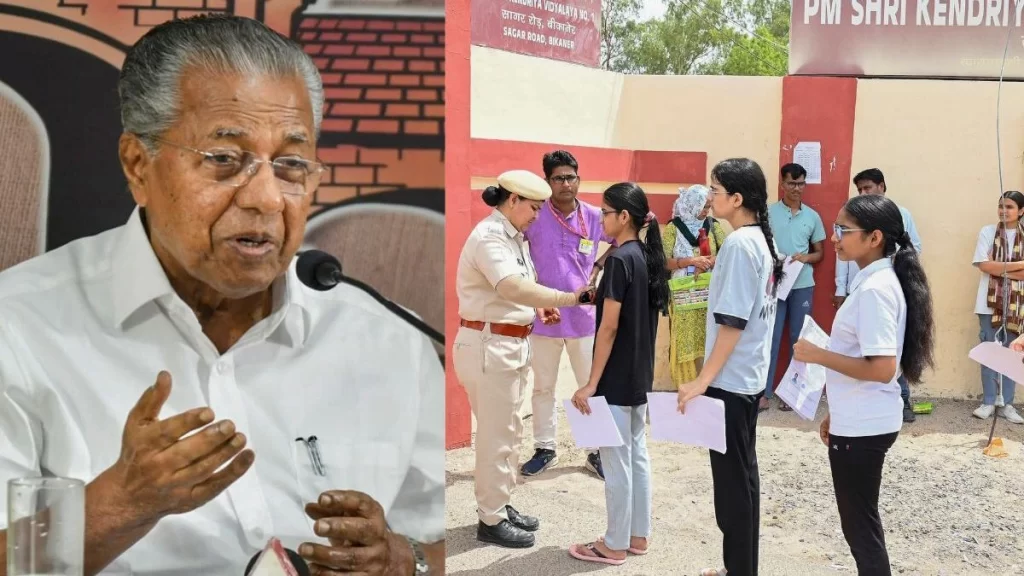
Kerala chief minister Pinarayi Vijayan on Wednesday demanded the scrapping of the National Testing Agency (NTA) altogether. He said the allegations of a question-paper leak in the National Eligibility-cum-Entrance Test (NEET-UG) were “extremely serious and condemnable” and called for exam duties to be returned to state and other government bodies. The demand sets off another wave of political backlash, student protests and requests for reform of the institutions accused for the recent high-profile exam anomalies that have repeatedly been attributed to the NTA.
Why all the fuss now
Pinarayi Vijayan’s public appeal to dismantle the NTA follows further claims about the conduct of NEET‑UG, which state politicians, student groups and opposition parties say point to systemic failure rather than individual lapses. Kerala has seen demonstrations and political pressure build: student groups took to the streets in Thiruvananthapuram and other towns, claiming repeated cancellations, irregularities and alleged leaks have ruined the careers and morale of thousands of applicants. National political personalities and opposition voices have also called for a thorough reform of the agency, pointing to a pattern of breaches across numerous major national tests.
The verdict of the critics
Critics claim numerous episodes since the NTA’s inception in 2018 have seen high-stakes tests marred by allegations of leaks, impersonation, irregularities or poor logistical preparation, with the NEET crisis the latest manifestation of deeper governance and technical difficulties. Those solutions, critics say, were limited and insufficient, leaving the agency exposed to further failure, although parliamentary and expert groups in the past have identified weaknesses and proposed revisions. For many parents and children, the issue is existential: One compromised test can determine admittance to medical and professional colleges, scholarships and jobs.
Political and administrative fallout
Pinarayi’s demand is both a political statement and a practical request for administrative change – he specifically proposed to restore the conduct of tests to various government bodies as was the practice before the NTA was created. There are supporters and adversaries of that proposition. Supporters say that decentralisation of oversight could mean closer accountability to state administrations and localised safeguards. Opponents warn that a return to a fragmented model risks uneven standards and greater opportunity for local manipulation, unless strong national safeguards are put in place. In the past, the Centre has supported reform efforts and guaranteed execution of expert suggestions rather than the outright abolition of the agency.
Student view and public confidence
Students and parents on the ground believe recurring disputes have eaten away at trust in the whole exam system. Many test takers spend years, coaching and substantial sums of money on a single exam window — and unexpected cancellations or allegations of leaks raise anxiety, financial stress and public outrage. Student groups in Kerala and abroad have called for thorough investigations, prosecution where appropriate and a firm strategy to restore integrity to tests. How do authorities restore trust after numerous violations? Now that’s the question rocking assemblies, court rooms and social media.
Legal and institutional alternatives
There are numerous institutional routes possible. The first is a major revamp of NTA’s governance, technology and accountability procedures – better procurement, independent audits, enhanced cybersecurity, tougher invigilation rules and open incident reporting. Another option, as Vijayan suggests, could be to dismantle the NTA and resort to state or specialised government entities conducting certain tests, but this needs a planned, legally strong transition plan to ensure no gaps in conduct and fairness. A third option is hybrid: keep a central testing power but with considerable structural adjustments and legislative safeguards put in place through parliament or judicial monitoring. All have compromises with respect to scale, speed, and political feasibility.
Technical weaknesses and the cyber dimension
The past’s controversies have exposed both human frailties and technical vulnerabilities. In past years, hacking, impersonation, and misuse of exam software showed that high-stakes testing required robust cybersecurity and trustworthy vendors. Experts suggest independent code audits, multi-party checks of question papers, end-to-end encryption in delivery systems and tight control on vendor access. Without these safeguards, the risk of skilled misconduct or opportunistic breaches is substantial, especially with millions of candidates spread across multiple exam windows.
Political Timing and the General Election Context
Vijayan’s statement comes at a time when the question of exam integrity has been a politically heated one across the country with opposition parties and civic society amplifying their requests for reform of the NTA. The promise to close down the NTA can be seen partly as a gesture towards public opinion in Kerala, where concerns about NEET and student protests have electoral implications. At the same time, national leaders have been leery about destroying institutions without clear, implementable alternatives, because of the logistic load of conducting dozens of national and professional exams annually.
Possible immediate actions
Options the Centre and state governments are expected to consider in the immediate term include joint inquiry panels, interim suspension of questionable exam cycles, criminal probe of leak claims, review of vendor contracts and procurement protocols. Courts may also be called upon to interfere when plaintiffs allege procedural unfairness or seek the annulment of results. Some interim relief solutions are offered to decrease immediate harm for impacted students, such as allowing re-examination periods or provisional admissions with tight verification, but these are difficult to scale quickly due to political and administrative challenges.
What reform could look like
Meaningful reform would require a combination of technical fixes and legal and institutional changes: statutory clarity on the NTA’s mandate and oversight, greater transparency on question-paper handling, external audits, whistleblower protections and direct accountability of officials who fail to apply safeguards. In particular, any reform package will need to demonstrate visible, rapid action to restore public confidence, or be seen as “tinkering” with the old mechanisms. Might a middle way be a hybrid model–national standards, state implementation, and local audit windows? That is a debate that policymakers will have to undertake openly.
Impact on Students & Families in India
The stakes are personal and immediate for millions of people. The sudden call off of exams, delay in results or the threat of paper leaks disturb career plans and lead to financial loss, from coaching fees to missed academic years. The costs to people are not just economic, but psychological. The greater uncertainty is a burden on mental health, particularly for young candidates in stressful environments. A policy response must integrate this human dimension with counselling help, clear timetables and compensation systems in cases of proven fault.
Where it goes after that
In the next few days, expect a quick political heat as state assemblies, student protests and parliamentary discussions will demand inquiries and reforms, and judicial scrutiny might ensue if complaints are filed. The centre will probably encounter pressures to undertake structural transformation, fight court cases or restructure exam governance. Meanwhile, students and parents will be looking for serious, enforceable steps to prevent future breaches and to provide recourse to those who’ve already been hurt.
One more thing
The dispute is not confined to one agency or one exam but points to wider questions about how a modern, complicated education system balances national standards, technical reliability and local responsibility. How do we develop an examination system that is secure and responsive to local realities? And if things go wrong, who do you blame—the administrators, the vendors, or the political masters?
Key points at a glance
Kerala CM Pinarayi Vijayan called for disbanding of NTA over alleged NEET-UG paper leak.
The NTA has been blamed for its frequent failings in the exams, prompting student demonstrations and political censure.
The choices are to reform the NTA, return tests to state agencies or adopt a mixed reform strategy and all have merits and cons.
Short-term steps could include inquiries, suspension of disputed examination cycles and intensified vendor supervision.
What we need are open, enforced adjustments, and sensitivity to the human cost of the failures, to rebuild students’ faith.
The next several weeks will test whether policymakers can translate indignation into measures that will genuinely avoid another disaster, or whether the cycle of scandal and repair will simply continue. Whatever the outcome, the pressure from states such as Kerala has one thing clear: national exam governance cannot be business as usual.
Kerala Demands End to NTA After Alleged NEET Paper Leak: Pinarayi Vijayan Calls for Agency’s Scrapping as Student Protests Surge