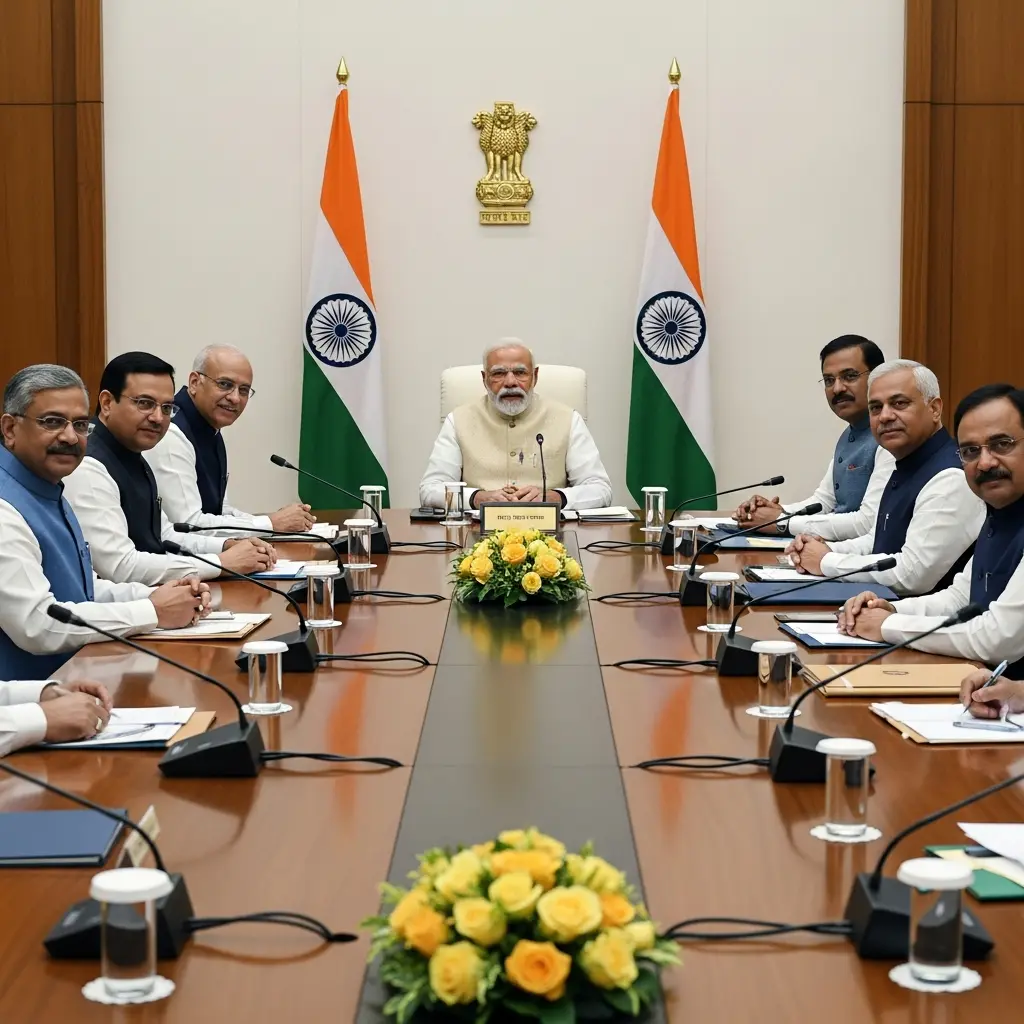
When the Prime Minister gathers every Chief Minister and Deputy Chief Minister of an alliance that now governs over half the country, it is more than a party ritual. It is a statement of intent.
There is a particular kind of political meeting that looks, on the surface, like an administrative exercise — schedules reviewed, resolutions passed, photographs taken — but is, in reality, something more purposeful. The NDA meeting of Chief Ministers and Deputy Chief Ministers chaired by Prime Minister Narendra Modi in New Delhi was one of those gatherings. It was a coordination summit, a governance review, and a political signal all rolled into one long working day.
The attendance alone told part of the story. With Chief Ministers and Deputy Chief Ministers from all 20 NDA-ruled states present, alongside BJP National President JP Nadda, Home Minister Amit Shah, and Defence Minister Rajnath Singh, the room represented an alliance that now governs a significant share of India’s population and geography. That kind of consolidated political weight does not gather simply to exchange pleasantries.
At the centre of the discussions was a theme that has become the defining frame of the NDA government’s self-presentation: governance as development delivery. Narendra Modi has long insisted that the test of political leadership is not rhetoric but results — welfare schemes reaching their intended beneficiaries, infrastructure projects completing on deadline, digital governance tools cutting out middlemen and reducing the friction between citizens and the state. The meeting was, by all accounts, a rigorous review of how well that test is currently being met across individual states.
“Solution-centric governance with a focus on grievance redressal is the distinctive identity of all NDA state governments.” — PM Narendra Modi
Each state, according to accounts of how these conclaves typically unfold, was expected to share its best practices — showcasing what is working in areas like water conservation, health service delivery, agricultural support, and administrative transparency. This peer-learning model reflects a deliberate BJP strategy: rather than imposing a top-down diktat, the central leadership uses these gatherings to create a competitive dynamic among state governments, encouraging them to benchmark against each other and accelerate the pace of delivery.
Key themes on the NDA meeting agenda
Digital governance and last-mile scheme delivery
Infrastructure expansion and state-level project timelines
Welfare saturation — Ayushman Bharat, PM Awas Yojana
Economic growth coordination between Centre and states
Youth empowerment and skills development
Election readiness in upcoming assembly poll states
Digital governance, in particular, has emerged as a central pillar of what the NDA frames as its model of administration. The rollout of direct benefit transfers, the expansion of the Jan Dhan ecosystem, and the push for DigiLocker and UMANG-based service delivery are not just policy decisions — they are, from the party’s perspective, evidence of a governing philosophy that trusts technology to do what bureaucracy historically could not: reach every beneficiary without leakage. The meeting pushed for faster adoption of these tools at the state level, where implementation gaps between policy design and ground reality tend to be widest.
Inevitably, the gathering also carried an electoral undercurrent. Several states in the NDA fold are approaching assembly elections over the next 12 to 24 months, and the coordination between central strategy and state-level campaign positioning is something the BJP has grown exceptionally disciplined about over the past decade. The NDA meeting served as an opportunity to align narratives, identify pressure points, and ensure that the governance reforms being implemented now translate into credible political capital when voters go to the booths.
Political analysts watching the meeting note that the BJP’s strength in these gatherings lies in its ability to present its governance model not as ideology but as administration — practical, quantifiable, and transferable. By having Chief Ministers discuss what is working in Rajasthan’s water management or Uttarakhand’s tourism development alongside central schemes, the party creates a template that can be adapted and replicated, giving each state government a set of visible achievements to communicate to their own electorates.
The emphasis on India’s Viksit Bharat vision — the aspiration to achieve developed-nation standards by 2047 — ran through the discussions as both a long-term goal and a near-term accountability framework. Modi has been relentless in using the 2047 horizon to recast each infrastructure project, each welfare scheme, each governance reform as a chapter in a larger national narrative. The NDA meeting reinforced that framing, urging Chief Ministers to see their work not merely as state administration but as a contribution to the country’s broader developmental arc.
“The PM emphasised the need to ensure saturation coverage of welfare schemes — that NDA-ruled states should be seen as the example of good governance for the rest of the country.”
What the meeting also underscored, in a way that does not always get sufficient attention in political coverage, is the complexity of coalition management at this scale. The NDA is not a monolith. It also has regional parties with their own identities, vote banks and policy priorities – Nitish Kumar’s JDU in Bihar, other alliance partners across the south, west and northeast. Holding all of these together under a shared governance agenda, without flattening regional diversity, requires a particular kind of institutional discipline. The regular NDA conclave model has become one of the key mechanisms for maintaining that cohesion.
For ordinary citizens, what ultimately matters is not the political optics of a leadership meeting but whether the governance reforms it discusses actually arrive at their doorstep — as a faster passport, a swifter hospital admission, a transparent land record, a timely crop support payment. That gap between conclave and consequence is where the real test lies. And by all indications, that is precisely the gap the Prime Minister spent the day asking his Chief Ministers to close.
One Table, Twenty States — What the NDA’s Leadership Conclave Signals About India’s Governance Direction.