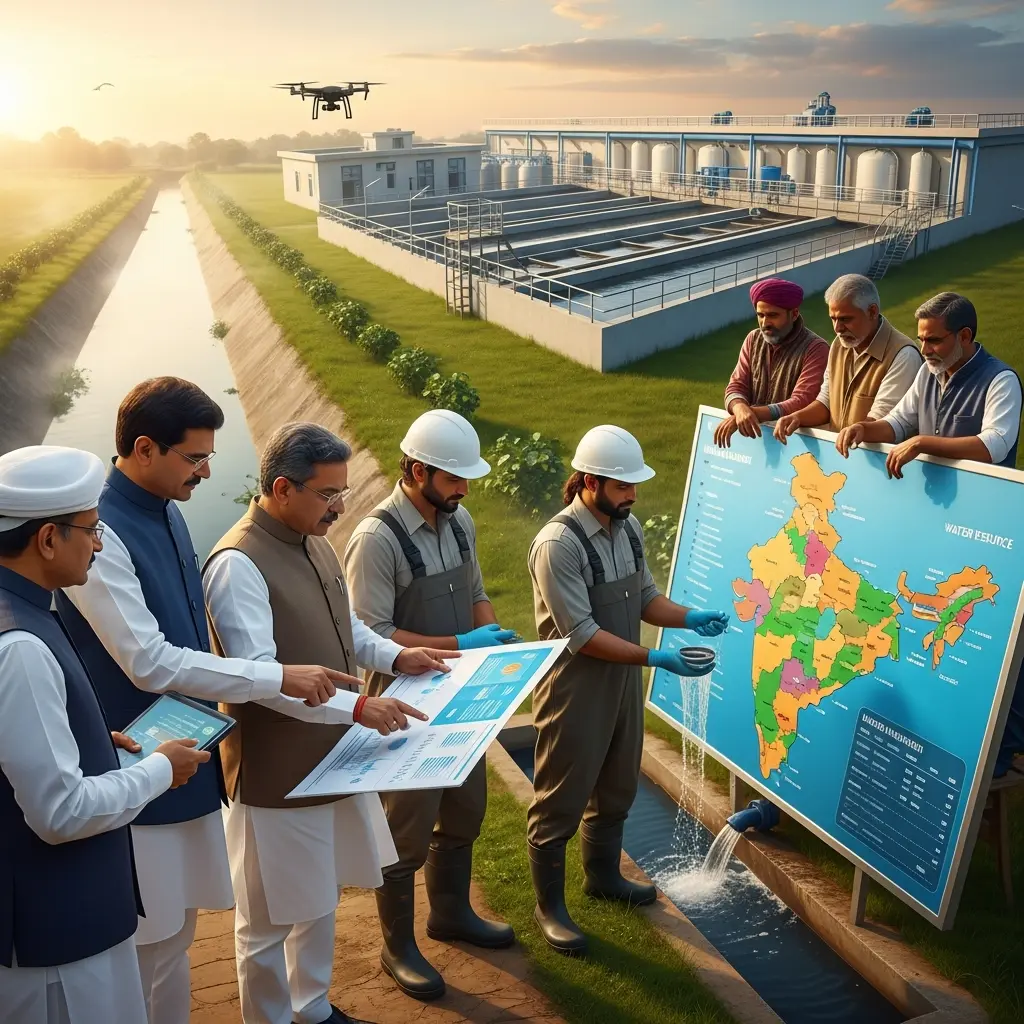
Aquifers are sinking. Monsoons are growing less predictable. And demand is set to overtake supply before the decade is out. India’s water crisis is no longer a future warning — it is a present emergency asking to be treated like one.
In Borichibari, a small settlement in Maharashtra’s Nashik district, three local wells have collapsed in recent years. Women in the village now walk 1.5 kilometres for every bucket of water they need. In Punjab, once celebrated as India’s breadbasket, aquifers in some areas have been drawn so far down that they have simply run dry. In Bengaluru — one of the country’s most prosperous technology hubs — groundwater reserves are declining at a pace that alarms hydrogeologists who have been monitoring the city for decades.
These are not isolated hardships. They are symptoms of a structural problem that policymakers, environmental scientists, and community leaders are now confronting with a new sense of urgency: India holds roughly 18% of the world’s population but commands only about 4% of the world’s freshwater resources. The arithmetic has always been daunting. What is changing is the awareness that the reckoning it implied can no longer be deferred.
Hyderabad, Delhi, Chennai, and Mumbai are all dealing with critically low groundwater, patchy monsoon performance, and demand that keeps rising as populations grow and urban economies expand. Water tanker costs have climbed. Supply disruptions that were once seasonal inconveniences are beginning to look like structural features. For millions of ordinary households, water scarcity is not an abstraction — it is a daily calculation about when to fill a vessel, how long a supply will last, and what happens if it runs out.
“India is not running out of rainfall. It is running out of the ability to store and manage it effectively — and that is a governance problem as much as a natural one.”
That distinction matters enormously for how the crisis is understood and addressed. India receives substantial rainfall annually — nearly 4,000 billion cubic metres — but only around 1,100 billion cubic metres is considered usable. The gap exists because of inadequate storage infrastructure, the extreme seasonal concentration of monsoon rains, and the uneven geographical distribution of precipitation. The northeast is relatively water-rich; large swathes of Punjab, Haryana, Rajasthan, and central India face chronic depletion. Floods and droughts now arrive in the same season in the same country, sometimes in adjoining districts.
Agriculture sits at the heart of the problem. India’s farming sector consumes nearly 80 to 85 percent of the nation’s available freshwater, often through flood irrigation methods that are far less efficient than drip or sprinkler systems. Government policies that have in the past encouraged the planting of water-hungry crops like paddy and sugarcane in already water-scarce regions have added to the pressure. The Pradhan Mantri Krishi Sinchayee Yojana — built around the principle of “per drop more crop” — represents a shift toward demand-side thinking, but scaling micro-irrigation across millions of smallholder farms is a complex and long-term undertaking.
Urban areas face a different but equally serious set of challenges. The World Bank estimates that most Indian cities lose 30 to 50 percent of their treated water through leakage, theft, and poor metering before it ever reaches a tap. This “non-revenue water” — water produced and treated at public expense but never paid for — in many cities exceeds the entire daily supply to tier-2 urban centres. Fixing this invisible haemorrhage through smart metering, pipe replacement, and stronger accountability in urban utilities represents one of the most cost-effective interventions available, yet it remains underprioritised in infrastructure planning.
What experts say must happen — the path to water security
Efficient irrigation
Scale drip and sprinkler systems; shift away from flood irrigation for water-intensive crops.
Urban pipe reform
Fix the 30–50% of treated water lost through leakage, theft, and poor metering in cities.
Community-led stewardship
Revive local water bodies and traditional conservation models with government support.
Unified legal framework
A National Water Framework Law to resolve inter-state disputes and fix governance gaps.
India’s water governance is, by most expert assessments, significantly fragmented. Multiple ministries, boards, and commissions handle different aspects of the water system — surface water, groundwater, sanitation, irrigation, urban supply — with overlapping mandates and limited coordination. The Central Ground Water Board, which is responsible for monitoring aquifer conditions across the country, still relies on outdated data systems in many regions. River basin management cuts across state boundaries that do not follow hydrological logic, generating the kinds of inter-state water disputes — the Cauvery, the Krishna, the Ravi-Beas — that have dragged through courts and commissions for decades.
What climate policy experts and water scientists increasingly argue is that sustainable development in India will ultimately be constrained by water long before it is constrained by capital or labour. The World Bank’s projection that water scarcity could shave six percent off India’s GDP by 2050 is striking, but even more striking is how little that number features in mainstream economic planning. Water is treated as a welfare issue. It is, in reality, also a productivity issue, a food security issue, a public health issue, and — as the United Nations’ January 2026 report on global water bankruptcy made plain — an existential one.
“Long-term water security will not come from a single breakthrough. It will be shaped by consistent policy, renewed attention to community practices, and gradual behavioural change — sustained over years, not election cycles.”
There are, encouragingly, models that work. In Bengaluru, citizen groups working alongside municipal agencies have restored polluted and encroached lakes, improving local water quality in measurable ways. In Pune, neighbourhood initiatives have experimented with water budgeting — tracking and managing daily consumption at a granular local level. In Tiruchirappalli, AI-based systems are being piloted to minimise losses in drinking water distribution. In Indore, the revival of 330 traditional water sources — wells and step-wells that were once abandoned — has meaningfully improved urban water availability. These are not marginal experiments. They are proof of concept, waiting to be taken to scale.
India has the institutional capacity, the technical expertise, and — with programmes like Jal Jeevan Mission, Atal Bhujal Yojana, and the Namami Gange initiative — the policy frameworks to begin turning the tide. What it requires now is the political will to treat water conservation not as a departmental responsibility but as a national strategic priority: funded accordingly, governed coherently, and held to account at every level of the system. The water is still there. The question is whether the seriousness to manage it is too.
India’s Water Reckoning — A Country With 4% of the World’s Freshwater Cannot Afford to Waste a Drop.