
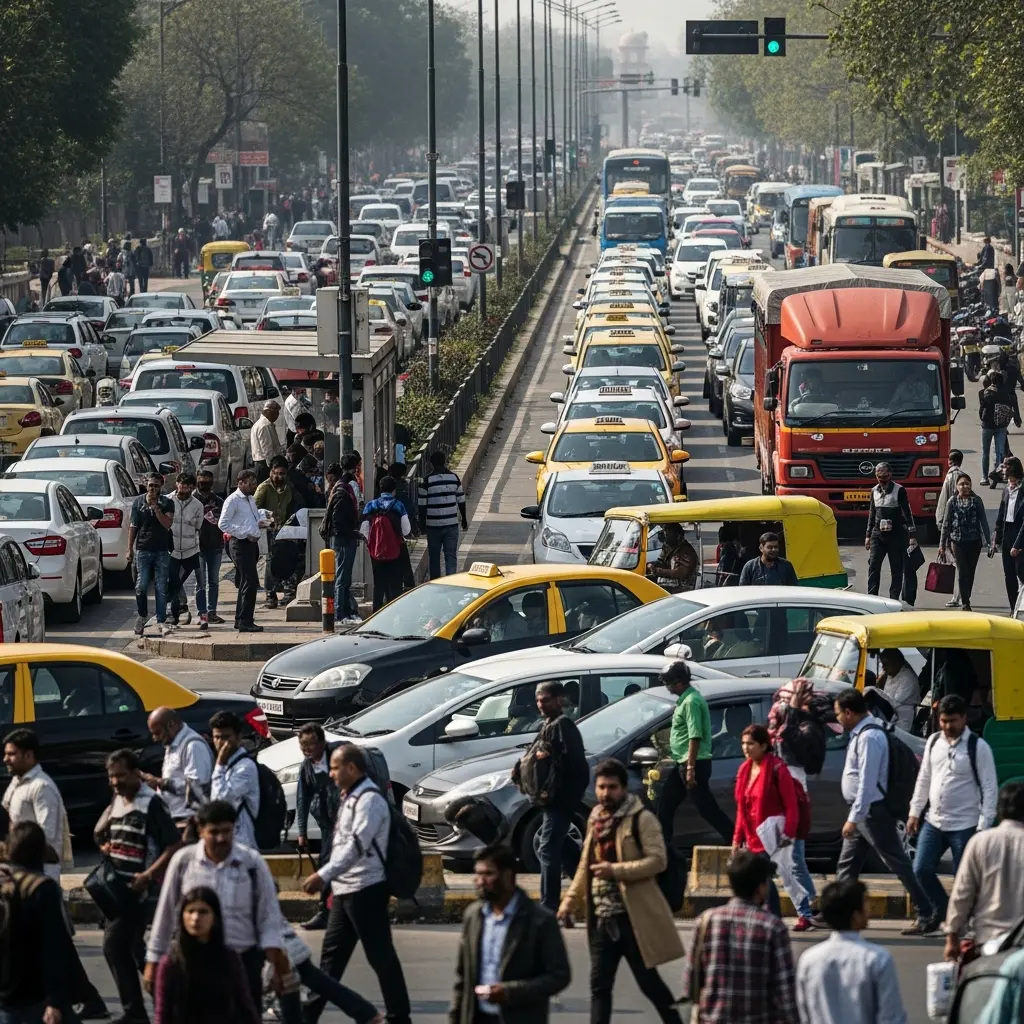
When taxi, auto, and truck unions walked off the job across Delhi-NCR to protest rising environmental taxes and unresolved fare disputes, it wasn’t just traffic that ground to a halt — it was the daily rhythm of millions of ordinary lives.
By seven in the morning, the signs were already unmistakable. Auto stands that are usually a blur of yellow and green sat eerily quiet. Cab aggregator apps cycled through surge price warnings before simply failing to find a driver. At bus depots and metro feeder points across the capital and its satellite cities, small knots of bewildered commuters stared at their phones, recalculating journeys that had, until yesterday, been entirely routine. The Delhi strike had arrived — and the city felt it immediately.
What triggered the walkout was, on paper, a set of specific economic grievances. Transport unions representing taxi, auto-rickshaw, and truck operators had grown increasingly frustrated with a combination of rising environmental levies — taxes designed to curb vehicular pollution in one of the world’s most choked urban airsheds — and a longstanding stalemate over fare revisions that they argue have not kept pace with fuel costs, insurance premiums, and vehicle maintenance expenses. The NCR transport protest, in this sense, was a long time coming.
Thousands
of commuters affected across Delhi-NCR
Partial
services on key routes during the strike
Multi-day
negotiations with authorities underway
A morning without wheels
For the vast majority of Delhi-NCR’s working population, the abstract politics of transport unions became very concrete, very fast. Office workers in Gurugram scrambled for shared rides. Students from Noida and Faridabad missed morning classes. Day labourers who depend on early-morning mobility to reach construction sites and factories found themselves stranded at crossroads, losing wages for every hour the strike held.
From the ground
“I waited almost ninety minutes for an auto. When one finally came, the fare he quoted was three times the meter rate. I had no choice — I was already late for work.”
— Office commuter, Dwarka Sector 10
Those who rely on app-based cab services found little relief either. With the taxi strike in India’s capital cutting driver availability to a fraction of normal levels, ride-hailing platforms saw demand spike while supply collapsed — a combination that pushed prices to heights that placed them firmly out of reach for ordinary commuters. Some services operated in a limited capacity, prioritising longer-distance trips where surge pricing made it economically worthwhile for the handful of drivers who chose to work. For everyone else, the city’s famous jugaad spirit kicked in: carpools were hurriedly arranged over WhatsApp groups, e-scooters were commandeered for longer distances than they were meant for, and the humble bicycle made an unlikely comeback on some office campuses.
Supply chains feel the squeeze
The disruption was not limited to commuters. The involvement of truck unions in the transport strike introduced a dimension that went far beyond the inconvenience of rush hour. Supply chains across northern India, already brittle due to the density of manufacturing, warehousing and distribution activity in the NCR belt, started showing signs of stress within hours. Wholesale markets in Azadpur and Ghazipur reported late or absent deliveries. Pharmaceutical distributors flagged concerns about time-sensitive shipments. Small businesses relying on daily restocking found their shelves thinning faster than they could manage.
For economists who track urban logistics, the episode is a useful reminder of just how load-bearing the informal transport sector is to the functioning of a megacity. The trucks and tempos and autos that grind through Delhi’s streets every day are not a backdrop to the economy — they are its circulatory system. When they stop, the effects cascade quickly and unpredictably.
“The transport unions aren’t wrong to raise these concerns. The question is whether the system can hear them without everything having to break down first.”
Between grievance and governance
Authorities moved to contain the situation through a combination of increased public bus frequency and accelerated negotiations with transport associations. The conversations, by all accounts, were substantive — covering not just the immediate trigger of environmental taxes but the broader question of how fare structures should be calibrated in an era of rising operational costs and tightening emissions norms.
The tension at the heart of the NCR transport protest is, in truth, a microcosm of a much larger national challenge. India is simultaneously committed to cleaning up its cities — and Delhi’s air quality crisis demands nothing less than aggressive intervention — and dependent on a transport workforce that operates on thin margins and has limited capacity to absorb the costs of that transition. Environmental taxes are, in principle, the right tool. But without complementary support — fare reform, subsidised vehicle upgrades, credit access for fleet renewal — they place the burden of a collective problem squarely on the shoulders of individual drivers who can least afford it.
Waiting for normal
As evening fell over Delhi, negotiations were continuing and partial services had resumed on some routes. The metro, mercifully, kept running — absorbing a surge in ridership that stressed stations at peak hours but held together. Authorities were cautiously optimistic that a resolution was within reach, though union leaders indicated they would not stand down without firm commitments rather than assurances.
For the millions of people who simply needed to get somewhere that day, the finer points of the negotiation were less important than one basic fact: the city they depend on had let them down. The Delhi news cycle will move on quickly, as it always does. But for the daily-wage worker who lost a day’s income, or the patient who missed a hospital appointment, or the small shopkeeper watching empty shelves, this was not a news story. It was just a very hard day.

