
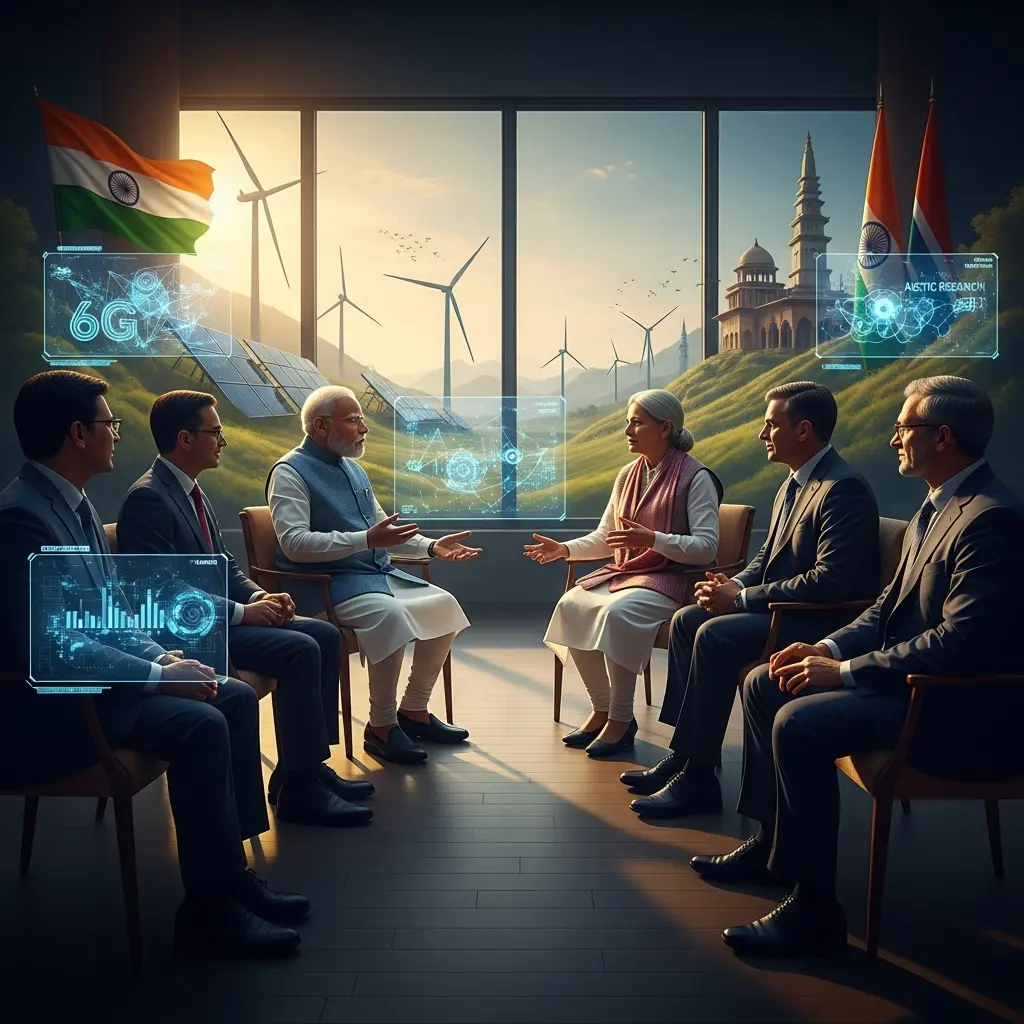
Where Fjords Meet the Ganges At the India-Nordic Summit, Prime Minister Narendra Modi and Nordic leaders went beyond diplomatic formality to forge a partnership grounded in clean energy, advanced connectivity and shared climate ambition.
There is something quietly extraordinary about watching nations separated by thousands of miles — by culture, by climate, by cuisine — find a common language in the urgency of the planet’s future. That is precisely what unfolded at the India-Nordic Summit, where Prime Minister Narendra Modi sat down with the leaders of Denmark, Finland, Iceland, Norway, and Sweden to sketch out a partnership that is, at its core, about reimagining what economic growth can look like when sustainability is not an afterthought but a foundation.
The India-Nordic Summit has never been a flashy affair. It does not generate the kind of breathless headlines that nuclear deals or defence pacts tend to attract. But those who follow the slow, methodical architecture of international partnerships know that it is precisely these quieter summits that often shape the world in more lasting ways. This year’s meeting made that point more clearly than ever.
“The partnership between India and the Nordic nations is not merely diplomatic — it is civilisational, rooted in a shared recognition that the next era of growth must be built on clean foundations.”
Green technology moves to the forefront
The centrepiece of this year’s summit was the deepened commitment to green technology cooperation. Nordic countries have long been global exemplars in this space — Norway leads in electric mobility, Denmark has mastered offshore wind, Finland’s cleantech sector is among the world’s most innovative. India, meanwhile, is in the midst of one of history’s most ambitious energy transitions, with renewable capacity additions that are consistently breaking records. The logic of collaboration, then, is almost self-evident.
What the summit did was translate that logic into concrete intent. Leaders pledged to strengthen bilateral frameworks for clean energy investment, with a particular focus on solar, wind and green hydrogen – sectors in which both sides have complementary strengths. For Indian startups working in the renewable energy space, the signal is especially significant. Access to Nordic capital, technology expertise, and regulatory know-how could help promising Indian ventures scale in ways that would otherwise take decades.
The 6G conversation arrives early — and deliberately
Perhaps the most forward-looking dimension of the India-Nordic Summit this year was the formal inclusion of 6G innovation on the agenda. It might seem premature — much of the world is still building out 5G infrastructure — but that is precisely the point. The Nordic countries, particularly Finland and Sweden, are home to some of the world’s leading telecommunications research ecosystems. India, with its massive domestic market, its engineering talent pool, and its growing ambitions to be a global technology standard-setter rather than a standard-adopter, has every reason to engage early.
The collaboration on 6G between India and the Nordic countries would be about more than faster internet speeds. It would be about who makes the rules for the next generation of global connectivity — a question with huge implications for economic competitiveness, national security and digital sovereignty. India’s presence in these conversations at this stage is a sign of how much the country’s tech standing has shifted in recent years.
Arctic research and the climate thread
Less discussed publicly but equally meaningful is the agreement to deepen cooperation in Arctic research. As climate change accelerates, the Arctic is changing faster than almost anywhere else on Earth, with consequences that ripple far beyond the polar regions — including into South Asia, where monsoon patterns, sea levels, and agricultural cycles are all influenced by what happens at the top of the world. India’s engagement with Arctic science is not new, but elevating it within the India-Nordic framework gives it fresh institutional momentum and, crucially, access to Nordic scientific infrastructure that is world-class in this domain.
People, not just policy
One of the more humanising aspects of the summit was the attention paid to mobility programmes for students and professionals. International partnerships tend to be most durable when they are felt not just by ministers and executives but by young engineers, researchers, and entrepreneurs who carry the relationship forward through their careers. The commitment to expanding pathways for Indians and Nordics to study, work, and collaborate in each other’s countries plants seeds that will take years to mature but will prove far more resilient than any single agreement signed at a summit table.
The India-Nordic Summit, in this sense, is a reminder that the most consequential partnerships are often built not with dramatic gestures but with patient, layered cooperation across many domains at once. Green technology, 6G, Arctic science, and people-to-people mobility may seem like a disparate list — but they are, in fact, a coherent vision of what a climate-focused, innovation-driven partnership between two very different parts of the world can look like when both sides are genuinely committed to making it work.
As Prime Minister Modi and his Nordic counterparts concluded their discussions, what lingered was not the language of agreements but the sense of a relationship quietly growing into something more enduring. In a world that often rewards noise, that kind of steady progress deserves more attention than it gets.

