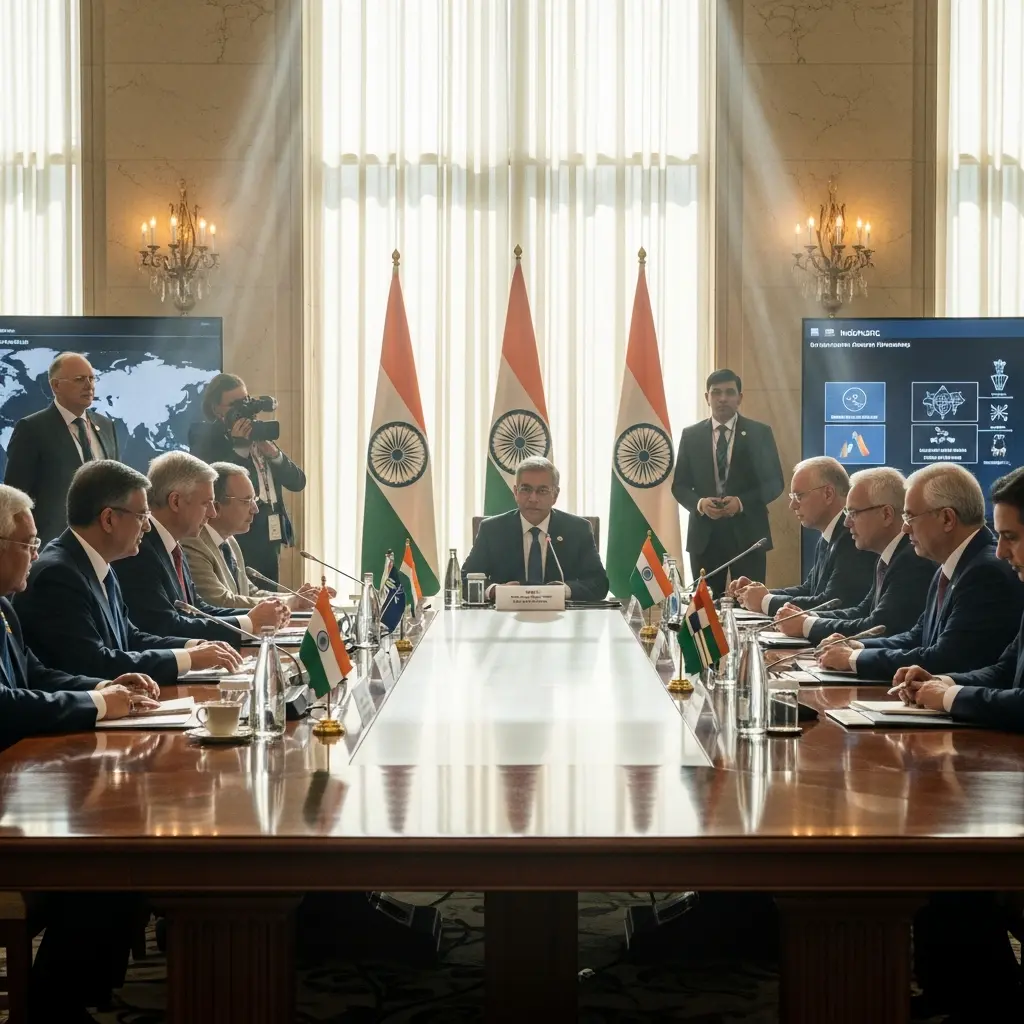
There is a quiet, but inevitable, change taking place in the world’s view of India. Not long ago, conversations about India’s place in global affairs were often framed around its potential — what it could become. Today, those conversations sound different. Leaders in Washington, Brussels, Tokyo, and Riyadh aren’t talking about India’s future; they’re responding to its present.
India’s foreign policy has entered a new phase, one defined not by alignment with a single bloc but by strategic confidence. In a world that is ever more fractured along geopolitical fault lines, New Delhi is doing something rare: it is keeping warm, working relationships on multiple fronts at once — with Western democracies and Asian neighbours, old allies and new partners.
Building Partnerships on India’s Own Terms
At the heart of India’s recent diplomatic momentum is a simple but powerful idea: India doesn’t have to pick sides. While much of the global order pushes countries toward binary loyalties—East or West, China or the US—India has carved a more pragmatic path.
This balanced approach to India’s foreign policy is no accident. It reflects decades of non-alignment philosophy, updated for the more transactional era. India engages on issues of mutual interest — trade, technology, defence, climate — without signing away its strategic autonomy. That credibility is exactly what makes it such an attractive partner for nations across the geopolitical spectrum.
In the past few months, there has been a flurry of high-level diplomatic activity. Discussions with European partners have focused on supply chain resilience and clean energy partnership. Indo-Pacific allies have been talking about maritime security and regional stability. And bilateral meetings with Gulf states have emphasized infrastructure investment and energy partnership. Each engagement is different in particulars but similar in spirit: India is open for business, and on its terms.
The Indo-Pacific Equation
India’s rising strategic importance is most apparent in the Indo-Pacific. With tensions in the South China Sea and the wider Asia-Pacific region still flaring, India’s position as a stabilising presence is being increasingly appreciated by friends who regard it as a credible democratic counterweight in a disputed neighbourhood.
International observers have observed that India’s involvement in multilateral frameworks such as the Quad has provided content to the notion of a free and open Indo-Pacific, not merely as rhetoric but as a functioning diplomatic reality. Defense cooperation agreements, joint naval exercises, and intelligence-sharing arrangements have given these partnerships real strategic substance.
For smaller countries in the region, India’s engagement offers something important: a partner who does not come with the political strings or debt traps that can be attached to infrastructure deals from other major powers. India’s approach to regional diplomacy, often based on development partnerships and capacity-building, has created goodwill that extends beyond formal agreements.
Manufacturing, Tech and Supply Chain Reset The pandemic hastened a worldwide reevaluation of supply chains, and geopolitical tensions have furthered that reassessment. India is trying to capitalize on that shift. Government officials have cited India’s expanding role in global manufacturing as one of the most impactful shifts in its economic positioning.
From semiconductor assembly to smartphone production, from pharmaceuticals to renewable energy equipment, India is gradually carving out a space for itself as an alternative hub to China-centric manufacturing networks. International investors have taken note. Foreign direct investment inflows have reflected genuine confidence in India’s manufacturing ambitions, underpinned by large-scale infrastructure investment, production-linked incentive schemes and a workforce that continues to grow in both size and skill.
Technology cooperation has been particularly busy. Semiconductors, artificial intelligence, and space technology partnerships have been front and center in recent bilateral talks – acknowledging that the next wave of global trade partnerships will be built as much on digital infrastructure as physical goods.
Clean energy: where diplomacy meets necessity Clean energy aspirations have become a defining feature of India’s diplomatic identity. Being one of the world’s largest energy consumers and one of the most ambitious in its renewable energy goals, India has made international cooperation on clean energy a key pillar of its global engagement.
Agreements on solar manufacturing, green hydrogen development, and climate finance have featured in discussions with partners ranging from the European Union to Japan. For countries looking to hit their own emissions targets, India isn’t just a market — it’s a potential manufacturing partner, a technology collaborator, and a major voice in shaping the global energy transition.
This gives India’s diplomacy an unusual dimension: it is simultaneously seeking foreign investment and offering strategic value in return, not as a supplicant but as an equal participant in shared challenges.
Looking Ahead
Analysts who track India’s diplomatic engagements tend to agree on the direction, even when they debate the pace. The consensus is that these engagements are likely to translate into real economic outcomes — more exports, increased investment inflows, and deeper infrastructure collaboration — over the coming years.
What makes the current moment particularly significant is not any single agreement or summit, but the accumulation of credibility that India has built. Countries engage with India because they see a partner that shows up, follows through and brings something to the table that others cannot easily replicate: scale, democracy, stability and strategic independence all at once.
In a fragmented world looking for reliable anchors, India’s growing role in international cooperation seems less like ambition and more like necessity for India and increasingly for the world.
India’s Strategic Partnerships Sharpen: A New Chapter in Diplomacy.