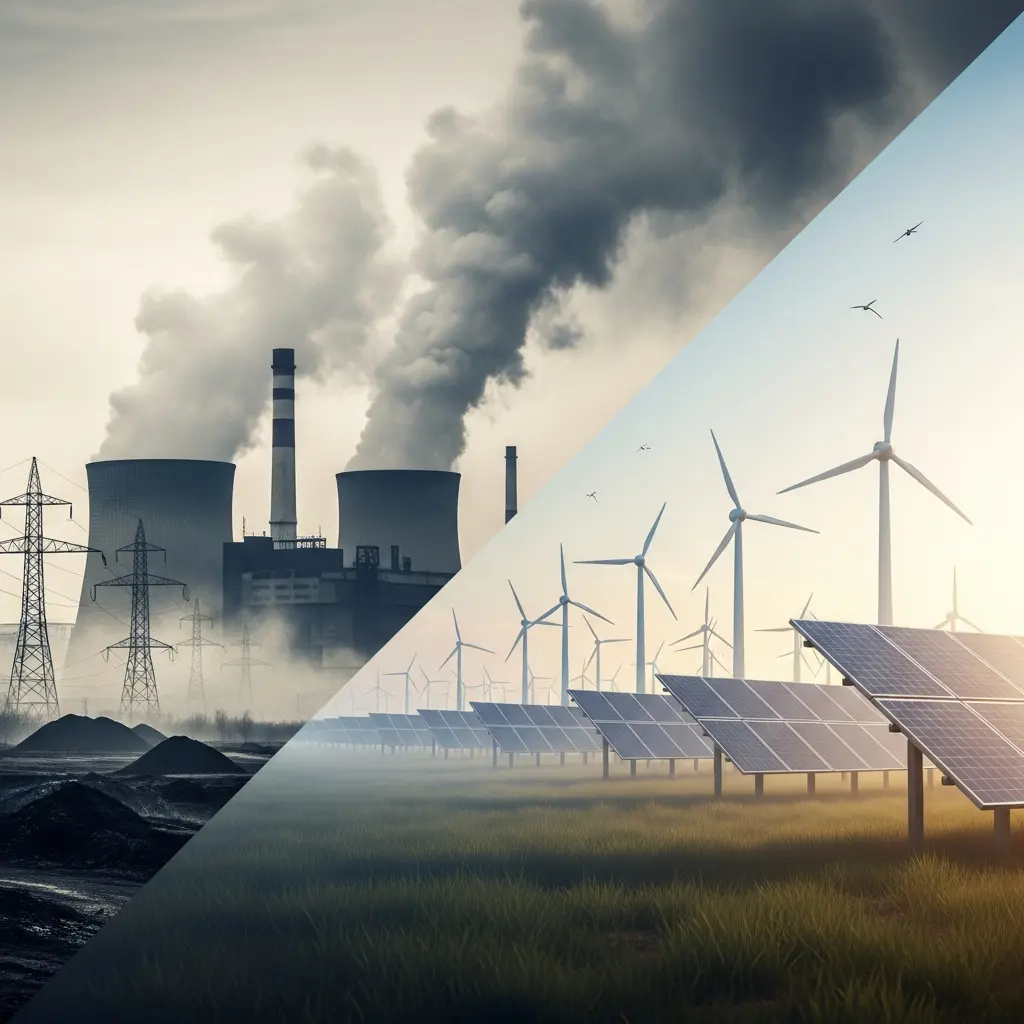
For years, the story of coal’s decline felt more like a forecast than a fact. Analysts predicted its fall. Climate summits declared its end. And yet, year after year, the numbers told a more complicated story — coal kept flowing, power plants kept burning, and demand kept surprising on the upside.
Something is beginning to shift. Not dramatically, not all at once, and not without significant regional variation — but the direction is becoming harder to argue with. Energy researchers now believe global coal demand may gradually stabilize, and in some markets meaningfully decline, by the end of this decade. The age of peak coal may not be a distant projection anymore. It may be arriving.
Understanding why requires looking honestly at both sides of the ledger: the forces genuinely pushing the energy market away from fossil fuels, and the very real reasons why coal hasn’t disappeared and won’t disappear quietly.
The Forces Pushing Coal Out
The most important driver of coal’s declining trajectory isn’t policy — it’s economics. Renewable energy has become, in most parts of the world, the cheapest way to generate new electricity. Solar and wind installations that would have seemed expensive a decade ago are now being built at costs that coal-fired generation simply cannot match on a levelized basis.
This isn’t a marginal difference anymore. In region after region, the math has flipped. New solar capacity, particularly utility-scale installations across sun-rich geographies, can deliver electricity at a cost per megawatt-hour that makes new coal plants economically indefensible. The financial community has absorbed this reality faster than the political conversation has. Coal assets are increasingly being priced as stranded, insurance coverage for new coal projects is harder to obtain, and the pipeline of new coal-fired capacity in developed economies has essentially dried up.
Energy storage — long cited as the missing piece that renewable transition needed to become truly viable — is maturing faster than most projections anticipated. Battery storage costs have followed a similar downward curve to solar panels, making it increasingly practical to smooth out the intermittency that was coal’s most durable competitive argument. A grid that can store daytime solar generation for evening peak demand doesn’t need a coal plant on standby in the same way it once did.
Wind energy has followed a parallel trajectory. Offshore wind, once eye-wateringly expensive, has become a core part of energy planning in Europe and is rapidly expanding in Asia and North America. Onshore wind remains one of the most cost-effective electricity sources available. Together, solar and wind are not just nibbling at coal’s market share — they are systematically replacing it in the economics of new power generation.
Investments in these technologies continue to accelerate, drawing capital from sources — pension funds, sovereign wealth funds, corporate balance sheets — that would not have been seen as natural clean energy investors even five years ago.
Why Coal Isn’t Going Away Yet
Here is where the analysis requires honesty rather than wishful thinking. Declaring coal dead because its long-term trajectory is downward misreads the actual state of the energy market, particularly in the developing world.
For a substantial number of economies — across South Asia, Southeast Asia, and parts of Africa — coal is not a legacy fuel being phased out. It is an active, present-tense solution to urgent problems: keeping the lights on, powering industrial growth, and providing energy security in contexts where the grid is still being built rather than rebuilt.
India, Indonesia, Vietnam, Bangladesh, and several African nations are at stages of economic development where energy access and industrial capacity are immediate needs, not aspirations. Coal, for all its environmental costs, offers something that matters enormously to policymakers in these countries: reliability, established infrastructure, and energy that doesn’t depend on financing conditions set by institutions based in wealthier economies.
The tension here is genuine and shouldn’t be dismissed with easy language about a just transition. A factory owner in a mid-sized Indian city, or a government minister in a country where a third of the population lacks reliable electricity, is not making an irrational choice when they support continued coal use. They are calculating on what is there, what is affordable and what is functional in their context.
This is why some developing economies continue to build coal capacity even as Western nations retire their plants. The global aggregate of coal demand reflects these divergent realities running in parallel: decline in the developed world, persistence in the developing one.
What Stabilization Actually Means
The word “stabilization” in the context of coal demand deserves some unpacking. It doesn’t mean coal becomes environmentally acceptable or that its long-term decline is in doubt. What it means, practically, is that the transition is uneven — that global consumption will plateau before it falls, and that the fall will be gradual rather than sudden.
For the clean energy agenda, this has concrete implications. Speed matters. The faster renewable infrastructure is deployed and made accessible to developing economies at competitive costs, the shorter the plateau. International financing, technology transfer, and honest engagement with the energy security concerns of emerging economies are not soft diplomatic niceties — they are the practical levers that determine whether stabilization turns to decline sooner or later.
The renewable transition is winning the argument. It is also winning on cost, on investment flows, and on public sentiment in a growing number of markets. But winning eventually and winning in time to meet climate targets are different things. The energy market is at a pivot point where the choices made this decade — in boardrooms, finance ministries, and development banks — will determine which of those timelines actually plays out.
Coal’s long goodbye has begun. How long it takes depends on choices that are still very much in front of us.
Coal’s Long Goodbye: Why the Energy Market Is Finally Turning a Corner.