
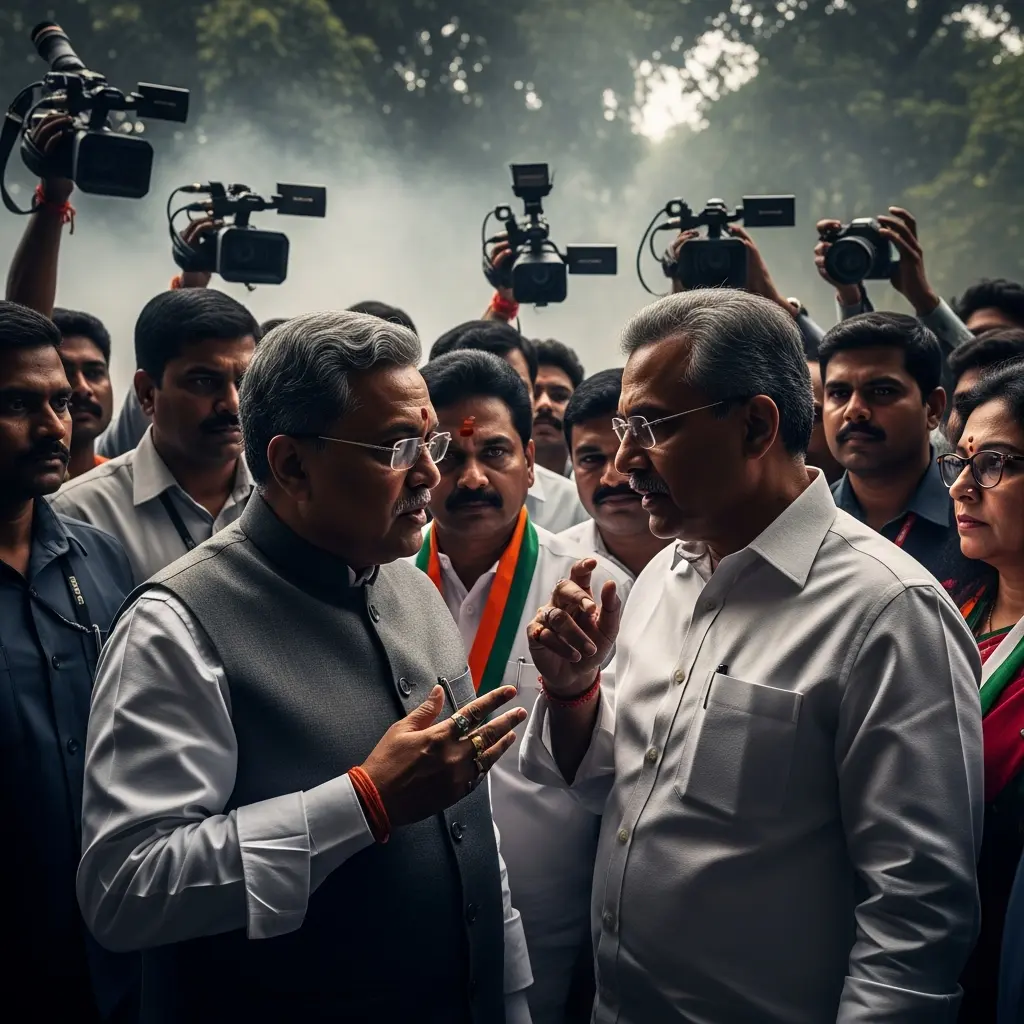
Whispers have grown into a roar inside the Congress party as the future of Chief Minister Siddaramaiah hangs in the balance — and D.K. Shivakumar waits in the wings.
Politics in Karnataka has rarely been a quiet affair, and the past few weeks have done nothing to change that reputation. The corridors of Vidhana Soudha are buzzing again — not over legislation or budgets, but over a question that has quietly consumed the Congress party in the southern state: how much longer will Siddaramaiah remain in the chief minister’s chair?
What began as background chatter in political circles has now crescendoed into something far harder to ignore. Senior Congress leaders have been spotted gathering in Bengaluru in what party insiders are calling “routine consultations” — a phrase that, in Indian political vocabulary, almost always signals anything but routine. The undercurrent of a possible leadership change is palpable, and no amount of careful press statements seems to be dampening speculation about what comes next for Karnataka’s ruling dispensation.
“In Karnataka, the question is no longer whether a change will come — it is when, and whether the party can manage it gracefully.”
At the heart of the Karnataka politics storm is a delicate power equation that the Congress high command has been trying to balance since it swept to power in 2023. Siddaramaiah, a veteran Kuruba leader with a mass connect across Old Mysuru and backward communities, was handed the chief minister’s role in a hard-fought internal negotiation. D.K. Shivakumar — party president, Vokkaliga strongman, and the man widely credited with engineering the election victory through sheer organizational muscle — accepted the deputy chief minister’s role with the understanding that the CM’s post would eventually be his. That “eventually” may now be approaching.
The DK Shivakumar camp has maintained public silence, but the optics tell their own story. His supporters have grown increasingly vocal in recent months, citing what they describe as an unfulfilled promise. Those loyal to Siddaramaiah, meanwhile, argue that the chief minister deserves to complete his term — pointing to what they frame as a reasonably stable administration and a welfare agenda that continues to resonate with voters. The two narratives now collide daily in the hallways of power, even as party spokespersons insist that all is well within the Congress leadership.
For the Congress high command in Delhi, this is a situation that demands careful handling. On one hand, disrupting a functioning state government mid-term risks sending exactly the wrong signal ahead of upcoming electoral cycles. On the other, keeping a restless Shivakumar sidelined for too long could fracture the organizational unity that the party sorely needs — in Karnataka and beyond. AICC leaders have been treading carefully, offering reassurances to both sides while reportedly working behind the scenes to find a timeline that neither damages the brand nor triggers an open rebellion.
What complicates things further is that the opposition isn’t merely watching from the sidelines — they’re amplifying every fissure they can find. The BJP and JD(S), both eager to paint the Congress government as one consumed by internal instability, have been quick to seize on every press byte and anonymous briefing as proof that the ruling party is in disarray. For voters, the spectacle of senior leaders privately maneuvering while publicly denying any tension is wearingly familiar — and could erode the goodwill Congress has cultivated in the state if the uncertainty drags on too long.
There is also a broader context to keep in mind when reading the India political update from Karnataka. The state has historically served as a bellwether — a place whose political mood sends ripples into national politics. A misstep here could set uncomfortable precedents for Congress’s coalition management playbook at the national level. Conversely, a smooth transition — if one is indeed in the works — could showcase the party’s ability to handle internal succession without the kind of ugly implosions that have plagued it elsewhere.
“A smooth transition could showcase Congress’s ability to handle succession. A messy one could haunt the party far beyond Karnataka.”
Analysts tracking Siddaramaiah news closely point to a few possible scenarios: a negotiated timeline in which he steps aside gracefully around the mid-term mark; a continuation of the status quo amid elite pressure to project stability; or — the most damaging of all — a drawn-out standoff that eventually forces Delhi to intervene. None of these outcomes is without political cost, and the party’s next few weeks of internal conversations will likely determine which path is taken.
For ordinary Kannadigas watching this unfold on their evening news, the frustration is understandable. Issues of drought relief, infrastructure development, and implementation of the much-discussed “guarantee schemes” ought to dominate the conversation. Instead, the headlines keep circling back to who sits in which chair. That, perhaps, is the most telling indictment of the current moment — a government with real work to do, but a political class too absorbed in its own arithmetic to let the work breathe.
Whatever decision emerges from the Congress party’s closed-door deliberations, it will carry consequences well beyond Karnataka. In Indian politics, leadership changes rarely stay local. They become signals, precedents, and sometimes, warnings. The state may be watching. The nation is watching too.

