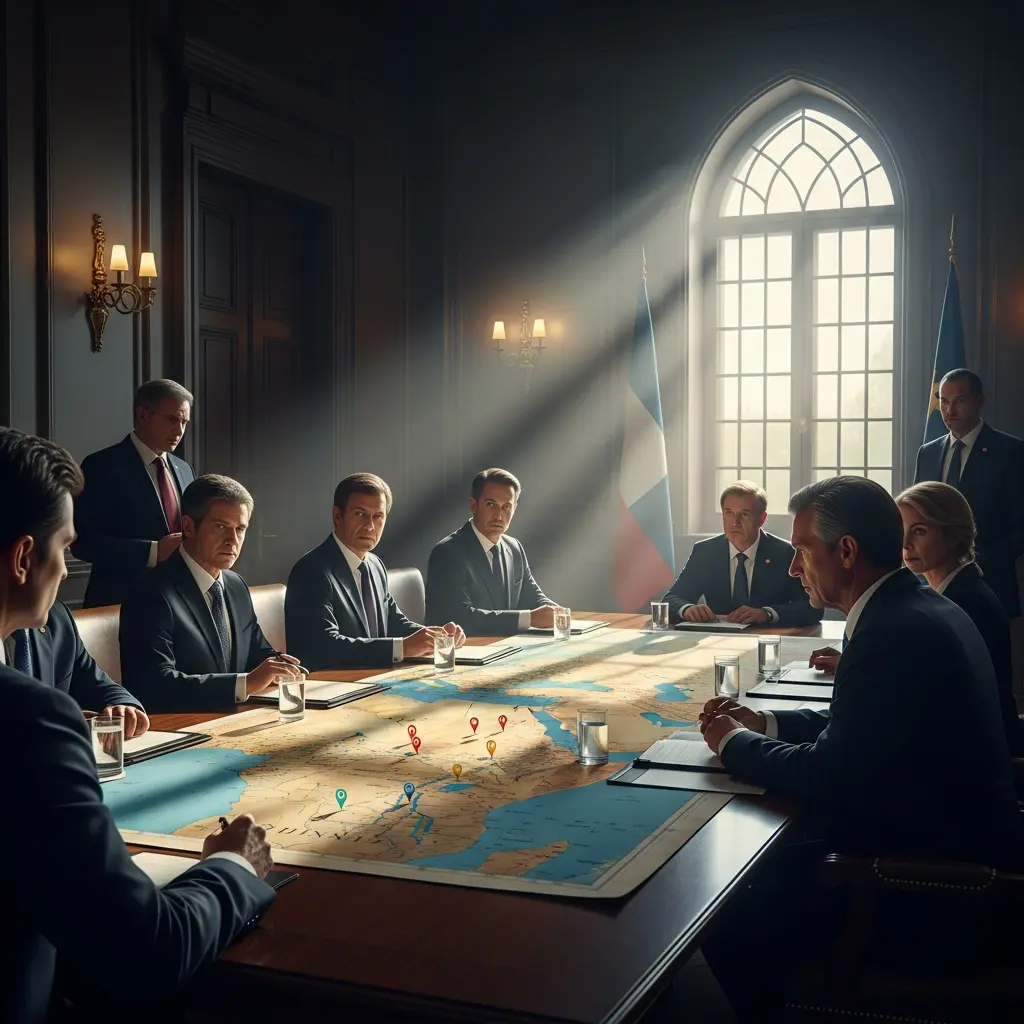
There is something almost surreal about the way the world keeps holding its breath over the Middle East. Diplomats fly in and out of Muscat and Islamabad. Back-channel calls stretch deep into the night. Leaders issue carefully worded statements, each syllable measured for the damage it might — or might not — do. And through it all, ordinary people across the region wake up each morning not knowing whether the day will bring peace or something far worse.
That tension has characterized the first half of 2026. What was a bitter military standoff has gradually, and not without great difficulty, been supplanted by a fragile diplomatic process – one in which the whole world has become invested, whether they want to be or not.
A Ceasefire of Necessity
On April 8, 2026, the United States and Iran agreed to a two-week ceasefire in what had become a regional war, mediated by Pakistan. It was not a moment of triumph—no handshakes, no rose gardens, no declarations of friendship. It was, at its core, an acknowledgement by both sides that continued fighting was becoming unsustainable for the region and the global economy alike.
Pakistan had become a key mediator between Washington and Tehran in recent months, playing a leading role in brokering the temporary halt of hostilities. For a country that has often been overshadowed in global diplomacy, it was a remarkable turn — a signal that the architecture of Middle East peacemaking is shifting, with new actors stepping into roles once monopolized by Western powers.
Leaders across Europe, from French President Macron to UK Prime Minister Starmer and European Commission President von der Leyen, welcomed the ceasefire, thanking Pakistan and other partners for facilitating the agreement. The joint statement was unusually united in tone — reflecting just how much the prospect of a broader regional war had unnerved capitals far beyond the Middle East.
The Talks That Didn’t Quite Work
Hope, however, has a way of arriving before it is ready. Senior US and Iranian officials met in Islamabad on April 11 and 12 for high-level talks that ultimately ended without agreement, with both sides citing significant differences over Iran’s nuclear programme and conditions related to maritime access in the Strait of Hormuz.
The failure was not surprising to seasoned observers. These are not disputes that lend themselves to quick resolution. Iran’s nuclear ambitions, its ballistic missile programme, the role of its regional proxies — these are decades-old fault lines, not misunderstandings that a weekend of diplomacy can bridge. Israeli Prime Minister Netanyahu made clear that despite the conditional ceasefire, there remained “goals to complete,” achievable either through diplomacy or renewed fighting — including securing enriched nuclear material within Iran. House of Commons Library
Still, the talks did not collapse entirely. After the Islamabad meetings failed to achieve a breakthrough, President Trump announced an indefinite extension of the ceasefire on April 21 to allow more time for negotiations. In the grinding world of geopolitics, that counts as progress.
The Strait of Hormuz: Where Geography Meets Geopolitics
Few chokepoints on earth carry more weight than the Strait of Hormuz. About 20 percent of the world’s oil passes through that narrow waterway, and its disruption has sent shockwaves through global energy markets since the conflict began. Gulf states, while broadly favoring de-escalation, have grown increasingly firm in demanding meaningful concessions from Tehran — particularly on Iran’s nuclear programme, long-range capabilities, and control of the Strait.
Oman, long a quiet facilitator between Washington and Tehran, has continued hosting consultations, with discussions over the Strait of Hormuz forming a central part of ongoing diplomatic engagement. Oman’s role is a reminder that sometimes the most effective diplomacy happens not in grand summit halls, but in modest rooms in Muscat, away from cameras and political pressure.
A Tentative Agreement — But Not Yet a Peace
As of late May 2026, the US and Iran have moved toward a tentative agreement, though the details remain unresolved and President Trump has not yet signed off on a final deal. The Trump administration has walked a careful line, straining to downplay provocative actions from Iran in an apparent effort to hold the fragile ceasefire together. CNNCNN
Trump, for his part, has consistently told allies he would not sign a final agreement without conditions being met on Iran’s nuclear programme and the removal of enriched uranium from Iranian territory. It is a hard line that pleases Israel, but one that makes the path to a comprehensive deal considerably narrower.
More Than Just Two Countries
What makes this diplomatic moment genuinely historic is how many players are now at the table — or trying to get there. Iran’s ambassador to China has suggested that international guarantees against future conflict could involve powers such as China, Pakistan, Turkey, and Russia. That framing speaks to a broader truth: the Middle East is no longer simply a stage for American influence. Multiple powers now have stakes in the outcome, and any lasting regional security arrangement will need to reflect that reality.
House of Commons Library
The Abraham Accords continue to evolve, with Israel deepening economic and security ties with UAE, Bahrain, and Morocco, while discussions with other Arab nations continue around joint security frameworks. These normalization threads did not disappear with the outbreak of conflict — in some ways, shared concerns about Iranian power have quietly strengthened certain partnerships.
The Human Cost Behind the Headlines
It is easy, amid the diplomatic language and strategic calculations, to lose sight of what is actually at stake. Lebanese officials have made ceasefire efforts a central focus of their Washington discussions, arguing that reducing military activity would prevent further humanitarian suffering and lower the risk of broader confrontation. There’s a moral weight to that argument that no amount of geopolitical maneuvering can fully drown out.
The Middle East in 2026 stands at one of its most consequential crossroads in decades. The diplomacy is imperfect, the actors complicated, the history heavy. But the fact that talks are still happening — that mediators keep flying, that phone lines stay open — is itself something. In a region that has known so much conflict, the continued pursuit of a negotiated path forward is neither small nor guaranteed. It deserves the world’s full and sustained attention.
The World Is Watching: Inside the Middle East’s Fragile Diplomatic Moment.