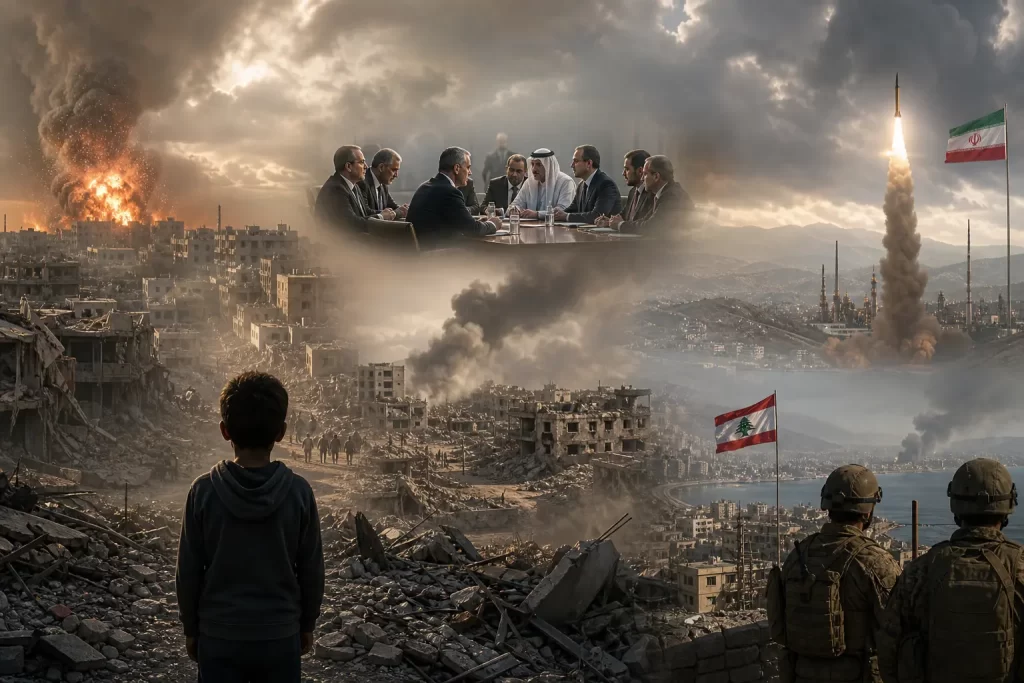
As ceasefire talks inch forward and humanitarian corridors hang in the balance, the question isn’t just whether diplomacy can hold — it’s whether it can arrive in time.
There is a particular exhaustion that settles over regions where conflict has become the rhythm of life. In Gaza, Lebanon, and across the wider Middle East, that exhaustion has grown into something heavier — a compound grief made of ongoing displacement, collapsed infrastructure, and the grinding uncertainty of not knowing what tomorrow holds. And yet, even now, diplomats continue to travel, phone lines between capitals remain open, and negotiators sit across tables from one another, searching for language that might hold.
The tension between war and dialogue has rarely felt more acute. Regional security analysts describe the current situation as one of the most volatile in decades, with multiple flashpoints — the humanitarian crisis in Gaza, the fragile stability along the Lebanon-Israel border, and the shadow of Iran’s nuclear posture — all demanding attention simultaneously. Each is its own crisis. Together, they form a knot that no single diplomatic thread can easily untangle.
Gaza: the humanitarian clock At the heart of it all is Gaza, where the level of civilian suffering has led international aid organisations to issue urgent calls for immediate humanitarian access. The delivery of food, medicine, and clean water to densely populated areas has been inconsistent at best, suspended entirely at worst. The United Nations and several non-governmental organizations have raised alarms about conditions that, by any measure, meet the threshold of a full humanitarian catastrophe.
Ceasefire negotiations have continued through indirect channels, with Qatar, Egypt, and the United States playing key mediating roles. Progress has been slow and, at times, halted entirely by disagreements over the terms of any lasting arrangement — who governs Gaza post-conflict, what guarantees exist for the return of hostages, how a durable peace might be structured without simply replanting the roots of future violence. These are not small questions, and the people living through the answers are paying a price that should trouble everyone watching from a distance.
“Diplomacy does not require optimism. It requires patience — and a willingness to stay at the table even when the other side has walked away.”
Lebanon: a border in suspension
Lebanon occupies its own precarious position in the regional calculus. The border situation between Lebanon and Israel, long a source of low-intensity friction, has experienced renewed instability as Hezbollah and Israeli forces exchange fire in patterns that risk escalating far beyond what either side may intend. The Lebanese civilian population, already battered by years of economic collapse and political dysfunction, absorbs each exchange as a fresh wound.
International pressure to prevent Lebanon from becoming a secondary front in a broader regional war has intensified. European and Arab League diplomats have been particularly vocal, warning that miscalculation along this border could trigger consequences that would be difficult to contain. The Lebanese government is weak and internally divided, so it has little control over Hezbollah’s operational decisions — a fact that makes any diplomatic effort to stabilize the situation through Beirut alone very difficult.
Iran: the wider shadow Iran is casting a wider shadow over both fronts, its role in the conflict a complex, controversial and closely monitored one. Tehran has long backed armed groups across the region, including Hezbollah in Lebanon, Hamas in Gaza, and a range of militia networks in Iraq and Yemen, through what analysts call the “axis of resistance.” The extent to which Iran directs, as opposed to simply enables, the actions of these groups remains a matter of interpretation. But its influence on regional security is not in dispute.
Diplomatic and economic pressure on Tehran has been maintained by the West, with sanctions remaining a key instrument. At the same time, back-channel conversations about Iran’s nuclear program and its regional posture have not entirely ceased. Some analysts argue that a diplomatic opening with Iran remains the only viable long-term path to regional stability. Others view such engagement as legitimizing a government that, they contend, has consistently acted in bad faith. Neither camp has offered a roadmap that fully satisfies the other.
The shape of what comes next
What makes the current moment particularly difficult to read is that both the conditions for continued war and the conditions for a negotiated pause exist simultaneously. The military dimensions of the conflict have not exhausted themselves. Neither has diplomacy. Both are ongoing — and they are running on parallel tracks that occasionally, briefly, intersect.
International mediators are operating in a space where the window for any given agreement can close within hours, where domestic political pressures on all sides constrain what leaders can publicly accept, and where the populations most affected by the outcome have the least say in it. This is not a new feature of Middle Eastern geopolitics. But it has rarely felt so stark.
What remains true, despite everything, is that the people of Gaza, Lebanon, and the broader region are not abstractions. They are people who go to sleep uncertain and wake up counting what is still intact. The attention of the international community — expressed not just in statements but in sustained diplomatic effort, in genuine humanitarian commitments, in the hard and unglamorous work of conflict resolution — is not optional. It is, at this point, the minimum that the moment demands.
Whether it will be enough remains the question that no one, not in any capital or conference room, can yet honestly answer.
Between Bombs and Bargaining Tables: The Middle East’s Fragile Moment.