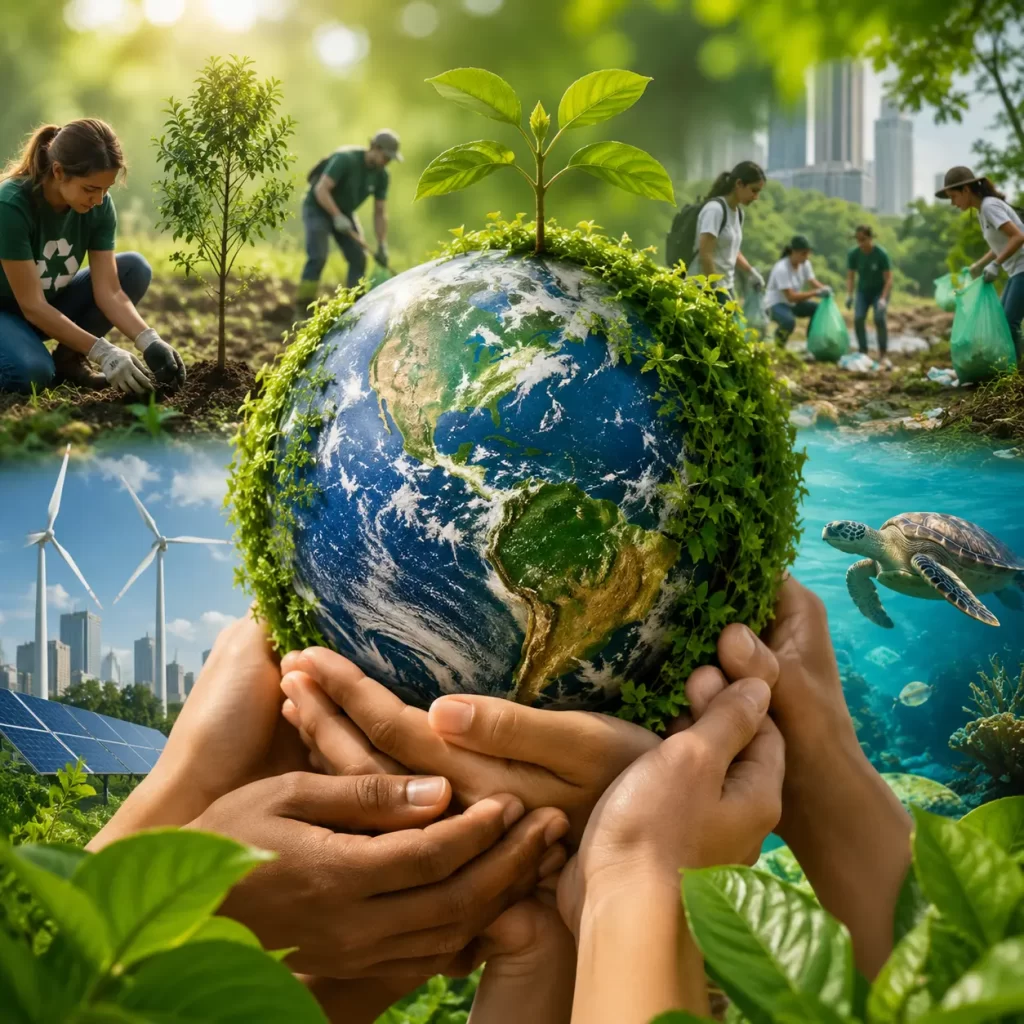
Every year on June 5th, the world pauses — briefly, collectively — to acknowledge the planet it lives on. Social media fills with green imagery. Politicians plant saplings in front of cameras. Corporations release statements about their sustainability commitments. Children in schools learn about recycling and rainforests. And then, in most cases, life resumes its familiar pace.
World Environment Day has always carried this tension between symbol and substance. The awareness is genuine, the intentions mostly sincere, and the energy — at least for a day — genuinely remarkable. But awareness alone has never planted a forest, cleaned a river, or reduced atmospheric carbon by a single part per million. What matters is what the awareness leads to.
This year’s global celebrations offered both the familiar rituals and, in places, something that looked like real momentum. The question worth asking is whether 2026 is different — or just louder.
A Day That Grew Into a Movement
World Environment Day was established by the United Nations in 1972, the same year as the Stockholm Conference that first brought environmental concerns into formal international diplomacy. For most of its early history, it was a relatively quiet observance — earnest, well-meaning, but limited in reach.
What changed was the climate. Not just the physical climate, though that too, but the cultural and political climate around environmental issues. The visible acceleration of climate change — more intense storms, record heat events, coral bleaching on a mass scale, wildfires that consume entire regions — has converted abstract concern into something more visceral. People aren’t just reading about environmental degradation anymore. They’re living inside it.
That shift has given World Environment Day a different kind of urgency. The tree plantation drives and awareness campaigns that mark the occasion aren’t peripheral anymore — they’re connected, however imperfectly, to a broader understanding that something large and difficult needs to happen.
What Countries Actually Did This Year
Across continents, the green initiatives that marked this year’s observance ranged from the modest to the genuinely ambitious.
In parts of South and Southeast Asia, large-scale plantation drives mobilised volunteers to restore degraded land along riverbanks and hillsides — areas particularly vulnerable to flooding and erosion. These aren’t photo opportunities; they’re ecological interventions, though their long-term success depends on whether saplings are maintained after the cameras leave.
European cities used the occasion to announce or accelerate urban sustainability targets — expanded cycling infrastructure, low-emission zones, and commitments to green building standards for new construction. Climate action at the city level has, arguably, outpaced national policy in many parts of the world, and World Environment Day provides a useful focal point for these announcements.
In Africa, environmental organisations focused heavily on biodiversity conservation — a dimension of the environmental crisis that often gets overshadowed by the climate conversation but is no less urgent. Species loss, habitat destruction, and the collapse of ecosystems have consequences that ripple through agriculture, water security, and human health in ways that are only beginning to be fully understood.
Pollution reduction featured prominently in campaigns across South Asia and parts of Latin America, where air quality crises in major cities have made environmental degradation impossible to ignore even for those who might otherwise tune out the broader debate. When the air is visibly brown and children are developing respiratory conditions at alarming rates, environment news stops being abstract.
The Honest Reckoning
For all the genuine energy around sustainability this year, honesty requires acknowledging the gap between what’s being celebrated and what’s being done at the scale the moment demands.
Global carbon emissions remain stubbornly high. Plastic production continues to outpace recycling capacity by an enormous margin. Deforestation in critical ecosystems like the Amazon and Congo Basin has slowed in some years and accelerated in others, but has not stopped. The commitments made at successive international climate conferences have, in aggregate, not been sufficient to keep warming within the limits scientists consider manageable.
None of this is an argument for despair — despair is, in many ways, the enemy of effective climate action. But it is an argument for honesty about what World Environment Day can and cannot accomplish. A single day of heightened awareness does not substitute for the sustained policy, investment, and behavioural change that genuine sustainability demands.
Why It Still Matters
And yet, dismissing World Environment Day as mere performance misses something important about how change actually happens. Public consciousness is a prerequisite for political will. Political will is a prerequisite for policy. Policy is a prerequisite for the systemic changes that individual action alone can never achieve.
The campaigns, the classroom programmes, the social media conversations — they’re not sufficient, but they’re not nothing either. Every person who genuinely engages with the ideas of climate action and environmental responsibility on June 5th is a potential advocate, voter, consumer, or professional who carries that understanding into the other 364 days of the year. That’s how movements build.
World Environment Day 2026: Beyond the Hashtags and Into the Hard Work.