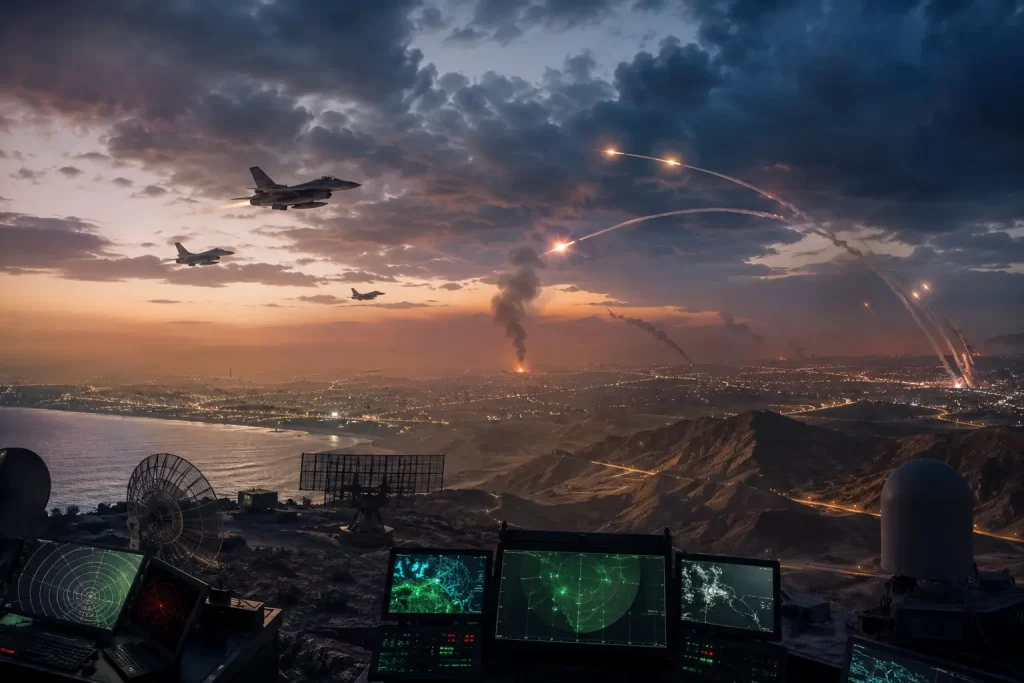
Fresh military exchanges between Israel and Iran have plunged the Middle East into its most volatile stretch in years — with global energy markets rattled, diplomatic back-channels strained, and millions of ordinary people caught somewhere between dread and exhaustion.
here is a particular kind of tension that settles over a region when two adversaries stop talking entirely and start shooting. The Middle East has lived with that tension before, but the latest round of military strikes exchanged between Israel and Iran has pushed it into unfamiliar territory — where every missile fired carries implications that ripple far beyond the borders of either country.
The most recent escalation began in the early hours, when Israeli air defense systems intercepted what officials described as a barrage of Iranian ballistic missiles and armed drones. Israel responded swiftly with precision strikes targeting military infrastructure inside Iranian territory — a pattern that has become grimly familiar over the past year, yet never quite routine enough to stop the world from watching with alarm.
What makes this round different is the breadth of what is now at stake. Diplomatic negotiations that had quietly resumed in recent months — aimed at reviving some version of a nuclear deal framework — have effectively collapsed. Mediators from Europe and the Gulf region who had spent weeks building trust between the two sides found their efforts wiped out overnight. The backchannel is silent. The formal channel barely exists.
“You cannot negotiate with one hand and strike with the other — at some point, the world has to choose which signal it actually means.”
For the broader region, the consequences are already visible. Iran’s proxy network — which spans Hezbollah in Lebanon, armed factions in Iraq and Syria, and the Houthi movement in Yemen — has shown signs of renewed activity, raising fears of a coordinated, multi-front response that Israel alone may struggle to absorb. Regional security analysts have spent years warning that a direct Israel-Iran confrontation risks activating this entire web simultaneously. That scenario, once theoretical, now looks plausibly close.
The impact on global energy markets has been swift and brutal. Crude oil prices surged sharply within hours of the first confirmed strikes, as traders priced in the risk of disruption to Gulf shipping lanes — particularly the Strait of Hormuz, through which roughly a fifth of the world’s oil supply passes. Saudi Arabia and the UAE, both of whom have quietly engaged in their own diplomatic outreach with Tehran in recent years, are now in an uncomfortable position: they cannot afford the conflict to widen, yet they have limited leverage to stop it.
In Washington, the response has been characteristically measured in public and reportedly frantic behind the scenes. The United States has long-standing security commitments to Israel, and senior officials have reiterated that support. But there is a growing awareness within the administration that military solidarity is not the same as strategic alignment — and that an unchecked escalation serves almost no one’s long-term interests, including Israel’s own.
What tends to get lost in the language of strikes and counter-strikes is the human dimension. Across both countries, and across the broader region, ordinary people are living with a background hum of anxiety that rarely makes the headlines. In Israel, air raid sirens and shelter drills have become part of daily life in ways that would have seemed surreal a decade ago. In Iran, where the economy is already under severe strain from international sanctions, the prospect of sustained military conflict feels less like an abstraction and more like an existential threat layered on top of already difficult circumstances.
“Sanctions, inflation, now bombs — the people of this region did not choose any of this, but they are the ones paying for it every single day.”
The international community’s response – a chorus of calls for restraint, emergency UN Security Council meetings and carefully worded statements from allied governments – follows a script that has become depressingly predictable. Words of caution are issued. Red lines are drawn. And yet the strikes continue, each one raising the threshold of what is considered acceptable just a little further than the last.
There is no easy off-ramp visible from here. Iran has shown no willingness to step back without something tangible in return — sanctions relief, security guarantees, or meaningful recognition of its regional interests. Israel, for its part, views a nuclear-capable Iran as an existential threat it cannot defer indefinitely, and each missile intercepted only strengthens the domestic political argument for more decisive action. Neither logic is without merit. Neither is sufficient to stop the cycle on its own.
What the region needs — and what has been in tragically short supply — is a credible third-party framework capable of holding both sides to something larger than their immediate grievances. The diplomatic architecture that once existed for this purpose has been hollowed out, undermined by years of mutual distrust and short-term thinking from powers that might have helped build something more durable.
Until that changes, the Middle East will remain what it is today: a region of extraordinary people and ancient civilizations, holding its collective breath, waiting to see which direction the next strike comes from — and how far it sends everything spiraling.
A Region Holding Its Breath: The Escalating Conflict Between Israel and Iran.