A powerful coronal mass ejection is racing toward Earth, carrying the potential for geomagnetic disruption, satellite interference, and some of the most spectacular aurora displays in recent memory — if you know where and when to look.
The sun, for all its predictable rising and setting, has a habit of reminding us that it is not a passive backdrop to our lives. It is an active, churning, occasionally temperamental star — and right now, it has flung a billion-tonne cloud of magnetized plasma directly at us. Scientists call it a coronal mass ejection. What it means in practice is that Earth is about to have a very interesting few days.
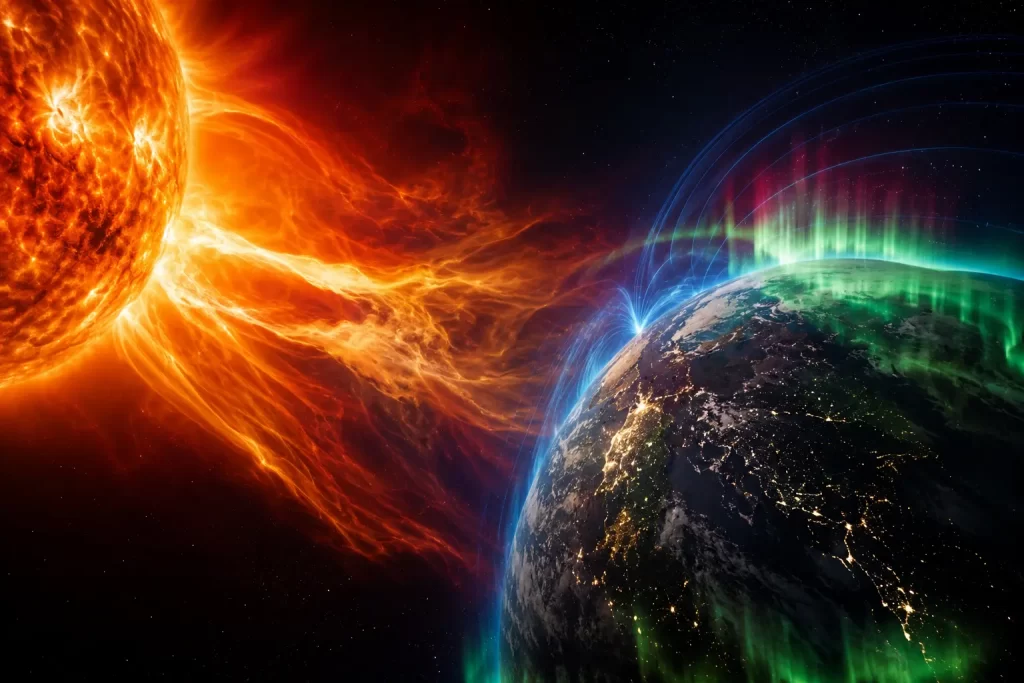
The ejection was triggered by a powerful solar flare originating from a large sunspot cluster on the sun’s surface. Within minutes of the flare, X-ray and ultraviolet radiation reached Earth at the speed of light — causing brief radio blackouts across parts of the sunlit hemisphere. That was the opening act. The main event, the CME itself, travels slower than light but is still moving at roughly a million miles per hour, a pace that will bring it to our doorstep within the next 48 hours.
When it arrives, it will interact with Earth’s magnetosphere — the invisible magnetic shield that wraps around our planet — compressing it on the side facing the sun and stretching it on the other. This interaction generates what scientists classify as a geomagnetic storm, rated on a scale from G1 (minor) to G5 (extreme). The current forecast puts this event firmly in G4 territory: severe, with the possibility of escalating further depending on the orientation of the CME’s magnetic field at the moment of impact.
“The sun does this on its own timeline. All we can do is measure, warn, and — honestly — appreciate the view.”
The practical consequences of a G4 storm are real and varied. Power grid operators face the risk of voltage irregularities and, in the most severe cases, transformer damage — the kind that can take months to repair. The 1989 geomagnetic storm that knocked out power across the entire province of Quebec for nine hours remains the cautionary tale every grid engineer carries with them. Satellites in lower orbits experience more atmospheric drag that can alter their path in ways that need to be corrected carefully. GPS systems, which depend on precise signal timing, may exhibit errors significant enough to affect aviation navigation and precision agriculture equipment.
High-frequency radio communications — still relied upon by aviation, maritime operations, and emergency responders in remote areas — are particularly vulnerable during the solar storm peak. Pilots flying polar routes may find their communication windows compressed or temporarily absent. Airlines have already begun assessing whether to reroute planned transoceanic flights away from high-latitude paths where the effects will be strongest.
Astronauts aboard the International Space Station are also being monitored closely. During intense geomagnetic events the radiation levels in some orbits can become unsafe and mission controllers could decide to move crew to parts of the station with better shielding .
“For most people on the ground, the storm will feel like nothing at all — until they look up and see colors in the sky that have no business being there.”
And then there is the aurora. The same magnetic disturbance that stresses transformers and scrambles GPS signals also excites the gases in Earth’s upper atmosphere, producing curtains of shimmering light in greens, pinks, purples, and reds. Normally confined to high-latitude regions near the poles, the aurora borealis and aurora australis can be pushed dramatically toward the equator during strong storms. A G4 event means that aurora sightings are plausible across much of northern and central Europe, large swaths of Canada and the northern United States, and southern parts of South America and Australia — places where the northern or southern lights are rarely, if ever, seen.
Northern Europe
Canada & northern US
Central Europe
Southern Australia
New Zealand
Parts of South America
If you are in any of these regions, the advice is simple: find dark skies, get away from city lights, and look north (or south, in the Southern Hemisphere) after midnight local time, when solar wind effects tend to peak. The Kp index — the global measure of geomagnetic activity — will be your best real-time guide. Free apps and NOAA’s own website provide live updates, letting you track exactly how active things are as the storm unfolds.
We are currently in an active phase of the roughly 11-year solar cycle, approaching what scientists call solar maximum — the peak of the sun’s activity, when sunspot numbers are highest and CME events are most frequent. This storm is unlikely to be the last significant one this cycle. The infrastructure warnings are genuine, and the agencies responsible for our power grids, satellites, and communication networks have been preparing for exactly this kind of event. But so, quietly, have amateur astronomers, photographers, and ordinary people who simply want to stand outside on a clear night and feel, just for a moment, the full scale of the solar system they inhabit.
The sun is not trying to disrupt our lives. It is simply doing what it has always done — burning, erupting, and occasionally reminding us that we are very small, very fortunate, and very much at the mercy of the star that makes everything here possible.
The Sun Just Sent Something Our Way — And It’s Going to Be Felt.