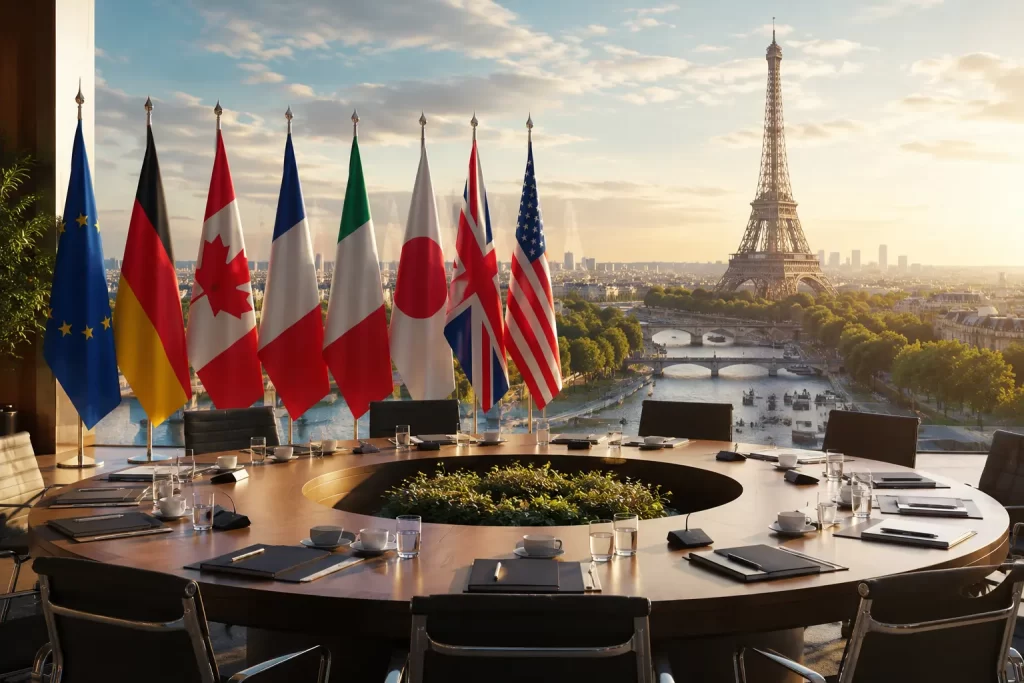
France is preparing to host the G7 Summit later this month — a gathering that carries more weight than usual, arriving at a moment when the fractures in global cooperation are plainly visible and the agenda has never been more complex.
There is something both reassuring and quietly pressure-filled about the moment world leaders gather in one room. The G7 Summit has never been short of grand ambitions — and France, no stranger to diplomatic theatre, is about to host one of the most consequential editions in recent memory. The setting will be elegant. The handshakes will be photographed. But what happens between those moments — in the working sessions, the bilateral pull-asides, the late-evening negotiations — will carry implications for billions of people who will never set foot in the room.
The G7 Summit 2026 arrives at a moment when the idea of international cooperation itself feels like it needs defending. Multilateral institutions that once seemed immovable have been strained by years of geopolitical rivalry, pandemic-era divergence, and the sharp centrifugal pull of domestic politics in each member country. The United States, the United Kingdom, Germany, France, Italy, Japan, and Canada — together representing roughly 44 percent of global GDP — will need to demonstrate that a group of wealthy democracies can still agree on more than the format of their joint communiqué.
France brings its own particular energy to the role of host. French diplomacy has a long tradition of threading needles — of finding language and frameworks that preserve ambiguity while projecting consensus. The Élysée will be hoping to use the France summit as a platform not just for outcome documents, but for restoring a sense of direction to Western-led multilateralism. It is an ambitious goal, and one that will test the host’s considerable diplomatic instincts from the first day of preparations to the final press conference.
“The G7 was never meant to govern the world. It was meant to show that open democracies could govern themselves well enough to lead it.”
The agenda, as ever, reflects the accumulated anxieties of the moment. Artificial intelligence governance has moved from fringe discussion item to headline priority with remarkable speed. In the three years since AI tools became widely available to the public, the gap between technological capability and regulatory infrastructure has widened into something that genuinely worries policymakers. The G7 nations are not starting from scratch — the Hiroshima AI Process, launched at the 2023 summit, produced a set of guiding principles — but the challenge now is turning principles into something with teeth. Expect significant debate over how to coordinate safety standards, prevent the misuse of AI in conflict settings, and ensure that developing nations are not left behind as the technology reshapes every sector of the world economy.
On economic matters, the picture is mixed enough to make agreement genuinely difficult. Inflation has eased considerably from its post-pandemic peaks, but interest rates remain elevated in several G7 economies, and the ripple effects on developing-nation debt are a growing moral and strategic concern. Trade tensions — particularly those involving supply chains for critical minerals and semiconductor components — have not been resolved so much as papered over. The summit will test whether global leaders can move from competitive industrial policy toward something resembling coordinated economic strategy, or whether the language of partnership will once again mask the reality of rivalry.
“Climate commitments made in conference rooms only mean something when they survive contact with the budget process back home.”
Security will inevitably command a significant share of the room’s attention. The ongoing conflict in Ukraine, now stretching into its fourth year, continues to test the cohesion of Western support — not just in terms of military aid and sanctions, but in terms of political will across populations that are growing weary and governments facing their own fiscal pressures. The Middle East remains a volatile backdrop. And the broader question of how the G7 manages its relationship with China — a country simultaneously central to global trade and increasingly positioned as a strategic competitor — sits just beneath the surface of almost every agenda item, rarely named directly but impossible to ignore.
Climate policy, meanwhile, occupies its now-familiar position: urgent in scientific terms, contested in political ones. Net-zero commitments made at previous summits have not always survived contact with domestic energy politics, and climate policy ambitions have a way of eroding between summits and implementation. France will push hard for concrete green finance commitments and a clearer timeline for phasing out fossil fuel subsidies — goals that are easier to endorse in principle than to defend before a home electorate.
USA, UK, France, Germany, Italy , Japan, Canada,EU.
What the G7 Summit ultimately produces — in terms of communiqués, side agreements, financial pledges, and the quieter understandings that never make it into official documents — will be picked apart by analysts for months. But there is something else worth watching: whether the seven leaders arrive in France looking like a coalition with a shared sense of purpose, or a collection of governments each managing their own set of pressures and hoping the others will carry the harder commitments.
The world has enough problems right now that it cannot afford the latter. And France, for all its diplomatic grace, cannot conjure consensus out of thin air. The raw material has to be brought to the table by the leaders themselves. That, more than any agenda item or summit venue, is what makes the coming days worth paying close attention to.
When Seven Leaders Sit Down Together, the Whole World Listens.