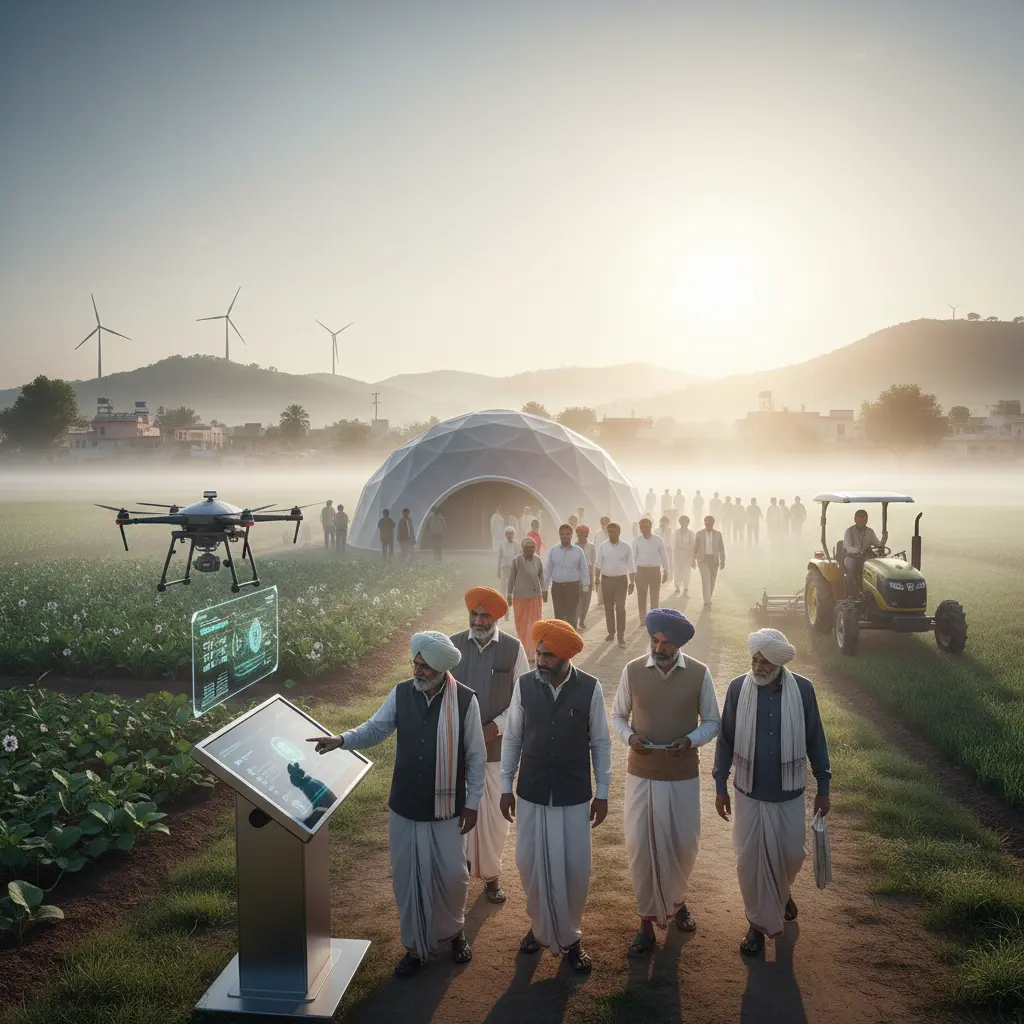
India feeds over a billion people. That fact alone should be enough to explain why agricultural innovation is not just a business story here — it is a lifeline story. And right now, across farm fields in Punjab and Telangana, in soil labs in Pune and agri-tech hubs in Bengaluru, something genuinely important is taking shape.
Agriculture innovation in India is gaining real momentum. Not the kind that lives only in conference presentations and government white papers, but the kind that is quietly, persistently changing how farmers make decisions, manage resources, and think about the seasons ahead.
The Urgency Beneath the Optimism
Before celebrating what’s working, it’s worth understanding why the push for agri technology has become so urgent. Indian agriculture faces a convergence of pressures that would test any farming system in the world.
Climate change is no longer a future threat — it is a present reality on Indian farms. Monsoon patterns have grown less predictable. Heatwaves arrive earlier and stay longer. Groundwater tables in critical agricultural states are dropping at rates that alarm hydrologists. Meanwhile, input costs — fertilizers, diesel, labor — have risen steadily, squeezing margins for small and marginal farmers who make up the overwhelming majority of India’s agricultural workforce.
The old ways of farming, passed down across generations, are running into conditions those generations never faced. That gap between inherited knowledge and new climate reality is precisely where agriculture innovation is stepping in.
Smart Farming Takes Root
The phrase “smart farming” can sound abstract until you see what it actually looks like on the ground in India. It looks like a farmer in Maharashtra receiving a soil moisture alert on a basic smartphone, adjusting his irrigation schedule, and saving water he previously couldn’t afford to waste. It looks like drone operators in Andhra Pradesh completing crop health surveys in hours that would have taken days on foot. It looks like women farmer collectives in Odisha accessing digital market price data before they negotiate with local traders — and negotiating better because of it.
Smart agriculture tools are becoming more accessible partly because India’s digital infrastructure has expanded dramatically over the last decade. Rural internet penetration has improved enough, though still patchy, to make mobile-based agri services viable at scale. Companies building for the Indian farm market have adapted accordingly — building for low-bandwidth conditions, regional languages, and the practical reality that many farmers are first-generation smartphone users.
Precision agriculture technologies, including GPS-guided equipment, remote sensing and AI-powered crop advisory platforms, are being piloted in several states with promising early results. Yield improvements and input cost reductions, even in early-stage deployments, are providing the kind of evidence that moves cautious farmers from skepticism to curiosity.
Industry Events Putting Innovation on Display
Across India, agriculture technology showcases and industry events have become important gathering points for the ecosystem of farmers, startups, researchers, policymakers, and investors working on these challenges. These events matter beyond the networking and the exhibition stalls. They matter because they create visible proof — farmers seeing technologies demonstrated in conditions that resemble their own, hearing from peers who have adopted new tools and are willing to share what worked and what didn’t.
The energy at these showcases reflects something real: a sector that has historically been slow to change is developing genuine appetite for practical innovation. Startups presenting soil testing kits, micro-irrigation solutions, climate-adaptive seed varieties, and farm management software are finding audiences that are asking sharper, more specific questions than they were just a few years ago.
Government initiatives — from the Digital Agriculture Mission to various state-level agri-tech programs — have added institutional weight to what might otherwise remain a fragmented startup ecosystem. When policy frameworks align with market innovation, adoption tends to accelerate.
Sustainable Agriculture: The Long Game A major shift in the Indian agriculture debate is the growing focus on sustainability Sustainable agriculture is no longer a fringe concern pushed by environmental NGOs; it is becoming an economic necessity.
Decades of input-heavy agriculture have left the soil impoverished in what was once India’s most fertile land, leading to reduced yields. Water shortages are forcing tough conversations about what to plant, how to irrigate, and whether it makes sense to grow water-intensive staples in certain areas in the long run. Farmers who have embraced natural-farming techniques, crop rotation and organic soil management are starting to see results that challenge the notion that you can’t be both sustainable and productive.
Carbon farming – where farmers are paid credits for sequestering carbon through better land management – is emerging as a potentially significant new income stream, especially for smallholders. The frameworks are still developing, but the direction of travel is clear.
The Farmer at the Center
For all the excitement around agri technology platforms, satellite imagery, and blockchain-based supply chains, the most important question remains the most human one: does this actually help the farmer?
India’s farming community is not a monolith. A large commercial operation in Haryana faces different challenges than a tribal subsistence farmer in Jharkhand. Agricultural innovation that doesn’t account for that diversity — that designs for an idealized farmer rather than actual farmers — will struggle to achieve meaningful scale.
The initiatives gaining the most traction in India right now share a common characteristic: they were built with farmers, not just for them. That distinction — between innovation imposed from outside and innovation developed through genuine engagement with farming communities — is increasingly recognized as the difference between pilot projects and lasting change.
India’s agricultural future is being written right now, in soil and code and careful conversation. The momentum is real. Whether it reaches every farmer who needs it remains the work ahead.
Agricultural Innovation Gains Momentum in India: How Smart Farming Is Reshaping the Future of Food.