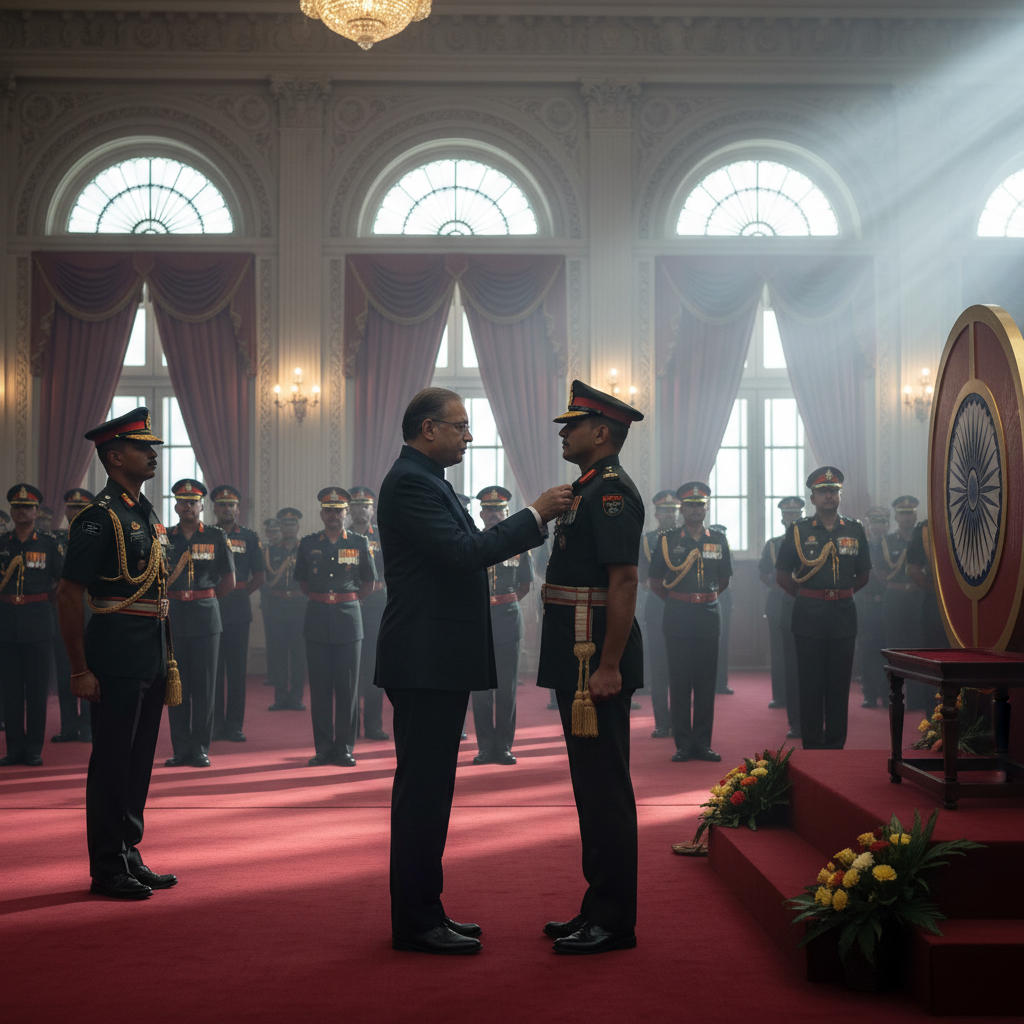
There’s something genuinely moving about watching the Defence Investiture Ceremony unfold at Rashtrapati Bhavan. Behind every medal pinned, there’s a story, sometimes one of triumph, sometimes one of unimaginable loss, but always one of extraordinary courage. This year’s ceremony was no exception, and it once again put a spotlight on the men and women who put their lives on the line for the country.
President of India Droupadi Murmu conferred the gallantry awards in two phases this year. The first phase took place on June 8 at Rashtrapati Bhavan, and a second phase followed on June 29, recognizing senior officers for distinguished service. Together, these ceremonies provided a fuller picture of how India formally honours bravery, both on the battlefield and in years of dedicated service.
Digging Into the Numbers President Murmu presented 51 gallantry awards to the personnel of the Armed Forces, Central Armed Police Forces and State and Union Territory Police during the Phase-I of the Defence Investiture Ceremony 2026. Breaking that down, the awards included seven Kirti Chakras, 15 Vir Chakras, and 29 Shaurya Chakras. Sadly, not all of these could be received in person. Two of the Kirti Chakras, three Vir Chakras, and one Shaurya Chakra were posthumous awards, a sobering reminder of the cost behind these honours.
For context, these three decorations form the backbone of India’s peacetime gallantry award system. The Kirti Chakra ranks as the second-highest peacetime gallantry honour, followed by the Vir Chakra and Shaurya Chakra, each recognizing different degrees of valor displayed during operations that don’t necessarily occur during declared war but are every bit as dangerous.
Stories Behind the Medals
What makes these ceremonies hit differently isn’t really the medal count, it’s the stories attached to each name. Among the Kirti Chakra recipients was Group Captain Prasanth Balakrishnan Nair, one of India’s selected Gaganyatris, honoured for his contribution to India’s human spaceflight programme and his readiness to take on high-risk space missions. It’s a striking example of how India’s gallantry awards aren’t limited to combat alone; they extend to anyone who shows extraordinary courage in service of the nation, even beyond Earth’s atmosphere.
Then there is Captain Lalrinawma Sailo who was awarded for neutralising three hardcore terrorists in a special forces operation in Srinagar district and Major Ashish Kumar who was honoured for a prolonged counter-terrorist operation in Anantnag in November 2024 that resulted in the killing of two terrorists including one high-value terrorist.
On the Vir Chakra side, Colonel Koshank Lamba was honoured for leading precision engagements that led to the destruction of terrorist infrastructure, while a notable group of Indian Air Force officers, including Group Captains Ranjeet Singh Sidhu, Manish Arora, Animesh Patni, Kunal Kalra, and Joy Chandra, along with several other officers, were decorated for their roles in complex air and ground operations involving precision strikes and air defence missions.
Honouring the Ultimate Sacrifice
Perhaps the most emotionally weighty part of the ceremony involved the posthumous awards. Lance Dafadar Baldev Chand was awarded the Shaurya Chakra (Posthumous) for engaging terrorists in hand-to-hand combat despite sustaining fatal injuries. Sepoy Janjal Pravin Prabhakar received the Kirti Chakra (Posthumous) after neutralising two terrorists before making the ultimate sacrifice, while Lieutenant Shashank Tiwari was honoured with the same award for giving his life while rescuing a fellow soldier from a raging river in North Sikkim. That last act in particular reflects something the armed forces often speak about, the deep sense of brotherhood and selfless service that defines military life, even when there’s no enemy in sight.
In another deeply personal moment for Jammu and Kashmir, Rifleman Sunil Kumar, from Trewa village in Bishnah block of Jammu district, was posthumously conferred the Vir Chakra for his exceptional gallantry and unwavering courage in the line of duty.
Who Was Present
The ceremony wasn’t just a quiet administrative affair. Vice President C. P. Radhakrishnan, Prime Minister Narendra Modi, and Defence Minister Rajnath Singh were all present to witness the proceedings, underlining how seriously the nation’s top leadership treats these moments of recognition. The awards together mirrored India’s continued efforts against terrorism, insurgency and hostile threats across Jammu & Kashmir, the Northeast and the country’s borders, while recognising extraordinary courage in aviation, maritime operations and humanitarian missions. Phase Two: Recognition for Long Service The second phase of the Defence Investiture Ceremony on June 29, turned its attention a little to senior officers and distinguished service medals. President Murmu presented the Param Vishisht Seva Medal to Air Marshal Ashutosh Dixit, the Uttam Yudh Seva Medal to Lt Gen Dhiraj Seth, and the Sena Medal to Major General Mandeep Singh. Lt Gen Dhiraj Seth, notably the Army Chief-designate, was recognized for distinguished service of an exceptional order during military operations.
The Significance of These Ceremonies Beyond the medals and formalities, the Defence Investiture Ceremony is a public, national recognition of sacrifice. It’s a moment of great pride but also of great loss for the families of the posthumous awardees. It strengthens a culture of valour among serving personnel that is deeply ingrained in India’s armed forces and security establishments.
These bi-annual ceremonies, generally after the Republic Day and Independence Day announcements, also act as a public reminder of the many ongoing operations that most Indians rarely hear of, from counter-insurgency operations in the border states to high-risk special forces operations that succeed quietly, without making headlines. Every gallantry award, be it a Kirti Chakra, Vir Chakra or Shaurya Chakra, is a testimony not just to individual bravery but to the larger commitment of India’s armed forces to national security, often at the highest possible personal cost.