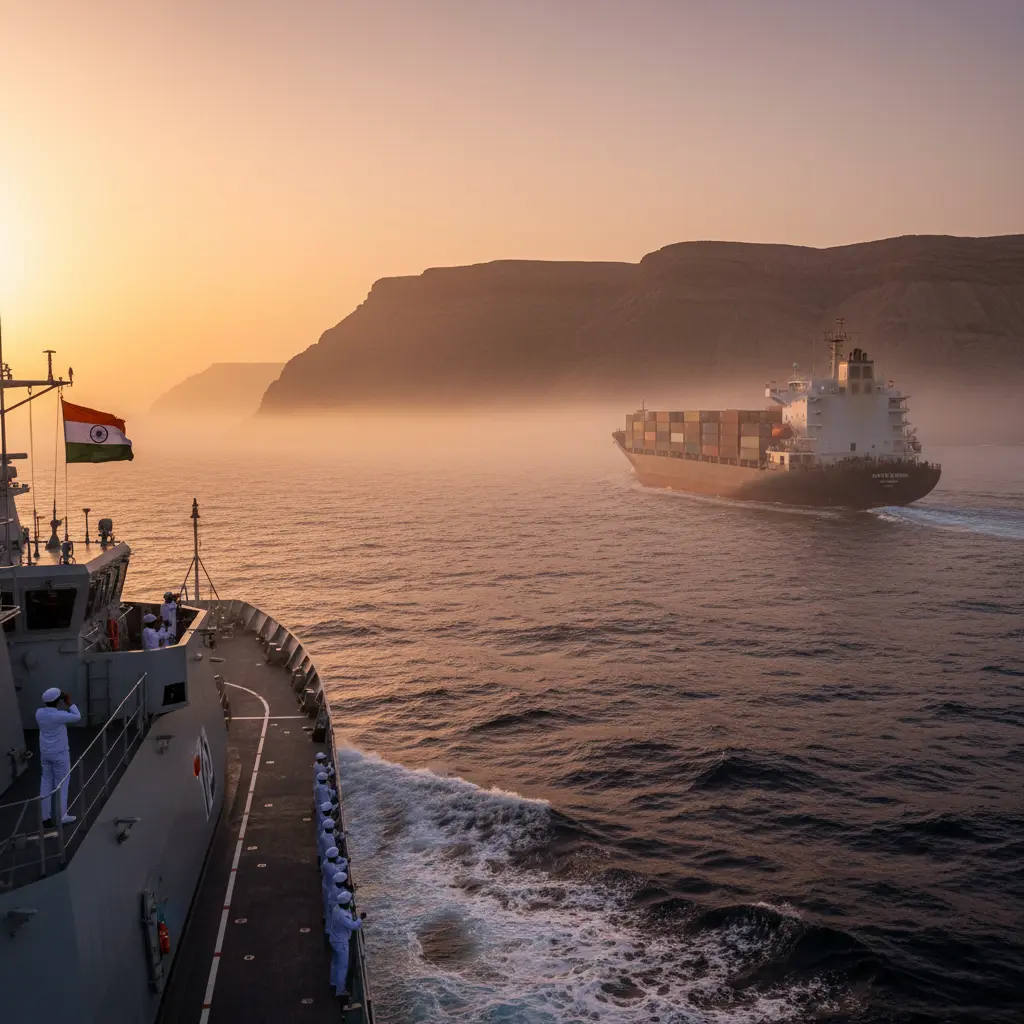
India has once again found itself at the centre of a fast-moving maritime security crisis, this time after a commercial vessel carrying eleven Indian nationals came under attack off the coast of Oman. The incident, which unfolded over the weekend, has added fresh urgency to long-standing worries about Gulf maritime security and the safety of civilian mariners passing through one of the world’s busiest and most sensitive shipping corridors.
What Happened
The vessel involved, GFS Galaxy, was transiting the Strait of Hormuz when it came under attack. Ten out of 11 Indian crew members on board have been rescued, one is still missing and search and rescue operations are on, the Ministry of External Affairs (MEA) said. The Indian Embassy in Oman is in close touch with local authorities, management of the vessel and other stakeholders to extend all possible assistance.
In its official statement, the MEA did not mince words. “We condemn the attack on the commercial vessel GFS Galaxy off the coast of Oman,” the ministry said, adding that it was grateful to Omani authorities for their support during the rescue operation. This isn’t the first time India has had to issue such a statement in recent months, and that repetition itself speaks to how precarious things have become in the region.
A Region Under Strain
The Strait of Hormuz isn’t just another patch of water. It’s a chokepoint through which roughly a fifth of the world’s traded oil passes, making it one of the most economically consequential stretches of ocean on the planet. Any disruption there sends ripples through global energy markets and shipping insurance rates almost instantly, which is part of why this attack has drawn so much attention beyond India’s borders too.
Reports indicate the attack has been linked to Iran’s Islamic Revolutionary Guard Corps, and the incident comes against a backdrop of escalating military exchanges in the region. The vessel itself is reported to have suffered an onboard fire and extensive damage to its engine room and thus is unable to continue its journey. It’s a clear reminder that even commercial, non-combatant ships are caught in the crossfire of wider geopolitical tensions playing out across the Gulf.
This is not a diplomatic abstraction for India, which depends heavily on these shipping lanes for its energy imports and trade. It’s a direct threat to supply chains, to the safety of Indian seafarers who make up a significant chunk of the world’s merchant navy workforce, and to the broader stability that keeps international commerce moving smoothly.
India’s Response and Position
New Delhi’s language this time was notably firmer than in some earlier statements. The MEA described the pattern of attacks as “deeply worrisome” and reiterated its call for “immediate de-escalation of tensions” along with a push for diplomatic solutions that could bring lasting peace and stability back to the region.
“The targeting of commercial shipping and civilian infrastructure in the region must end, and free and unimpeded navigation and commerce through the international waterways in the region, in keeping with international law, must be restored at the earliest,” the ministry said. It’s a statement that reflects India’s broader foreign policy posture on maritime issues — one that consistently emphasises international law, freedom of navigation, and multilateral cooperation over unilateral military posturing.
This isn’t the first such incident this year either. Indian officials have repeatedly flagged concerns about ships flying the Indian flag, or carrying Indian crew, being caught up in regional hostilities. Each time, the response has followed a similar pattern: condemnation, coordination with local authorities for crew safety, and a renewed appeal for international cooperation to prevent further attacks.
Why This Matters for India’s Foreign Affairs India’s foreign policy strategy in the Gulf has always been a fine balancing act between two priorities: the welfare of the large Indian diaspora and workforce in the region and the protection of trade routes critical to India’s energy security. As such incidents become more common, that balancing act is becoming harder and harder to maintain.
India has also sounded the alarm over the economic consequences of a protracted crisis in the Strait of Hormuz, with some officials hinting that the country may have to build much larger strategic oil reserves to cushion against future shocks. It signals how seriously New Delhi is taking the prospect of ongoing disruption to Middle East shipping routes.
Looking AheadAs search and rescue operations continue for the missing crew member, the larger question looming over the region is whether diplomacy can keep pace with the rate of military escalation. India’s calls for restraint and dialogue are consistent with its historical non-aligned position and preference for negotiated solutions but the ground situation in the Gulf now suggests that stability may not return soon.
For now, India’s message is unambiguous: commercial shipping and civilian mariners should not be collateral damage in regional conflicts, and the international community must act with urgency to restore safe passage through one of the world’s most vital maritime arteries.
India Condemns Commercial Vessel Attack Near Oman, Calls for Urgent De-escalation.