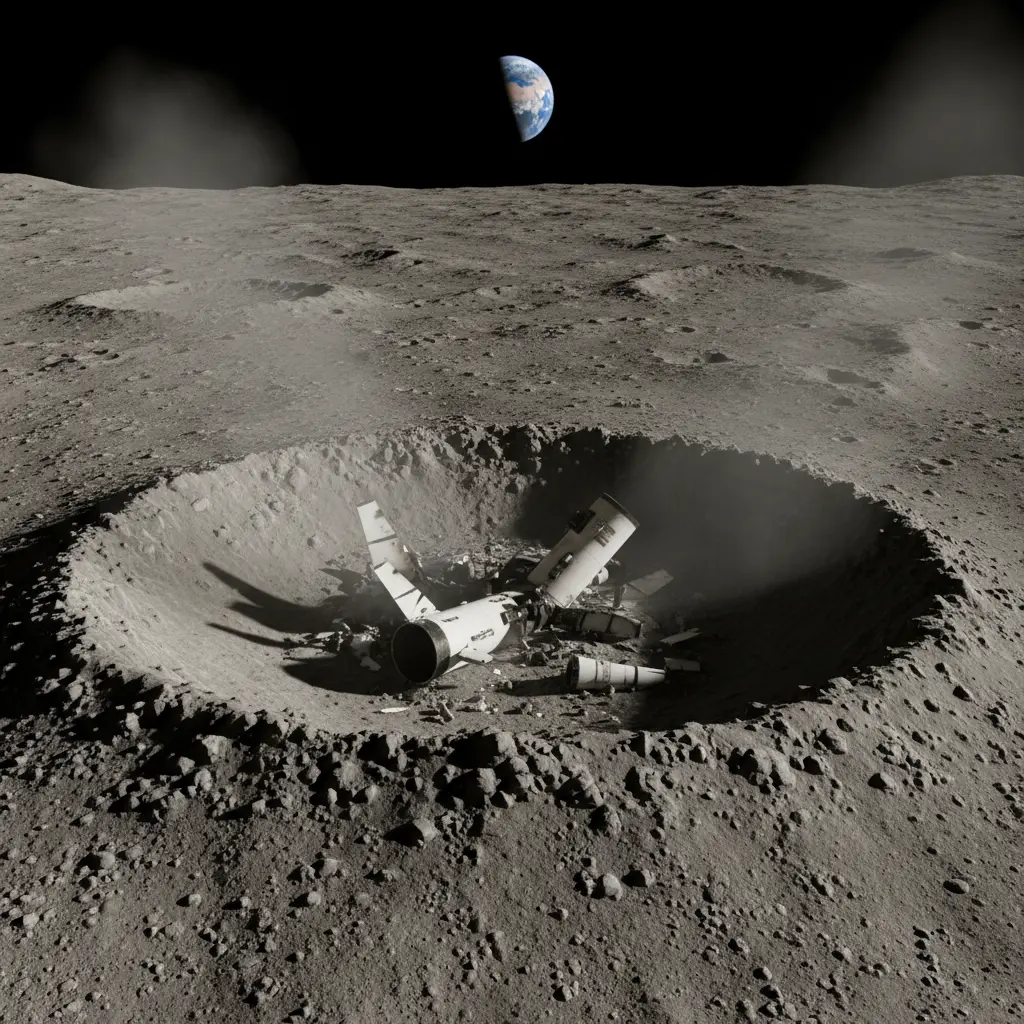
Space just got a little more crowded — and now the Moon has a fresh scar to prove it. In the early hours of Wednesday, August 5, 2026, a spent Falcon 9 upper stage slammed into the lunar surface near Einstein Crater at roughly 5,400 miles per hour, carving out a brand-new crater on a world that hasn’t seen a natural impact of that scale in who knows how long. NASA has confirmed the event posed no risk whatsoever to Earth, but it’s already turning into one of the more talked-about space debris stories of the year.
A Rocket That Had Nowhere Left to Go
The story of this particular piece of hardware goes back more than a year and a half. The Falcon 9 launched on January 15, 2025, carrying two commercial lunar landers — Firefly Aerospace’s Blue Ghost and ispace’s Resilience — on their way to the Moon. Once the rocket delivered its payload, the mission for the upper stage was technically over. But unlike the reusable first-stage booster, which flew itself back to Earth, the upper stage had no fuel left for a controlled deorbit or an escape burn. It was simply left drifting in space with nowhere planned for it to go.
For roughly 18 to 19 months, that stage tumbled quietly through the solar system with no propulsion and no purpose, until physics eventually did what physics does. Independent astronomers tracking publicly available orbital data realized the object was on a collision course with the Moon well before it happened, and NASA’s Center for Near Earth Object Studies — the same team that normally watches for objects that might threaten Earth — confirmed the trajectory. Amateur astronomer Bill Gray is widely credited with first flagging the impending lunar impact.
Impact Near Einstein Crater
The roughly 4,000-kilogram, 39-foot-long stage struck the Moon’s western limb near Einstein Crater at around 6:35 UTC, or about 2:35 a.m. Eastern time, traveling at more than 5,400 miles per hour. Because the Moon has essentially no atmosphere to slow anything down, the stage stayed fully intact right up until the moment of impact, unlike debris re-entering Earth, which usually burns up or breaks apart on the way in.
Scientists estimate the collision released energy equivalent to roughly three tons of TNT, gouging out a new crater expected to measure around 18 meters — about 60 feet — wide and somewhere between 4 and 12 meters deep, depending on which research team’s modeling is used. Since the rocket body is largely hollow rather than a solid mass like an asteroid or meteoroid, researchers expect the resulting crater to be shallower and less dramatic than one carved by a natural object of similar size and speed.
The impact wasn’t visible from Earth, since it occurred in daylight on the lunar surface and on a stretch of the Moon that’s notoriously difficult to observe from home. Still, it didn’t go entirely undetected. The European Southern Observatory’s Very Large Telescope in Chile picked up spectral signatures of sodium and lithium gas in the debris plume, which lingered for five to ten minutes after the crash — indirect but solid confirmation that the impact happened right where predicted.
No Danger to Earth, NASA Says
Understandably, some may hear “rocket debris” and “collision” in the same sentence and wonder if this is cause for concern back home. It isn’t. NASA was clear that the object never posed any risk to Earth, and put the event into useful perspective by noting that a meteoroid carrying similar energy strikes the Moon roughly every six days anyway. In other words, from a purely physical standpoint, this was a fairly routine-sized impact — the only unusual part is that it was man-made.
NASA Administrator Jared Isaacman echoed that sentiment publicly, reassuring the public that the event wasn’t a cause for alarm even as the agency continues developing its long-term plans for a permanent lunar base.
What Happens Next
Confirming the exact size and shape of the new crater will take a little more time. Because the impact happened out of view from Earth-based telescopes, scientists are now waiting on NASA’s Lunar Reconnaissance Orbiter, along with other lunar orbiters, to pass over the crash site and photograph it directly — something expected to happen within the coming days to a week.
But the incident has touched off a broader, 2026-centric discussion about space debris, extending far beyond the immediate scientific curiosity. With commercial lunar missions accelerating and no universal requirement for spacecraft operators to plan end-of-life disposal for rocket stages, experts warn that uncontrolled lunar impacts like this one could become more common rather than less. Some researchers are already calling for clearer international guidelines to prevent future debris from complicating scientific observation sites or, eventually, areas near planned lunar bases.
But for now, the Moon has quietly acquired another mark, a small but symbolic reminder that even the most routine of rocket launches leaves something behind long after the mission itself is considered a success, on its already heavily cratered surface.