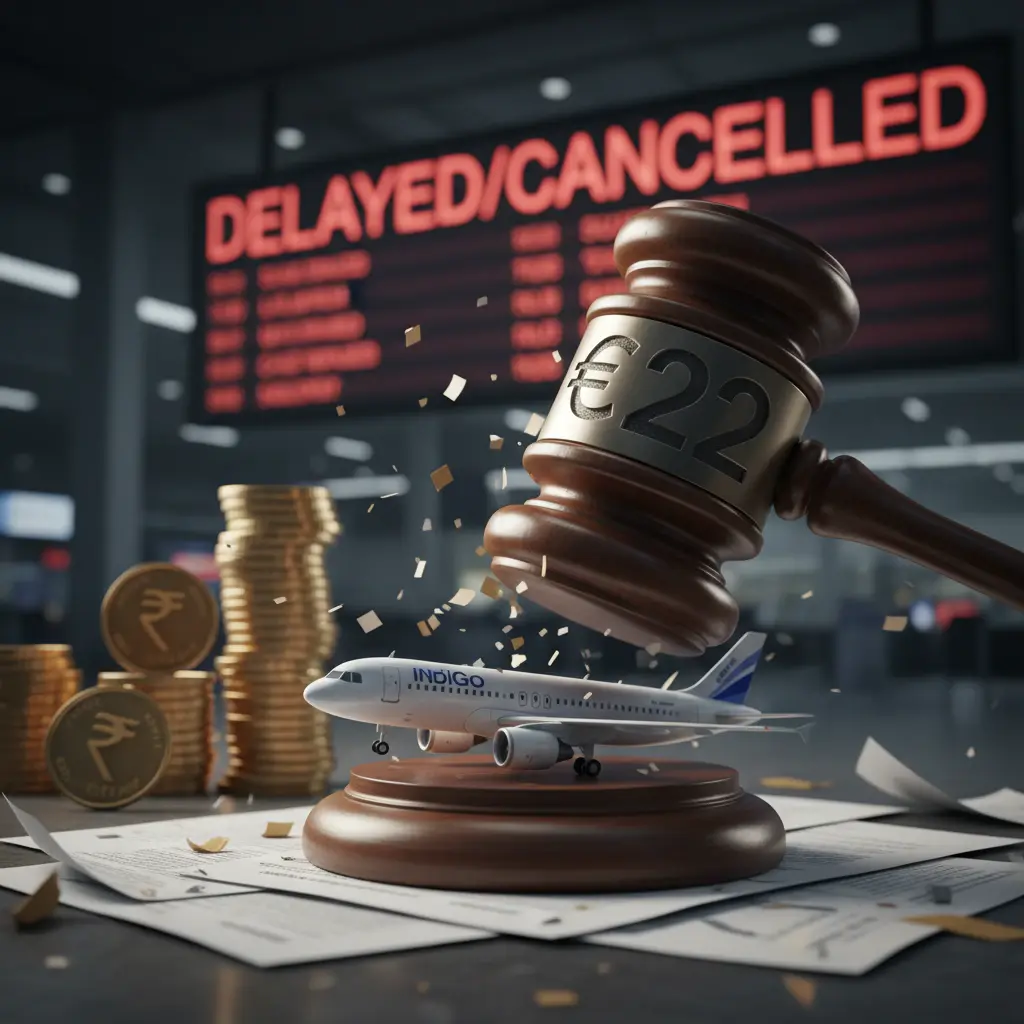
India’s aviation regulator has come down hard on the country’s largest airline. The Directorate General of Civil Aviation, DGCA, has imposed a penalty of more than Rs 22 crore on IndiGo Airlines after a wave of flight delays and cancellations left hundreds of thousands of passengers stranded across the country. It’s one of the steepest enforcement actions the regulator has taken against a domestic carrier in recent memory, and it’s still sending ripples through India’s aviation sector.
What Triggered the DGCA Action
The trouble began between December 3 and December 5, 2025, when at least 2,507 IndiGo flights were cancelled and another 1,852 were delayed, affecting nearly three lakh passengers across multiple airports. Anyone who was flying IndiGo that week remembers the chaos: overcrowded terminals, confused ground staff, and passengers stuck for hours with little clarity on when, or if, their flight would take off.
The DGCA on Saturday imposed a penalty of Rs 22.20 crore on IndiGo and directed the airline to furnish a Rs 50-crore bank guarantee to ensure long-term systemic correction, after a probe found that over-optimisation of operations and inadequate regulatory preparedness had led to the massive disruption. To put that fine in context, the penalty is one of the largest ever levied on an Indian airline, and it stemmed from IndiGo’s failure to comply with new Flight Duty Time Limitation, or FDTL, norms for pilots. These FDTL rules exist to manage pilot fatigue and protect crew work-life balance by regulating how long pilots can work and when they need rest.
How the Regulator Reached Its Conclusion
The DGCA didn’t act on gut instinct here, it set up a four-member high-level committee to carry out a comprehensive assessment of what went wrong. That committee reviewed IndiGo’s flight schedules, crew management practices, and operational control systems, and even interviewed senior airline officials as part of the process.
What the panel found wasn’t a case of bad weather alone. According to the committee’s report, IndiGo had stretched its operational resources while trying to maximise efficiency, running dense flight schedules with limited flexibility in crew rosters and insufficient operational buffers, which left the airline unable to recover once disruptions began. The DGCA ultimately concluded that IndiGo failed to adequately prepare for the implementation of the revised FDTL norms, and that failure triggered operational instability across its entire network.
Beyond the financial penalty, warnings were also issued to the Deputy Head of Flight Operations, the AVP of Crew Resource Planning, and the Director of Flight Operations for lapses in operational oversight, supervision, manpower planning, and roster management. Even IndiGo’s leadership didn’t escape scrutiny. The DGCA cautioned CEO Pieter Elbers for inadequate overall oversight of flight operations and crisis management, and issued a warning to the Senior Vice-President of the Operations Control Centre, directing that he not be assigned any accountable position going forward. deccanheralddeccanherald
A Fine Broken Down by the Day
The math behind the penalty is fairly straightforward once you see it laid out. The DGCA imposed a cumulative penalty of Rs 20.40 crore for non-compliance stretching over 68 days, from December 5, 2025, to February 10, 2026. Essentially, IndiGo was fined at a rate of Rs 30 lakh per day for that period. Separately, penalties of Rs 30 lakh each were imposed across six distinct counts, including the airline’s failure to establish and effectively implement a scheme to comply with FDTL norms.
The regulator isn’t just walking away after collecting the fine, either. IndiGo has been directed to furnish a Rs 50 crore bank guarantee, tied to a structured reform programme called the IndiGo Systemic Reform Assurance Scheme. Under that framework, Rs 10 crore of the guarantee is linked to leadership and governance reforms certified within three months, Rs 15 crore is tied to manpower planning, fatigue-risk management, and rostering reforms sustained over six months, and another Rs 15 crore is connected to upgrades in digital systems and operational resilience within nine months.
Pilots Say the Punishment Doesn’t Go Far Enough
Not everyone thinks the DGCA went far enough. The Federation of Indian Pilots has openly criticised the penalty, arguing it doesn’t reflect the scale or duration of the hardship passengers went through during those three chaotic days. FIP President CS Randhawa said the regulator appeared to have leaned mainly on financial penalties while sidestepping clear personal accountability for those responsible for the operational failures. The pilots’ body has argued that systemic lapses of this scale demand consequences that go beyond fines, particularly given how long the disruption dragged on and how much strain it placed on both passengers and flight crew.
Where Things Stand Now
The DGCA has not publicly responded to that criticism, while IndiGo has maintained that it’s reviewing the regulator’s findings and working to strengthen its internal processes to prevent a repeat. The airline has also reiterated its long-term commitment to serving India’s aviation needs as the country works toward becoming a global aviation hub by 2030. Brut.
For now, the episode stands as a pointed reminder of just how quickly things can unravel when scheduling ambition outpaces operational readiness, especially with new safety norms in play. As India’s skies get busier every year, this fine, and the reform scheme attached to it, will likely be watched closely as a test case for how seriously airlines take passenger welfare when the pressure is on.