
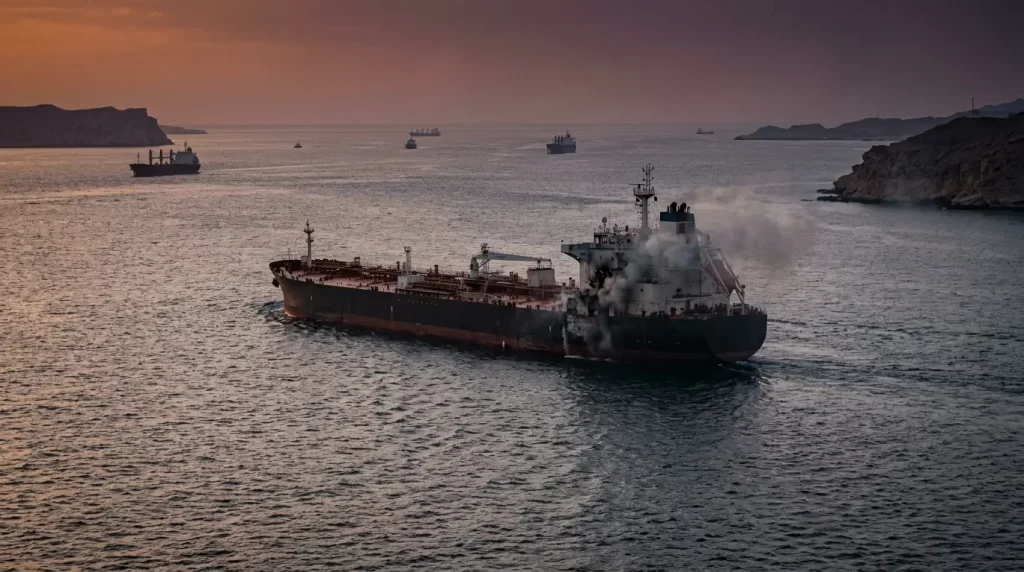
There are few places on the map where a single incident can move markets, rattle governments, and make shipping executives reach for their phones all at once. The Strait of Hormuz is one of them. On 6 October, a maritime monitor reported that an oil tanker had been struck as it was leaving the waterway, and the news landed at the worst possible moment: just as negotiations between Washington and Tehran appear stuck in place.
The details of the strike are still thin. What is clear is the setting. This is a narrow channel that, before the war began, carried roughly a fifth of the world’s oil and gas. When something goes wrong there, the effects do not stay local. They show up in fuel prices, in shipping insurance quotes, and in the planning meetings of countries that never touch the Gulf directly.
A Strait Under Pressure
The tanker attack is not an isolated headline. It sits inside a much larger story about a conflict that has reshaped how the world thinks about energy security. Ships that once moved through Hormuz without a second thought now do so with careful calculation. Captains weigh routes, owners weigh risk, and insurers weigh everything.
For the crews, this is more than an abstraction. Sailors leaving the strait with a full cargo of crude are carrying something valuable through a space where the margin for error has shrunk. Every report of a vessel being hit reminds them, and the companies that employ them, how fragile the arrangement is.
Talks Going Nowhere Fast
The diplomatic picture is just as tense. The Iran US talks remain at an impasse, and the positions on each side show why. Iran’s parliament speaker has said the strait stays closed until seven conditions are met. That is a demanding stance, and it signals that Tehran sees the waterway as leverage it does not intend to give up cheaply.
Across the table, a US official has said no agreement is possible unless Iran’s nuclear programme is addressed. In other words, one side is tying the strait to a list of its own demands, while the other is tying any deal to the nuclear question. Those are not easy positions to reconcile, and neither side has shown much appetite for blinking first.
When two governments each insist the other must move before talks can progress, the result is usually a stalemate. And stalemates, in a region this volatile, tend to invite incidents like the one reported this week.
The Numbers Don’t Quite Agree
Perhaps the most interesting wrinkle in the story is that nobody seems to agree on how much oil is actually moving. According to Kpler, regional oil exports topped pre-war levels last week. If that is right, it suggests the market has adapted far better than many feared, with barrels finding their way out despite the closure rhetoric and the security risks.
Shell’s CEO paints a more cautious picture, putting flows at about 80% of pre-war volumes. That is still a substantial amount of oil, but it describes a market that has not fully recovered.
Why the gap? There are a few plausible reasons. Different analysts count different things. Some track tanker movements through the strait itself, while others measure exports across the wider region, including cargoes that leave through alternative routes and pipelines. Timing matters too, since a single strong week can look very different from a monthly average. Neither figure is necessarily wrong. They may simply be measuring different slices of the same complicated picture.
What both numbers do show is that the world is still very dependent on this corridor, and that oil keeps flowing even when the political temperature is at its highest.
Why the Market Is Watching Closely
Energy traders hate uncertainty more than they hate bad news. A confirmed disruption can be priced in. An unresolved standoff, with periodic incidents and conflicting data, is much harder to read. That is the situation now.
A struck tanker raises several questions at once. Was it targeted deliberately? Was it a warning? Will it prompt retaliation, or will it be quietly absorbed into the background noise of an already tense situation? Until those answers arrive, markets are likely to stay jumpy.
Shipping companies face their own dilemma. Rerouting costs time and money, but sailing through a risky zone can cost far more if something goes wrong. Higher insurance premiums, delayed cargoes, and tougher crew negotiations all add up, and eventually consumers feel it at the pump or on their utility bills.
What Happens Next
There is no obvious off-ramp at the moment. For the Strait of Hormuz to return to something resembling normal, one of two things probably has to happen: either the diplomatic deadlock breaks, or both sides settle into a tense equilibrium where incidents are contained and oil keeps moving.
The first option would require compromise on issues that both governments treat as core. The second is more likely in the short term, but it comes with a constant risk that one incident escalates beyond what anyone intended.
For ordinary people far from the Gulf, the lesson is a familiar one. Global energy supply depends on a handful of chokepoints, and when politics collides with geography, everyone pays attention. The tanker struck leaving Hormuz may turn out to be a contained event, or it may be remembered as one more sign that the standoff is wearing thin.
For now, the world is watching a narrow strip of water and waiting to see who moves first. Given where the Middle East war and the stalled talks currently stand, that wait could be a long one.

